Following a pivotal Supreme Court decision that significantly altered the Voting Rights Act, Black congressional members face potential reductions in their representation. This ruling permits Republican-led states to reconfigure U.S. House districts without considering racial implications, potentially designing many districts to favor GOP candidates.
Rep. Yvette Clarke, who leads the Congressional Black Caucus, expressed determination to counteract the ruling’s consequences, stating, “The Supreme Court has opened the door to a coordinated attack on Black voters across the country. This is an outright power grab.”
Historically, under Section 2 of the Voting Rights Act, voters could contest electoral maps that diluted minority voting power. The recent decision is likely to trigger a wave of redistricting in Republican-controlled states, potentially affecting the composition of the Black Caucus, particularly from 2028 onwards.
Uncertain Impacts Ahead
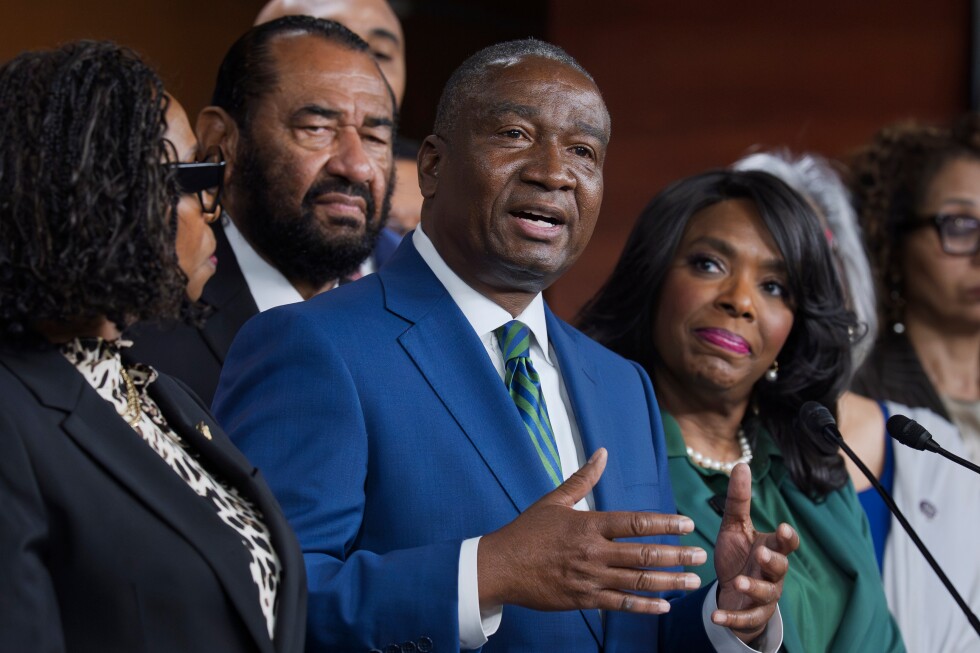
Clarke, along with over a dozen other Black Caucus members including House Minority Leader Hakeem Jeffries, responded to the ruling with a mix of anger, resolve, and sorrow. The exact number of seats at risk remains uncertain, but experts estimate that over a dozen minority-held seats might be eliminated.
Rep. Troy Carter, a Black Democrat from Louisiana, described the ruling as “a devastating blow to our democracy, plain and simple.” Republican officials in several Southern states are already strategizing to implement the ruling. Florida Republicans have swiftly redrawn a U.S. House map, altering a district meant to elect a Black representative.
Kristen Clarke of the NAACP expressed concerns that “former slave-holding states” will quickly alter districts that currently enable Black and minority voters to elect their preferred candidates. The role of state laws or constitutional protections against racial discrimination in hindering these changes is uncertain.
While Republican leaders and Black conservatives view the decision as a triumph over race-based mandates, Linda Lee Tarver of the Project 21 Black Leadership Network stated that civil rights laws were not meant to “institutionalize racial line-drawing as a default feature of our political system.”
The Evolution of Black Political Representation
Since its inception in 1971, the Congressional Black Caucus has grown, driven by the Voting Rights Act’s influence that increased minority representation in Congress. Initially numbering nine Black representatives, the formation of the CBC followed court-mandated redistricting. Shirley Chisholm, the first Black congresswoman, expanded Charles Diggs’ Democracy Select Committee into the formal Caucus.
The CBC gained prominence by boycotting President Nixon’s State of the Union address in its first year, prompting him to meet with the group. They proposed over 60 recommendations to aid the Black community, earning the nickname “conscience of the Congress.” Democratic Sen. Raphael Warnock expressed concern that the recent ruling might significantly diminish the Caucus’s influence.
Mobilizing for Change
Thomas Johnson, a Black resident of New Orleans, expressed dismay over the ruling, fearing it could dismantle predominantly Black districts. Democratic strategist Antjuan Seawright emphasized the importance of legal battles and voter turnout efforts to counteract potential district changes.
Rep. Terri Sewell of Alabama, involved in a major Voting Rights Act case supporting Black representation, highlighted the urgency of mobilizing communities in legislation, courts, and voting, stating, “We need to vote like we’ve never voted before.”