Advisory Panel Proposals on Religious Liberty Stir Debate
A group advising former President Donald Trump has put forward several proposals influencing religious liberty policies. One notable suggestion includes awarding the Presidential Medal of Freedom to a baker who refused service for a same-sex wedding. Additionally, there are calls for the Department of Justice to intervene in cases involving Amish parents opposing New York’s vaccine mandate and Catholic nuns contesting gender identity accommodations in hospices.
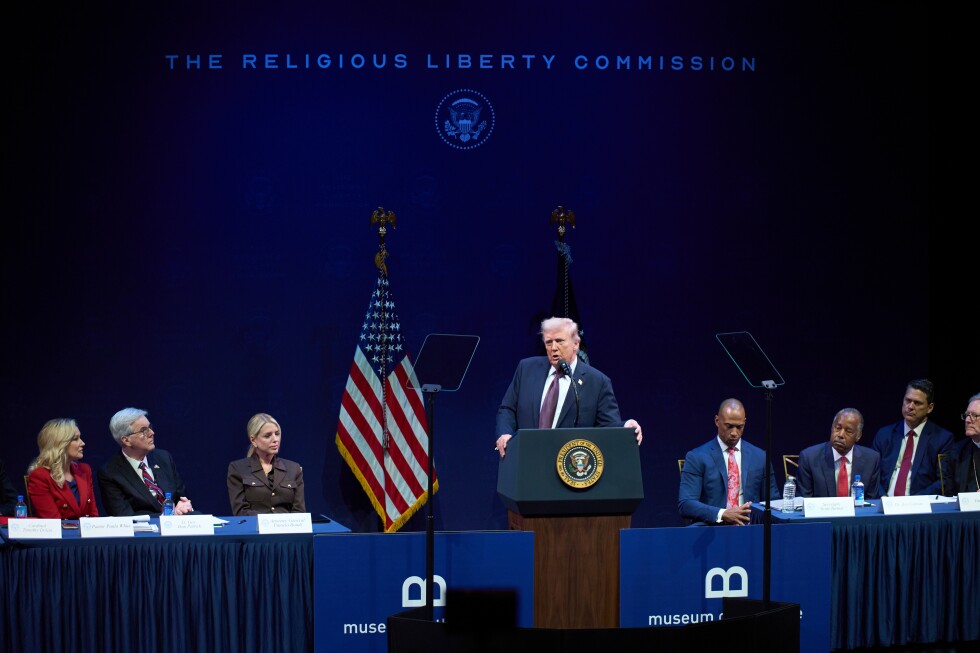
The Religious Liberty Commission, chaired by Dan Patrick, is advocating for the establishment of a federal hotline with a message asserting, “There is no separation of church and state.” These suggestions, along with others, are being considered for inclusion in the commission’s upcoming report. The panel comprises primarily of Trump’s conservative Christian supporters, aiming to broaden religious expression in public domains and facilitate religious exemptions in various sectors.
Critique on Commission’s Composition and Focus
The commission has faced criticism for its perceived singular focus, reflecting the views of Trump’s base. A lawsuit by a progressive coalition challenges the commission’s lack of diversity, noting that most members are conservative Christian leaders, with only one Orthodox Jewish rabbi included. Critics argue this composition undermines the constitutional separation of church and state.
The current administration seeks to dismiss this lawsuit, citing legal nuances about the composition of advisory panels. Meanwhile, a task force created by Trump claimed Christians faced discrimination under President Biden’s administration, though progressive groups have criticized this report for lacking evidence of systemic bias.
Internal Dynamics and Key Hearings
Tensions within the commission have been minimal, with one exception involving Carrie Prejean Boller, who was removed after a dispute over antisemitism definitions. Hearings have highlighted workplace conflicts between religious beliefs and regulatory requirements, including issues on gender and vaccine mandates. The commission has also heard testimonies from Jewish individuals about harassment at pro-Palestinian protests.
Ongoing Debate on Church-State Separation
Dan Patrick has voiced strong opposition to the concept of church-state separation, labeling it a “lie” during an April meeting, proposing the mass dissemination of this message via bumper stickers. This stance echoes sentiments expressed by Trump, who suggested a temporary disregard for the separation at a White House event in 2025.
Supreme Court rulings have historically interpreted the First Amendment as establishing a separation between church and state, a principle derived from Thomas Jefferson’s writings. However, balancing religious freedom with freedom from government-endorsed religion continues to be a contentious legal matter.
Broader Implications and Initiatives
The commission’s discussions extend to educational and workplace settings, advocating for more visibility of religious rights and exemptions. Suggestions have been made to restore benefits for military personnel discharged over vaccine refusals. Bishop Robert Barron has emphasized the need for religious charities to receive federal aid without compromising their values. He also urged humane treatment for detained immigrants and opposed enforcement actions in places of worship.
Kelly Shackelford of the First Liberty Institute proposed that governments should cover legal costs in lost religious liberty cases, arguing this would empower citizens.