Texas Court Upholds Classroom Display of Ten Commandments
In a notable decision, a U.S. appeals court has affirmed that Texas can mandate the display of the Ten Commandments in public school classrooms. This ruling marks a significant triumph for those advocating for increased religious presence in educational settings.
The 5th Circuit Court of Appeals determined that the Texas law aligns with the First Amendment, which guarantees religious freedom and prohibits government endorsement of religion. Texas Attorney General Ken Paxton celebrated the outcome as “a major victory for Texas and our moral values,” emphasizing the educational importance of the Ten Commandments.
This decision could potentially escalate to the U.S. Supreme Court, as other states like Arkansas and Louisiana have enacted similar laws, facing legal challenges. A comparable law in Arkansas was recently blocked by a federal judge, while Louisiana’s law was upheld by the appeals court earlier this year.
The initiative to display religious texts in schools has sparked controversy. The American Civil Liberties Union, representing opposing families, expressed deep disappointment, arguing that the ruling contradicts foundational First Amendment principles. They maintain that the decision undermines the separation of church and state, and limits parental discretion in religious education.
Despite the contention, the court’s decision reversed an earlier district court ruling that had prohibited the posting of the commandments in classrooms. The appeals court clarified that the law does not dictate religious practice or belief, stating, “No child is made to recite the Commandments, believe them, or affirm their divine origin.”
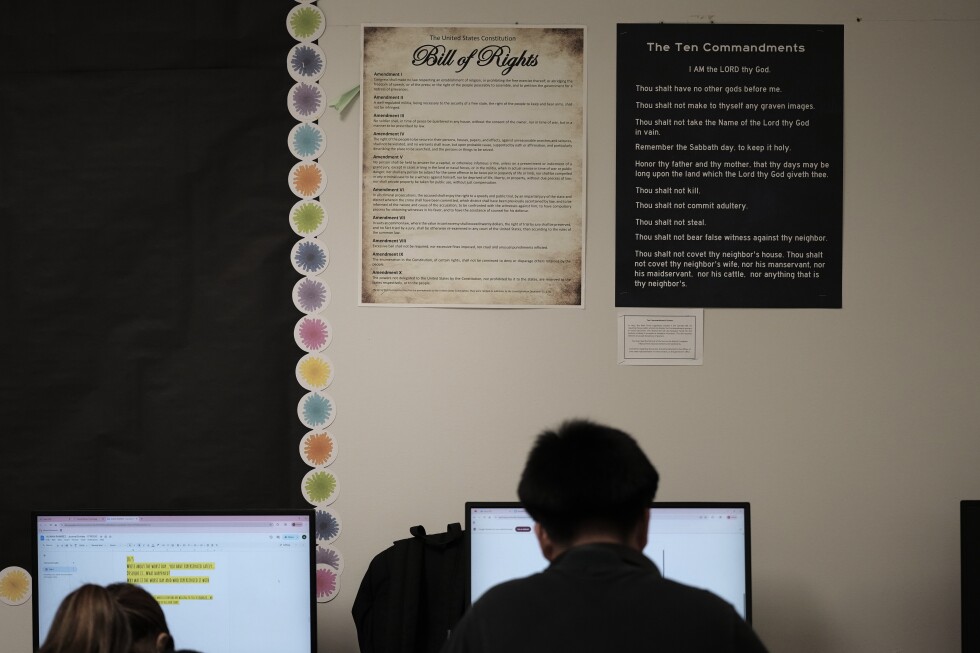
As the new school year commenced, several Texas school districts began displaying the Ten Commandments. The law, effective September 1, represents the largest national effort to integrate these religious tenets into public education.
Louisiana Attorney General Liz Murrill expressed satisfaction with the court’s decision, affirming the constitutionality of their similar law. Meanwhile, in Alabama, Governor Kay Ivey has recently signed a comparable mandate.
For further details, visit the original Associated Press article.