COLUMBIA, S.C. (AP) — South Carolina has become the latest battleground in a widespread movement to redraw congressional districts, with Republicans aiming to reshape majority-Black areas following a pivotal U.S. Supreme Court decision that has altered the legal landscape for minority voting rights. The decision has prompted efforts to reorganize districts to potentially favor Republican interests.
In South Carolina, efforts are underway, spurred by former President Donald Trump, to realign a district historically held by a Black Democratic representative. The goal is to achieve a Republican sweep of the state’s seven congressional seats. Similar initiatives are taking place in Alabama, Tennessee, and Louisiana, where lawmakers are reevaluating district maps following the Supreme Court’s recent ruling that invalidated Louisiana’s current map.
The Supreme Court’s decision indicated that Louisiana’s creation of a second Black-majority district overly relied on race, challenging long-standing interpretations of the Voting Rights Act. This has opened avenues for Republicans to attempt the dissolution of majority-Black districts that traditionally support Democrats.
This decision has intensified the ongoing national redistricting conflict in advance of the November midterm elections, where control of the closely divided House is at stake.
Redistricting Efforts in South Carolina
Democratic U.S. Rep. Jim Clyburn, who has represented South Carolina’s 6th District since its restructuring in 1992 to favor minority voters, is seeking an 18th term. However, his chances may be affected if Republicans succeed in redrawing his district. To initiate this process, a two-thirds vote in both state legislative chambers is required, but even slight Republican dissent could halt the effort.
Senate Majority Leader Shane Massey has cautioned that the redistricting attempt could backfire due to narrow political margins, potentially resulting in an additional Democratic seat. Massey noted a friendly discussion with Trump concerning their mutual concerns on redistricting. South Carolina’s primaries are set for June 9, with early voting commencing shortly.
Alabama’s Primary in Limbo
Alabama’s House is contemplating legislation to permit a special congressional primary if the Supreme Court authorizes adjustments to its U.S. House districts. Following the ruling on Louisiana, Alabama officials have appealed to dismiss a judicial mandate enforcing a map that includes two districts with significant Black populations. They favor a 2023 Legislature-approved map that could bolster Republican chances in Democrat-held districts.
Alabama’s primaries are scheduled for May 19. Should the Supreme Court approve the state’s request near or after this date, the proposed legislation would nullify primary outcomes, prompting the governor to arrange a new primary using revised districts. Democrats have criticized this move as an attempt to revert to past discriminatory practices.
Democratic U.S. Rep. Terri Sewell voiced strong opposition, stating Republicans aim to “secure an electoral victory by taking Alabama back to the Jim Crow era,” during a rally outside the Alabama Statehouse.
Tennessee’s Memphis District Under Scrutiny
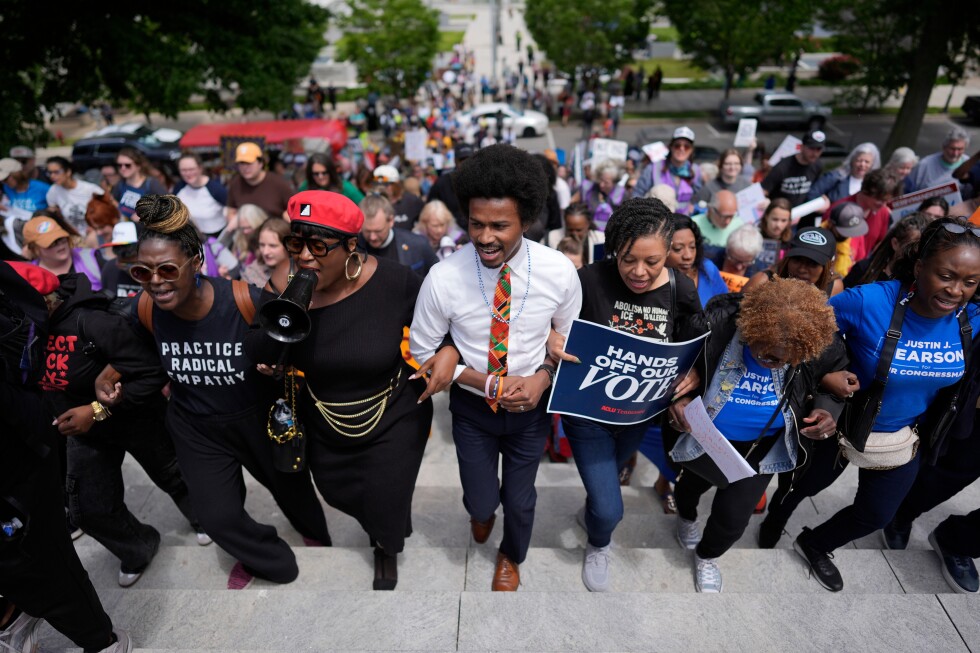
Tennessee lawmakers, summoned by Republican Gov. Bill Lee, are considering a plan, endorsed by Trump, to dismantle the state’s sole Democratic U.S. House district, centered around Memphis. While Republicans remain reticent about the proposal, protests erupted in the Senate chamber with chants of “shame, shame, shame.”
Sen. Raumesh Akbari, a Memphis Democrat, condemned the redistricting as “an act of hate.” Martin Luther King III expressed “grave concern” in a letter, warning that dividing Memphis could undermine his father’s legacy in voting rights advocacy. Tennessee’s candidate qualification period ended in March, with the primary set for August 6.
Louisiana’s Postponed Primary
Following the Supreme Court’s decision, Louisiana’s Republican Gov. Mike Landry has delayed the state’s May 16 congressional primary to allow for legislative approval of new U.S. House districts. A redistricting committee, led by Republican State Sen. Caleb Kleinpeter, plans a public hearing.
Prior to the postponement, over 41,000 absentee ballots had been submitted, accounting for a third of the total distributed. The breakdown included approximately 19,000 from Democrats, 17,000 from Republicans, and the rest from independents. Several lawsuits have been filed by Democrats and civil rights organizations contesting the primary suspension.