Louise Arbour Appointed as Canada’s Next Governor General
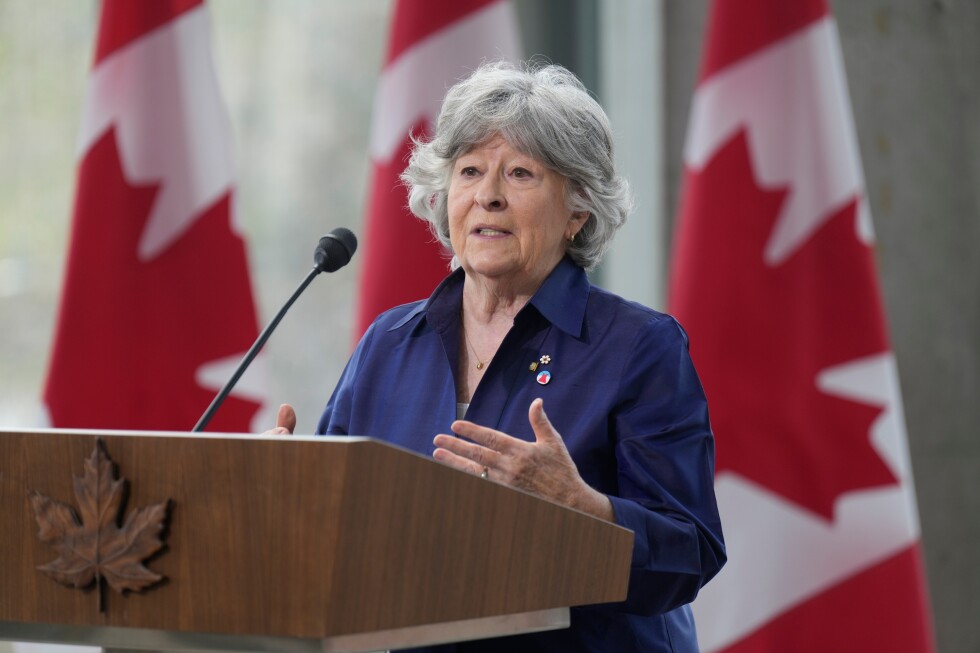
TORONTO (AP) — Prime Minister Mark Carney has announced that Louise Arbour, a retired Supreme Court Justice, will serve as Canada’s next governor general. This appointment positions Arbour as the representative of King Charles III, who is the constitutional head of state in Canada, part of the Commonwealth of former British colonies.
Carney confirmed that King Charles III endorsed Arbour’s appointment following his recommendation. “I will have an opportunity to have very in-depth conversations with Arbour in private on issues that affect Canada and the rest of the world,” Carney stated.
Although the governor general’s role involves significant constitutional responsibilities, it remains largely ceremonial. Carney’s choice of a Francophone for this position is notable.
When questioned about her views on monarchy, Arbour stated in French that she “doesn’t really know what that term is supposed to mean,” while expressing her support for the current system. “I will be the representative of the Crown in a constitutional arrangement that has served Canada extremely well throughout our history, even more in recent decades,” she mentioned.
Arbour is set to succeed Mary Simon, the first Indigenous governor general of Canada, whose five-year term concludes in July. Simon’s tenure faced criticism for her lack of proficiency in the French language, as noted by Daniel Béland, a political science professor at McGill University in Montreal.
Béland highlighted Arbour’s recognition and respect in Quebec, a predominantly French-speaking province. Her appointment coincides with the provincial Parti Québécois’ promise to hold an independence referendum by 2030, contingent on securing a majority government in the upcoming October elections. “Having a Francophone as Governor General might help,” Béland suggested.
Arbour, 79, is celebrated as a global authority in legal scholarship, human rights, and justice. Her distinguished career includes appointments to the Supreme Court of Ontario, the Court of Appeal for Ontario, and the Supreme Court of Canada. In 1996, she was named Chief Prosecutor for the International Criminal Tribunals for the former Yugoslavia and Rwanda by the United Nations, where she achieved groundbreaking convictions for genocide and war crimes. She also served as a U.N. Special Representative for International Migration from 2017 to 2018.
Canada, which remained a British colony until 1867, has since functioned as a constitutional monarchy, maintaining a parliamentary system based on British traditions.