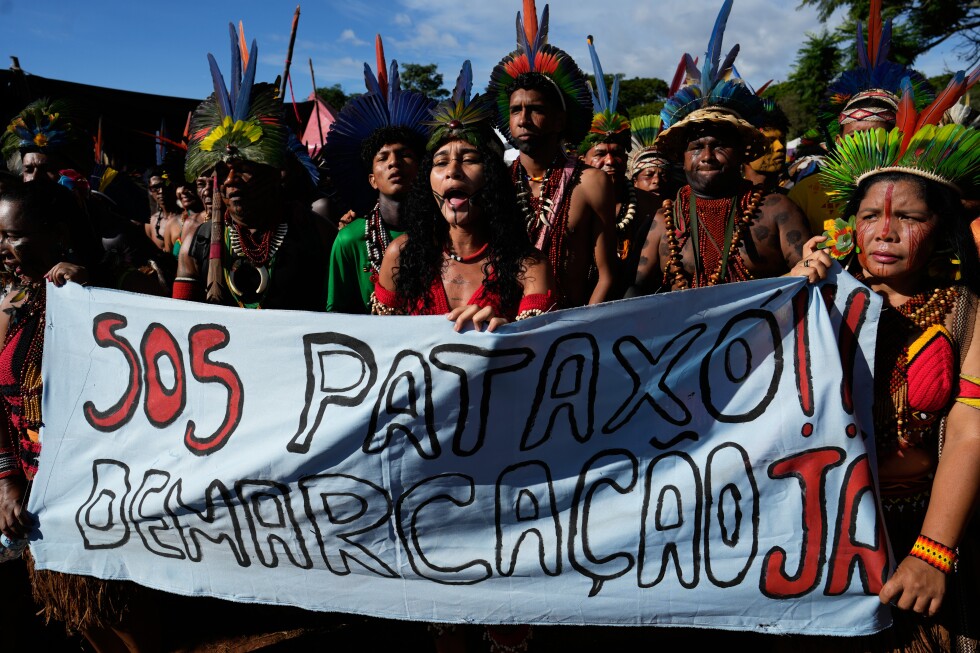
Indigenous Protest in Brazil’s Capital Highlights Land Rights Concerns
In Brazil’s capital, thousands of Indigenous people took to the streets on Tuesday to voice their concerns over perceived land rights violations. These violations are attributed to large corporations engaged in farming, logging, and mining projects.
The protestors, representing around 7,000 individuals from 200 Indigenous groups, were part of the annual Free Land Encampment, now in its 22nd year. This significant mobilization saw participants marching towards Three Powers Square, where the presidential palace, Congress, and the Supreme Court are located.
The demonstration comes as Indigenous leaders aim to pressure President Luiz Inácio Lula da Silva, who has expressed support for Indigenous rights and environmental protection. Despite his stance, Lula has promoted some projects that conflict with these goals. As he eyes reelection in October, Indigenous groups are keen to hold him accountable.
A Unified Front Against Land Violations
Amid the rising violence against the Pataxo people in Bahia state and ongoing protests in the Amazon, the encampment serves as a platform for unified demands. Indigenous leader Alessandra Korap, speaking with The Associated Press, emphasized the need for Indigenous voices in decision-making processes, stating, “The Congress, the Supreme Court, and the president make decisions for us without hearing us.”
Korap, a winner of the 2023 Goldman Environmental Prize, highlighted the importance of collective action, saying, “In an assembly like this, when Indigenous peoples from across Brazil stand united, no one dares to approach us, even as they make decisions about our lives.”
The Role of Indigenous Territories in Environmental Protection
Preserving Indigenous territories is recognized as a critical strategy to reduce deforestation in the Amazon, the world’s largest rainforest. According to a 2022 study by MapBiomas, Indigenous lands in Brazil have only lost 1% of their native vegetation over three decades, compared to 20% on private lands.
Despite these conservation efforts, the Indigenous communities continue to face challenges. Recent protests in Para state against a Canadian-operated gold mine and other contentious projects highlight ongoing struggles.
Political and Economic Pressures
Dinamam Tuxá, head of the Articulation of Indigenous Peoples of Brazil, expressed concerns about political pressures on Indigenous rights. “Brazil’s current political environment is forcing us to remain increasingly mobilized, unified, and visible,” Tuxá explained.
While President Lula’s administration has made some progress, legislative and economic forces continue to threaten Indigenous interests. Proposals to reinterpret land rights and allow mining in Indigenous territories remain contentious topics.
Lula has been invited to the encampment, though his attendance was not confirmed. Nonetheless, representatives from his administration, including the minister of Indigenous Peoples, are expected to engage with Indigenous leaders during the event.
Legal Challenges and Indigenous Rights
In February, Brazil’s Supreme Court Justice Flávio Dino ordered Congress to legislate on mining in Indigenous lands within two years. This ruling acknowledges the ongoing illegal mining activities in these areas and stresses the need for regulation and community consent.
Renata Vieira, a lawyer with Instituto Socioambiental, warned of the potential dangers posed by mining legislation, stating, “Any legislation on mining in Indigenous lands will be very harmful.”
The encampment’s theme, “Our future is not for sale, and the answer is us,” reflects the determination of Indigenous communities to protect their rights and territories amidst ongoing political, economic, and environmental challenges.