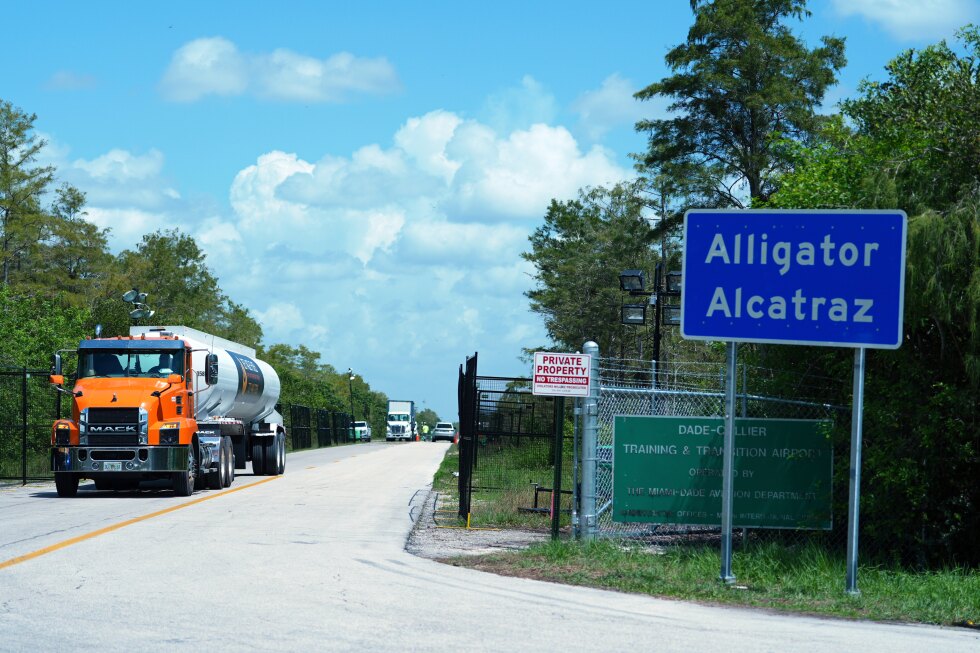
Environmental Groups Seek Closure of Florida’s ‘Alligator Alcatraz’ Detention Center
ORLANDO, Fla. — On Tuesday, environmental organizations appealed to a federal appellate court to lift a temporary stay that currently allows the continued operation of an immigration detention center located in Florida’s Everglades, commonly referred to as “Alligator Alcatraz.”
The facility remains operational, housing detainees, due to a prior decision by the appellate court in early September. This decision was influenced by arguments from the state of Florida and the Trump administration, stating that the state had not applied for federal reimbursement yet, thus was not bound by federal environmental law. The detention center was established by state officials last summer as part of President Donald Trump’s immigration enforcement strategy.
During a hearing in Miami, the appellate judges focused on the degree of federal government control over the state-managed facility and when an environmental review would be necessary under federal law. The judges have not yet indicated a timeline for their decision.
Jesse Panuccio, representing the Florida Department of Emergency Management, argued that both federal funding and federal control are prerequisites for federal environmental law to apply, and since federal agencies do not have control over the detention center, the law does not apply. “You need both,” Panuccio stated. “Even with funding, I don’t think that would follow because they don’t have federal control.”
In late September, Florida was informed that FEMA had sanctioned $608 million in federal funds for the center’s construction and operation.
Paul Schwiep, an attorney for the environmental groups, countered that the facility falls under federal review requirements because the U.S. Department of Homeland Security had approved the funding and immigration is federally governed. The criterion is “substantial federal control” rather than complete control.
Chief Judge William Pryor reacted, “It’s not federally controlled when the state retains authority to make decisions.”
Judge Nancy Abudu inquired about state authority in immigration matters, to which Adam Gustafson, representing the federal government, responded that states could be delegated certain responsibilities. “Is it also, once the federal government gives the states its authority, it’s the ‘Wild, Wild West?’” queried Abudu.
In mid-August, a federal district judge in Miami ordered the facility to cease operations over a two-month period, citing a failure to conduct an environmental impact review according to federal law. The appellate court intervened, halting the order pending appeal.
This environmental lawsuit is one of three federal challenges against the Everglades facility. Another case involved a detainee contesting the legal authority of Florida agencies and contractors to operate the center. The case was resolved after the detainee agreed to leave the United States.
In a separate lawsuit, a federal judge in Fort Myers, Florida, mandated that the Everglades facility must provide better access for detainees to their attorneys, ensuring confidential and unmonitored legal communications.
Follow Mike Schneider on Bluesky: @mikeysid.bsky.social.