Federal Judge Blocks Alabama’s Use of Nitrogen Gas for Executions
A federal judge has permanently barred Alabama from using nitrogen gas as a method of execution, ruling it unconstitutional. This decision was made by U.S. District Judge Emily Marks, following an appeals court’s reversal of her earlier decision, which had upheld the method’s constitutionality. The ruling affects inmate Jeffrey Lee, 49, who was slated for execution on Thursday.
Alabama’s adoption of nitrogen gas as an execution method in 2024 has faced significant legal challenges. The state remains at the forefront of this controversial technique, which has been used eight times in the United States, predominantly in Alabama.
The Alabama Attorney General’s office has filed an appeal against the ruling, but has yet to issue a public statement. Similarly, Jeffrey Lee’s legal team has not commented on the decision.
In her ruling, Judge Marks highlighted the appeals court’s finding that the nitrogen gas method poses “a substantial risk of serious harm.” She also noted that alternative execution methods, such as a firing squad, are available to the state. This aligns with the requirement for inmates to propose an alternative method when challenging execution protocols.
“Therefore, Lee has shown by a preponderance of the evidence that the protocol constitutes cruel and unusual punishment in violation of the Eighth Amendment,” Marks wrote.
The ruling allows Alabama to proceed with Lee’s execution using either lethal injection or the electric chair, both of which remain authorized state methods.
The 11th U.S. Circuit Court of Appeals played a critical role in this decision, with a panel of three judges describing the protocol’s three-minute duration for loss of consciousness as “intolerable” due to the likely suffering involved.
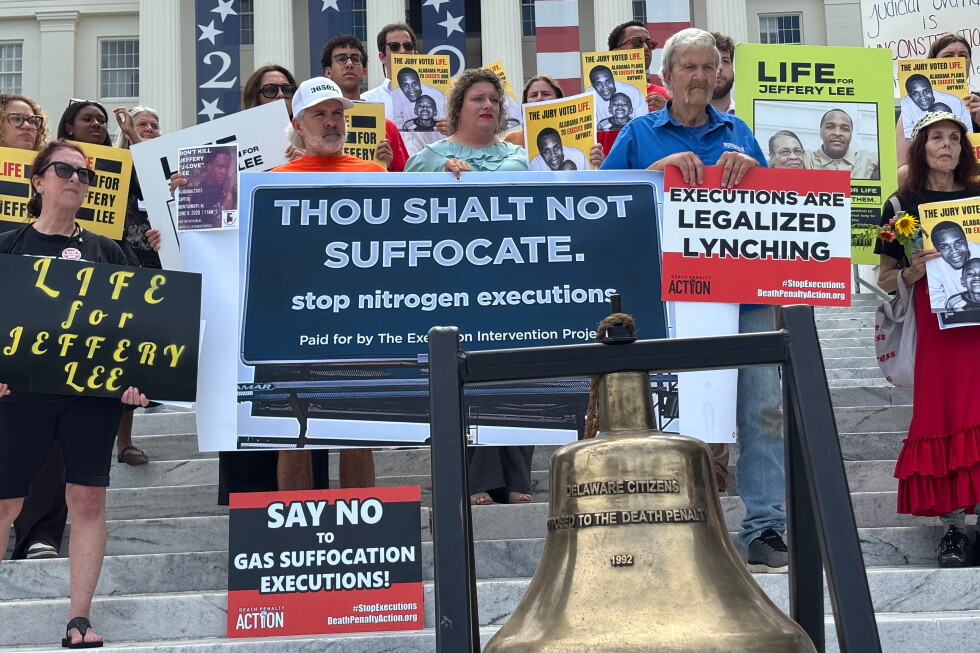
Opposition to nitrogen gas executions has been vocal, with death penalty critics and activists condemning the method. “Three minutes of conscious suffocation is torturous. If that doesn’t violate the constitution, let alone international law, nothing would,” stated Bernard Harcourt of Columbia University Law School. The Rev. Jeff Hood, who has witnessed two nitrogen executions as a spiritual adviser, hopes this ruling signals an end to the method.
Alabama maintains that nitrogen gas is constitutional, despite ongoing litigation over various execution methods. Judge Marks acknowledged these challenges, stating, “Were Alabama to adopt firing squad as a method of execution, that method would likely be challenged as well. Indeed, there is likely no method—no matter how humane—that would be immune to constitutional challenge. But the Constitution does not guarantee a painless death, and human life cannot be purposefully extinguished without some risk of pain. The Court, the condemned, and the State must all confront that sobering reality.”
Jeffrey Lee remains at Holman Correctional Facility in Atmore. He was convicted of capital murder for the 1998 killings of Jimmy Ellis and Elaine Thompson during a pawnshop robbery. Although a jury recommended life imprisonment, a judge imposed a death sentence, a practice Alabama ceased in 2017 with the abolition of judicial overrides.
For more information on execution methods, visit the Associated Press.