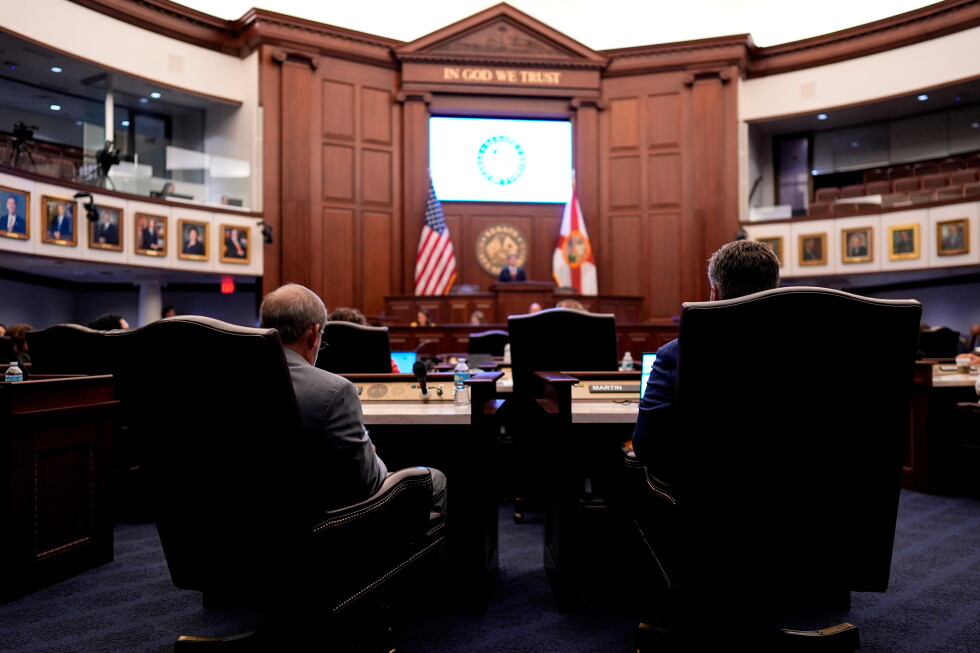
Florida Supreme Court Upholds GOP-Drawn Congressional Map
The Florida Supreme Court has decided to permit the use of newly-drawn U.S. House districts by Republicans for the upcoming midterm elections. This decision aligns with broader efforts by the GOP to maintain their narrow House majority through strategic redistricting nationwide.
Legal representatives for voters who opposed the new district maps argued that they breach Florida’s constitutional ban on partisan gerrymandering. They requested the continuation of previous districts until the case’s conclusion. However, the court, in a 6-1 decision, rejected the call for a temporary injunction, citing a lack of jurisdiction to intervene at this juncture as the legal process continues in lower courts.
Currently, Republicans hold 20 out of Florida’s 28 House seats. The new district boundaries, signed into law by Republican Governor Ron DeSantis after a rapid two-day legislative session, could potentially help the party secure up to four additional seats in this election cycle.
This ruling provides clarity for prospective congressional candidates facing a looming deadline to qualify for Florida’s primaries scheduled for August 18.
Florida’s Attorney General James Uthmeier, representing the new district maps in court, celebrated the decision as a “complete and total victory” via social media. Meanwhile, opponents of the ruling expressed their displeasure and vowed to continue challenging it, potentially extending the legal battle into the 2028 election cycle.
“The Florida Supreme Court’s failure to stop this brazen partisan power grab is not only an assault on democracy, but an abdication of its duty to the people of Florida,” stated Genesis Robinson, executive director of Equal Ground, one of the groups that filed the lawsuit. Similarly, Amy Keith of Common Cause Florida labeled the new districts as “a pretty clear partisan gerrymander” and committed to preventing these maps from influencing future elections.
National GOP Redistricting Strategy
Redistricting typically follows the census at the start of each decade. Florida, among other Republican-led states, has embarked on mid-decade redistricting as part of a strategy connected to former President Donald Trump’s efforts to preserve a Republican majority in the House by redrawing district lines to their advantage.
On April 29, Florida’s legislature passed the new House map, coinciding with a U.S. Supreme Court decision that weakened the federal Voting Rights Act, affecting a majority-Black congressional district in Louisiana. Since then, several Southern states have similarly attempted to remove minority districts traditionally won by Democrats.
Governor DeSantis had convened a special legislative session in anticipation of the court’s ruling. His office stated that no racial data was used in the creation of the new map, which modifies a southeastern Florida district previously intended to elect a Black representative under the federal Voting Rights Act.
A 2010 constitutional amendment in Florida not only bans partisan gerrymandering but also mandates that districts should not be drawn to diminish minority voting power. It requires districts to be compact and aligned with existing political and geographical boundaries where possible.
Debate Over Redistricting Restrictions
DeSantis’ General Counsel, David Axelman, argued in a memo to lawmakers that the racial redistricting provision in Florida’s Fair Districts Amendment contravenes the U.S. Constitution. He suggested that if one component is invalid, the entire 2010 amendment, including its anti-gerrymandering measures, should be nullified.
State officials’ attorneys echoed these arguments to the Florida Supreme Court after a previous lower court ruling declined to impose a preliminary injunction against the new map. They argued it was too late in the election season to revert to the previous maps.
In a Supreme Court filing, attorneys for the state officials described the new map as “cause for celebration” during America’s 250th anniversary and praised it as a “truly colorblind map.” This, they argued, avoids segregating individuals based on race.
Conversely, voter representatives claimed that the new districts were drawn with partisan bias, asserting that the new congressional maps represent “among the most extreme partisan gerrymanders enacted in any state over the past half-century.”
The new district map keeps 82% of voters in Republican-represented districts in their previous districts, while only 41% of voters in Democrat-represented districts remain in their original districts, according to Chris Shenton, an attorney for Common Cause and other challenging groups.
Judicial Opinions on the Case’s Urgency
While the Supreme Court’s majority offered a brief written opinion, two justices elaborated on the matter’s significance. Justice Adam Tanenbaum emphasized the judiciary’s measured approach, stating that there was no need for expedited treatment in this case.
In contrast, Justice Jorge Labarga, in his dissent, showed disappointment that an appellate court didn’t fast-track the case to the Supreme Court. He noted that the state constitution allows for urgent matters to be expedited and argued that the impending 2026 congressional elections, influencing millions of Floridians, meet this criterion.