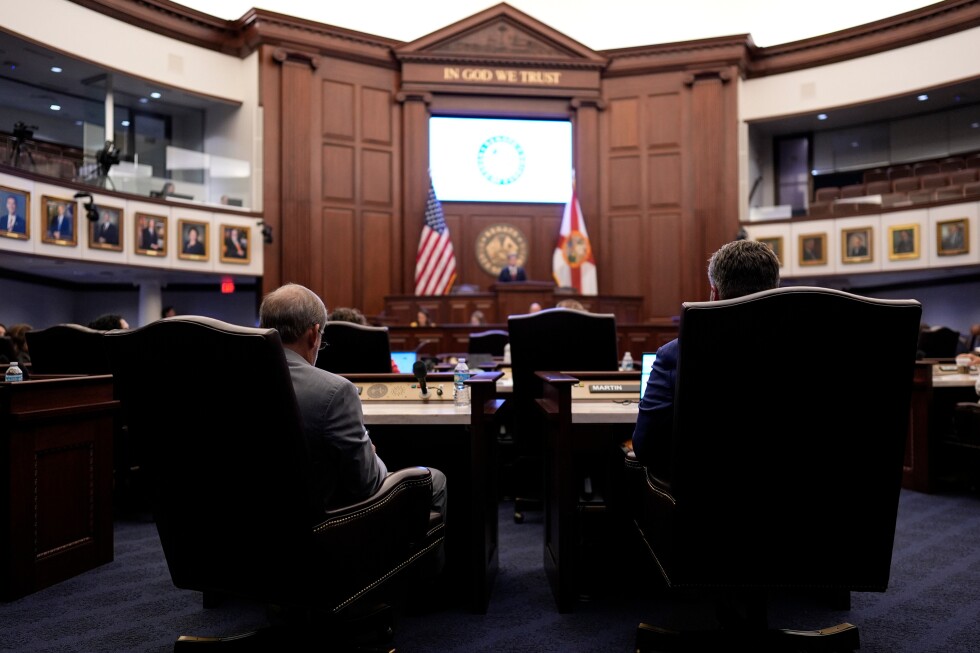
Florida’s newly established U.S. House districts, which could boost the Republican Party’s prospects for additional seats, are under legal scrutiny for potentially breaching state constitutional restrictions on partisan gerrymandering. This Friday, these districts will be contested in court by lawsuits representing voters, aiming to prevent their use in the upcoming midterm elections.
The legal challenge comes at a critical time for President Donald Trump, who is seeking to maintain a slim Republican majority in the House through redistricting efforts favoring the GOP. Currently, Republicans hold 20 out of Florida’s 28 U.S. House seats. The new districts, approved by Republican Governor Ron DeSantis during a brief legislative session, could potentially secure four more seats for the party in November.
The Florida Legislature ratified the new district map on April 29, coinciding with a U.S. Supreme Court decision that reduced federal Voting Rights Act safeguards for minorities by invalidating a majority-Black district in Louisiana. This decision has prompted several Southern states to consider removing minority districts that typically support Democrats.
Redistricting occurs every ten years after the census to balance populations. However, following Trump’s push for mid-decade redistricting last year, Republicans anticipate gaining up to 15 seats across states like Texas, Missouri, North Carolina, Ohio, Florida, Tennessee, and Alabama. Meanwhile, Democrats foresee a potential six-seat gain through new maps in California and Utah.
In Virginia, Democrats had hoped to secure four additional seats, but the Virginia Supreme Court recently nullified a Democratic redistricting plan, citing procedural violations by the legislature.
Partisan Map-Making Challenged in Florida
Although the U.S. Supreme Court decided in 2019 that it lacks jurisdiction over partisan gerrymandering cases, it affirmed that state courts could handle such claims based on state constitutions and laws. Florida’s constitution, amended in 2010, bars the creation of U.S. House districts that favor or disadvantage any political party or incumbent and protects minority voting strength. It also mandates compact and boundary-conscious districts.
Voter-led lawsuits are seeking a temporary halt to the new map, arguing it breaches the constitutional amendment by favoring the GOP. One lawsuit in Leon County describes the map as taking “the state’s partisan skew to an unprecedented extreme.” However, a brief from the Florida Senate counters that partisan intent is unproven, suggesting a full trial is necessary before any injunction.
Governor DeSantis had convened lawmakers before the Supreme Court’s ruling in the Louisiana case, anticipating a weakening of minority protections. Florida’s redistricting reshaped a southeastern district, previously aimed at electing a Black representative under the Voting Rights Act. The Governor’s office claims racial data was not considered in forming the new map. In a memo, DeSantis’ General Counsel David Axelman argued that Florida’s racial redistricting guidelines conflict with the U.S. Constitution, suggesting the entire 2010 amendment, including its anti-gerrymandering provisions, is void if any part is invalid.