Supreme Court Rulings: Trump Gains Power Despite Setbacks
In a recent series of Supreme Court decisions, President Donald Trump experienced both defeats and triumphs. While the court blocked his efforts in certain areas such as tariffs and birthright citizenship, it simultaneously expanded his influence over federal regulatory agencies. A significant ruling now permits the president to dismiss leaders of independent regulatory bodies at will, overturning long-standing legal protections designed to ensure agency independence.
Unitary Executive Theory Strengthened
The Supreme Court’s ruling on Monday marked a pivotal shift in presidential power, granting the president the authority to remove heads of independent regulatory agencies without cause. Historically, these leaders were shielded by laws that required the president to cite reasons like negligence before dismissal. This decision potentially allows the executive branch to reshape agencies intended to operate independently of the president’s influence.
However, the Federal Reserve remains an exception. The court ruled that its leadership cannot be dismissed at will, allowing Federal Reserve governor Lisa Cook to retain her position amid ongoing challenges to her attempted removal over disputed allegations.
Voting Rights Act Impacted
The Supreme Court’s recent decisions have further weakened the Voting Rights Act of 1965. In a ruling this April, the court made it increasingly difficult for minority voters to contest electoral districts unless they can provide evidence of intentional racial discrimination. This aligns with Trump’s advocacy for redistricting strategies to maintain Republican control in the House, impacting states like Alabama, Louisiana, and Tennessee, which have eliminated predominantly Black districts in response.
Immigration Policies Upheld
President Trump’s immigration policies received significant backing from the Supreme Court this term. The Department of Homeland Security was authorized to terminate deportation protections for Venezuelans and Haitians, and to impose restrictive asylum-seeking measures at the southern border. The court also expanded the powers of border officers in cases involving green-card holders accused of crimes.
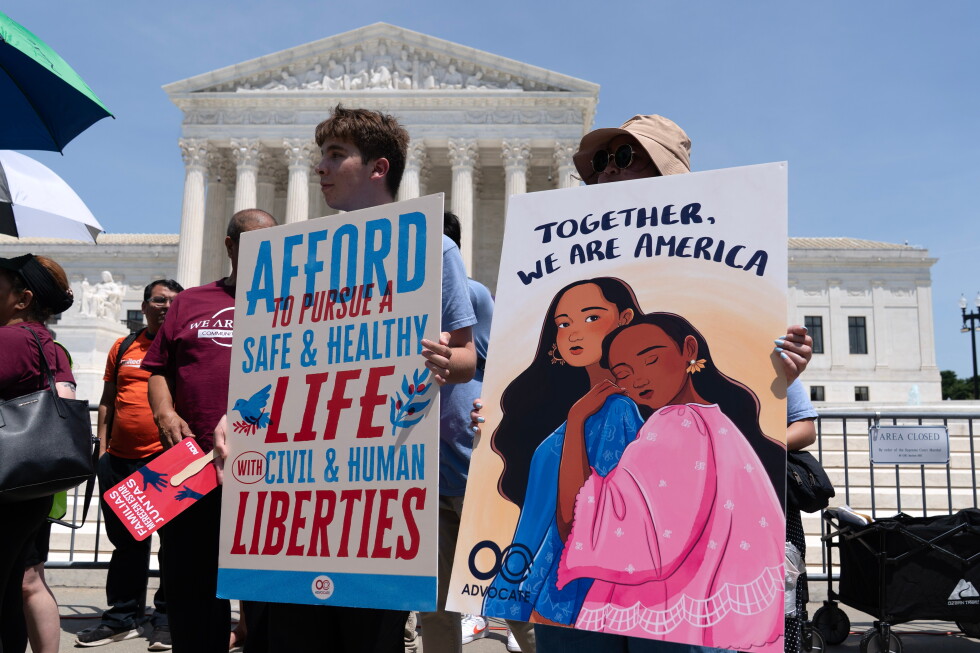
Despite setbacks in the birthright citizenship case, where six justices ruled against Trump’s executive order, four justices supported the administration’s interpretation of the 14th Amendment, which would deny citizenship to children of certain non-citizens.
Racial and Religious Statements Examined
Trump’s contentious statements regarding race and religion have been scrutinized by the court. In a recent decision concerning Haitian migrants, Justices Samuel Alito and Elena Kagan disagreed over the racial implications of Trump’s rhetoric. Alito argued for neutral interpretations, while Kagan highlighted racial undertones in the president’s comments.
The court’s stance mirrors its 2018 ruling on the travel ban, where Chief Justice John Roberts dismissed Trump’s comments about Muslims as irrelevant to the case’s legal merits. Justice Sonia Sotomayor, however, perceived clear animus towards the Muslim faith in the full context.
Global Tariffs Rejected
In February, the Supreme Court rejected Trump’s attempt to impose global tariffs through emergency powers, a move unprecedented by previous presidents. Trump criticized the decision and the justices involved, yet persisted in imposing tariffs under different authorities, which remain contested.
Gun Rights Expanded
The Supreme Court has recently bolstered Second Amendment rights through two key decisions. One ruling prohibits barring firearm ownership due to cannabis use, acknowledging its widespread legal use. Another decision struck down a Hawaii law requiring permission to carry guns in public spaces, impacting similar laws in other states.
These decisions build on a 2022 landmark ruling expanding gun rights, with a new case on the legality of semiautomatic rifle bans set for consideration.