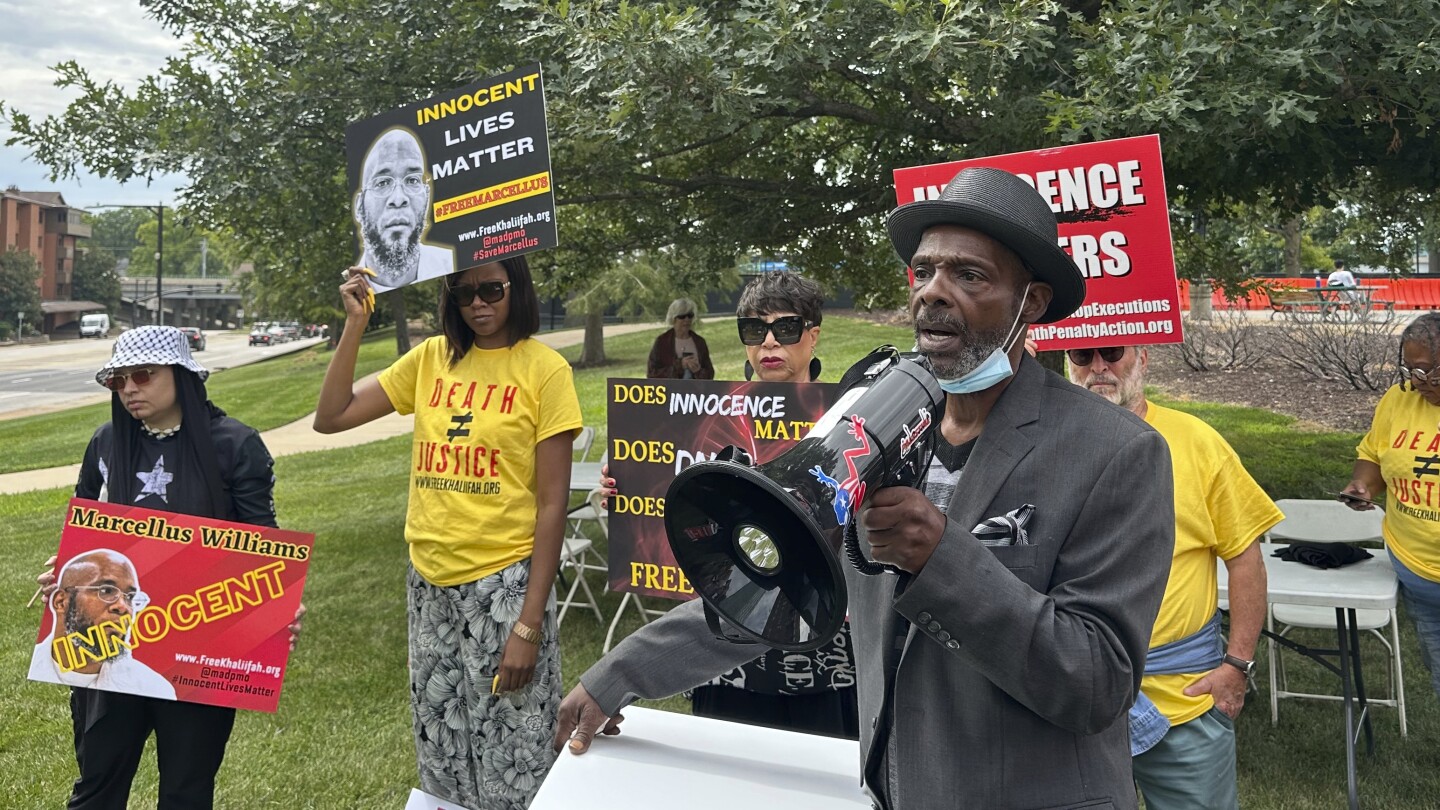
JEFFERSON CITY, Mo. (AP) — A Missouri man’s efforts to avoid execution encountered significant hurdles on Monday, as both the state’s highest court and governor denied motions to halt his impending lethal injection.
Marcellus Williams is scheduled to be executed at 6 p.m. on Tuesday for the 1998 murder of Lisha Gayle, a social worker and former journalist, who was fatally stabbed during a break-in at her suburban St. Louis residence.
Governor Mike Parson, a Republican, denied Williams’ clemency plea, which sought to commute his death sentence to life imprisonment. Concurrently, the Missouri Supreme Court dismissed a request to postpone the execution to allow a lower court to re-evaluate claims of racial bias in jury selection.
Williams’ legal team has an ongoing appeal pending before the U.S. Supreme Court.
Williams, 55, maintains his innocence, although his legal representation has recently prioritized claims of procedural errors during jury selection and the mishandling of the murder weapon over asserting his innocence.
In a unanimous decision, the state Supreme Court upheld a lower court’s ruling that dismissed Williams’ legal arguments.
“Despite nearly a quarter century of litigation in both state and federal courts, there is no credible evidence of actual innocence or any showing of a constitutional error undermining confidence in the original judgment,” Judge Zel Fischer stated in the court’s decision.
Governor Parson argued that Williams has had ample legal opportunities to prove his innocence and criticized his attorneys for attempting to “muddy the waters about DNA evidence,” which he said had been repeatedly rejected by courts.
“Nothing from the real facts of this case have led me to believe in Mr. Williams’ innocence,” Parson declared. “As such, Mr. Williams’ punishment will be carried out as ordered by the Supreme Court.”
Parson, a former sheriff, has never granted clemency in a death penalty case.
St. Louis County Prosecuting Attorney Wesley Bell has raised questions about Williams’ guilt and has sought to overturn his sentence. Bell’s office intends to appeal the Missouri Supreme Court’s ruling to the U.S. Supreme Court, spokesman Chris King confirmed.
“Even for those who disagree on the death penalty, when there is a shadow of a doubt of any defendant’s guilt, the irreversible punishment of execution should not be an option,” Bell said in a statement.
The Midwest Innocence Project has also advocated on Williams’ behalf.
“Missouri is poised to execute an innocent man, an outcome that calls into question the legitimacy of the entire criminal justice system,” said Tricia Bushnell, an attorney with the Midwest Innocence Project.
If carried out, Williams’ execution would be the third in Missouri this year and the 100th since the state resumed capital punishment in 1989.
Williams has faced execution twice before. In January 2015, the state Supreme Court halted his execution less than a week before it was scheduled, allowing time for additional DNA testing. In August 2017, then-Governor Eric Greitens, a Republican, issued a stay just hours before Williams was to be executed and appointed a panel of retired judges to review the case. The panel, however, never reached a conclusion.
Concerns over DNA evidence prompted Bell to request a hearing to challenge Williams’ guilt. New DNA testing revealed that DNA on the murder weapon belonged to members of the prosecution’s office, who had handled it without gloves after the original crime lab tests.
Without definitive DNA evidence pointing to another suspect, attorneys from the Midwest Innocence Project negotiated a deal with the prosecutor’s office for Williams to enter a no-contest plea to first-degree murder in exchange for a life sentence without parole.
Judge Bruce Hilton approved the agreement, which was also accepted by Gayle’s family. However, following an appeal by Republican Missouri Attorney General Andrew Bailey, the Missouri Supreme Court blocked the agreement and ordered an evidentiary hearing, which took place on August 28.
The prosecutor from Williams’ 2001 trial testified at the hearing that the jury, which included only one Black member, was fair. He admitted to striking a potential Black juror partially because of his resemblance to Williams, which Williams’ attorneys argued was evidence of racial bias.
On September 12, Judge Hilton ruled that Williams’ first-degree murder conviction and death sentence would stand, a decision upheld by the Missouri Supreme Court on Monday.
Prosecutors at the original trial claimed Williams broke into Gayle’s home on August 11, 1998, discovered a butcher knife, and fatally stabbed Gayle 43 times when she came downstairs. They alleged he stole her purse and her husband’s laptop, later selling the device.
Williams’ girlfriend testified that she saw the stolen items in his car and questioned his decision to wear a jacket on a hot day to hide blood on his shirt. Additionally, Henry Cole, who shared a cell with Williams in 1999, testified that Williams confessed to the murder and provided specific details.