The Emergence of Drone Warfare: A Wake-Up Call
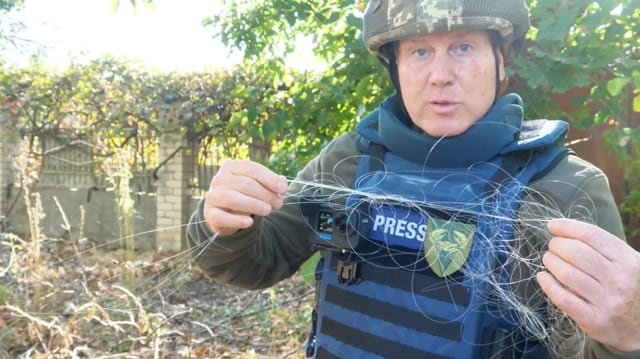
A 17-minute documentary titled “Drone Hunters of Kherson” is shedding light on a new era of warfare, urging both Pentagon planners and American taxpayers to recognize that the future of combat is already upon us. This film takes the audience to the front lines in Ukraine, showcasing a battlefield unlike any previously seen.
Since Russia’s full-scale invasion of Ukraine in 2022, drones have overtaken traditional artillery as the main instrument of destruction. Tasks that once required heavy artillery can now be performed with inexpensive, commercially available drones that are quickly repurposed and deployed. Ukraine, as depicted in this film, is the epicenter of 21st-century drone warfare.
Civilians in the Crosshairs
Russian forces have been uploading drone footage online, revealing unsettling scenes of how these devices are being used. Alarmingly, the targets often include civilians rather than combatants.
“They’re talking about hunting humans. They’re talking about it as a kind of flex, and they post these images on Telegram, and they share them around. … It’s not collateral damage. Civilians are the targets. Little old ladies walking back from the market with shopping bags under their arms. They’re the targets.” — Ken Harbaugh, former Navy pilot
Ken Harbaugh, the first American to embed with Ukraine’s elite 11th “M. Hrushevskyi” Brigade, the 34th Coastal Defense Brigade, and the 30th Marine Corps, serves as a guide in the documentary. He describes the conflict as “a blend of trench warfare and the Terminator,” where soldiers live underground while drones patrol the skies.
A New Kind of War the U.S. Isn’t Ready For
Both Harbaugh and former U.S. Representative Denver Riggleman, an executive producer on the film, express concern that America’s military procurement system is not equipped for the rapid pace of the current battlefield.
“We don’t have an answer for it. The public is barely even aware of the threat. They know what drones are, but they do not know about their offensive capabilities and just how cheap and ubiquitous they are and how easily they can be turned into weapons.” — Ken Harbaugh
Harbaugh witnessed how swiftly Ukrainian forces innovate. Drone warhead triggering mechanisms are designed and 3-D printed overnight and fitted the next day based on newly selected targets.
“I have seen the innovation cycle at the front in Ukraine occur in a matter — I’m not exaggerating — of hours, and I’ve seen triggering mechanisms for warheads that are about to be fitted to the next day’s drones being 3-D printed the night before based on the next day’s targets.” — Ken Harbaugh
This rapid innovation contrasts starkly with U.S. military operations.
“That kind of innovation, which takes hours or days in Ukraine, literally takes years in the United States when you go through the procurement process, the design iterations and all the various approvals … unless we adopt some of the Ukrainian approach to innovation, we’re never going to be able to adapt to a battlefield that changes by the day. We cannot have an innovation system that operates in timescales of years and decades responding to a battlefield that changes by the day.” — Ken Harbaugh
“Even with the biggest military budget in the world, we’re trying to catch up.” — Denver Riggleman
The Threat Is No Longer Hypothetical
The documentary, filmed last fall, has gained urgent relevance as the United States enters its second month of armed conflict with Iran following the joint U.S.-Israeli offensive, Operation Epic Fury. So far, 13 American service members have been killed and nearly 300 wounded.
Recently, an Iranian missile and drone attack struck Prince Sultan Airbase in Saudi Arabia, injuring a dozen U.S. troops, with two seriously affected. The first American casualty of this conflict was due to a Shahed drone.
“I think the lack of preparedness was evident that the first U.S. service members killed was by a Shahed [drone]. When you’re looking at drone warfare, we should have been well ahead of the curve with a U.S. military the might that we have, and instead, we’re at the mercy of countries that had to adapt in real time in a wartime environment.” — Denver Riggleman
Why Fiber Optic Drones Are Especially Dangerous
The documentary highlights fiber optic drones as particularly concerning due to their unique challenges. Unlike radio-controlled drones, these models cannot be jammed or electronically detected, lacking an electromagnetic signature. Physical intervention is the only means to stop them.
Ukrainian counter-drone units thus rely on foot patrols, positioning soldiers between drone operators and potential civilian targets. Harbaugh emphasized, “you have to have people between the drone operator and the civilian targets.”
Stopping these drones once airborne is difficult. Riggleman explained the challenge of shooting them down:
“The best way right now to shoot down drones is with a Kalashnikov … or with a .50 cal. I actually got to do that training, and even in a simulated environment, I was lucky to get 20 to 30%. These guys [have] got to be on target every time.” — Denver Riggleman
“You have people underground living like [it’s] 1916, while you have fiber optic and radio-controlled drones buzzing around.” — Denver Riggleman