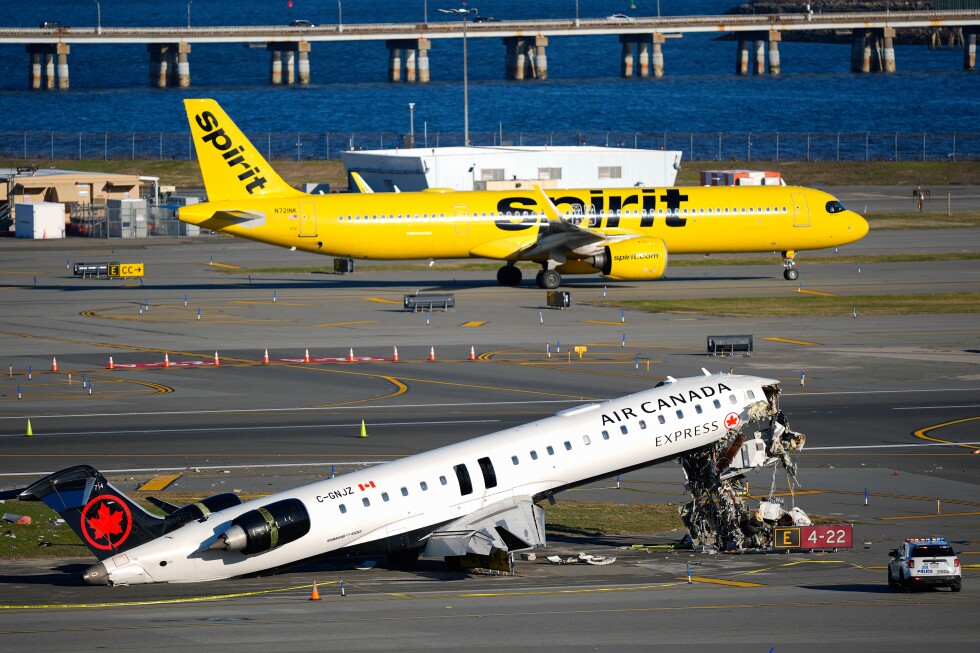
Critical Error at LaGuardia Airport Leads to Fatal Collision
In a tragic incident at New York’s LaGuardia Airport, a fire truck was mistakenly authorized to cross a runway merely 12 seconds before an Air Canada flight landed, resulting in a fatal crash that took the lives of both pilots, as reported by federal investigators on Tuesday. The National Transportation Safety Board (NTSB) is investigating the failure of multiple safety protocols which permitted the truck on the runway late Sunday night.
An Air Canada aircraft, originating from Montreal with over 70 passengers on board, collided with the fire truck, causing several injuries. Fortunately, most passengers managed to escape the damaged plane. A remarkable survival story emerged when a flight attendant, still in her seat, was thrown onto the tarmac but survived.
Investigation Focuses on Safety Protocols
The investigation is scrutinizing whether having just two controllers on duty overnight at the airport is sufficient, why a warning system did not indicate the impending crash, and whether the fire truck received the last-minute instructions to halt. Jennifer Homendy, NTSB chair, mentioned, “We rarely, if ever, investigate a major accident where it was one failure. When something goes wrong, that means many, many things went wrong.”
The NTSB has not yet interviewed the injured firefighters or determined if they attempted to brake or turn the vehicle to avoid the collision. Meanwhile, inquiries are ongoing regarding the air traffic controllers’ actions, especially as they were handling a separate, concurrent emergency involving an unusual odor in a United Airlines jet.
Concerns Over Air Traffic Control Staffing
Typically, two controllers work the late-night shifts, a practice the NTSB has questioned for years. The crash occurred during an unexpectedly busy night due to weather-related delays, with aircraft landing frequently in a short span. This situation has sparked discussions about whether two controllers are enough in such high-pressure scenarios. The FAA’s current requirement for two controllers has been in place since 2018, following incidents of controllers falling asleep while on duty alone.
Failure of Advanced Surveillance System
At LaGuardia, one of 35 major U.S. airports equipped with an advanced surface surveillance system (ASDE-X), the technology failed to prevent the collision. The system, designed to show the location of all planes and vehicles, was ineffective as the fire truck lacked a necessary transponder. Despite nearby emergency vehicles stopping in time, the system did not trigger an alarm.
Although the NTSB has not yet mandated transponders for all airport vehicles, Homendy advocates for their standardization, stating, “Air traffic controllers should know what’s before them, whether it’s on airport surface or in the airspace. They should have that information to ensure safety.” The Port Authority, which oversees the airport, has refrained from commenting due to the ongoing investigation.
Flight Operations Disrupted by the Crash
The incident exacerbated existing travel frustrations, with LaGuardia, the third busiest airport in the New York region, experiencing significant delays and cancellations. About 25% of flights were canceled the following Tuesday, with delays averaging over four hours, although these disruptions did not significantly affect other U.S. airports.
Kathryn Garcia, the Port Authority’s executive director, confirmed that the deceased pilots were Canadian. In total, approximately 40 individuals, including two from the fire truck, were hospitalized. While some suffered serious injuries, most were discharged within hours, and several did not require medical attention.