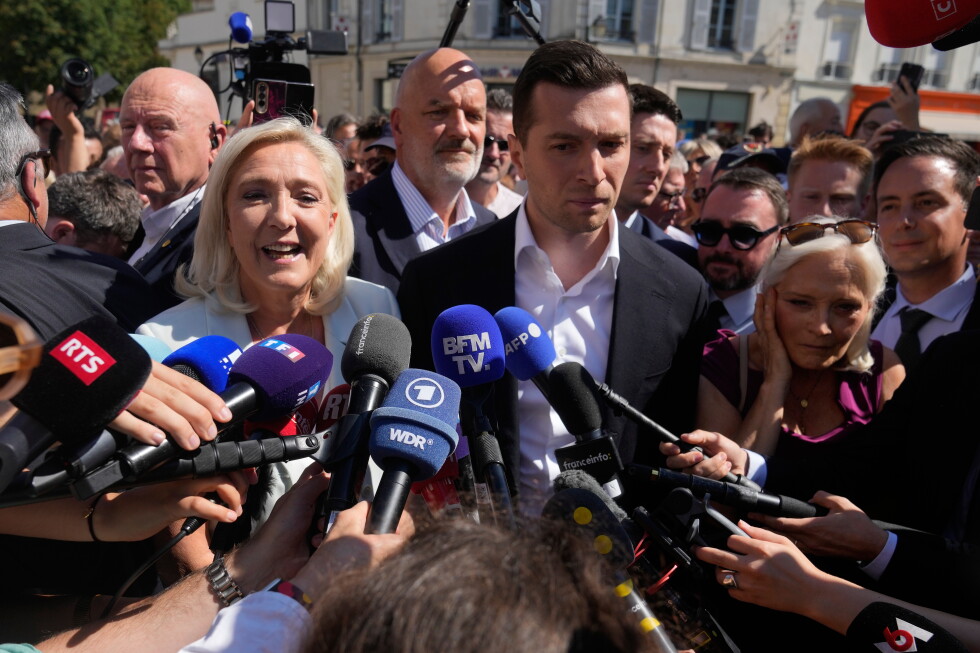
PARIS — The political landscape in France is witnessing an unusual turn as the nation gears up for a critical election next year. Far-right figure Marine Le Pen has announced her candidacy for the presidency, marking her fourth attempt. This comes despite her previous convictions for embezzling public funds, raising questions about her suitability for such a significant role.
An appeals court in Paris has altered the trajectory of Le Pen’s political ambitions by reducing a ban that previously prevented her from seeking public office. This judicial decision has effectively cleared her path to campaign for the presidency of one of the European Union’s largest nations, with the election just under ten months away.
Le Pen, 57, is leveraging her legal challenges as part of her campaign narrative, portraying herself as a resilient contender standing against systemic barriers for the sake of France. Luc Rouban, a senior researcher at Paris’ Sciences Po, notes that Le Pen’s argument centers on her perseverance and commitment to her national project.
Legal Uncertainty Clouds the Campaign
Although the appeals court reduced both the ban and a prison sentence from last year, Le Pen was ordered to serve a year of home detention with electronic monitoring. This situation introduces the peculiar possibility of a presidential candidate campaigning with an electronic tag.
The timeline for Le Pen’s legal battle remains uncertain. Her decision to challenge the ruling in France’s highest court delays the enforcement of the electronic monitoring sentence until the court reaches a verdict, expected before the election’s first round in April.
“I will therefore campaign without an electronic bracelet,” Le Pen affirmed. If elected, she would gain presidential immunity, negating the need for electronic monitoring during her term. However, legal discussions suggest that electronic monitoring could be reconsidered after her presidency.
Ethical Concerns Surround Le Pen’s Candidacy
Critics argue that Le Pen’s criminal convictions render her unfit for presidential office. Bernadette Flament, a resident near a recent campaign stop, expressed disapproval, stating, “A president who governs, who will govern France, who has been convicted, is unacceptable.”
Public sentiment in France shows a strong demand for higher ethical standards in politics, exacerbated by past scandals involving prominent figures, including former President Nicolas Sarkozy, who was imprisoned last year.
Despite her attempts to minimize the impact of her conviction, the public’s expectation for accountability remains a significant hurdle for Le Pen’s campaign, according to Rouban.
Le Pen and Bardella: A Unique Campaign Strategy
Le Pen has introduced a novel approach by announcing a joint campaign with Jordan Bardella, likening it to a political “duo.” Bardella, the youthful president of their National Rally party, appeals to younger voters and represents a shift in campaign dynamics.
While this strategy breaks with French tradition, where the president independently selects the prime minister, it aims to broaden the party’s appeal by combining Le Pen’s experience with Bardella’s modern outreach.
Célia Belin from the European Council on Foreign Relations suggests that this pairing could attract a diverse voter base, securing support from both traditional National Rally followers and new demographics drawn by Bardella’s appeal.