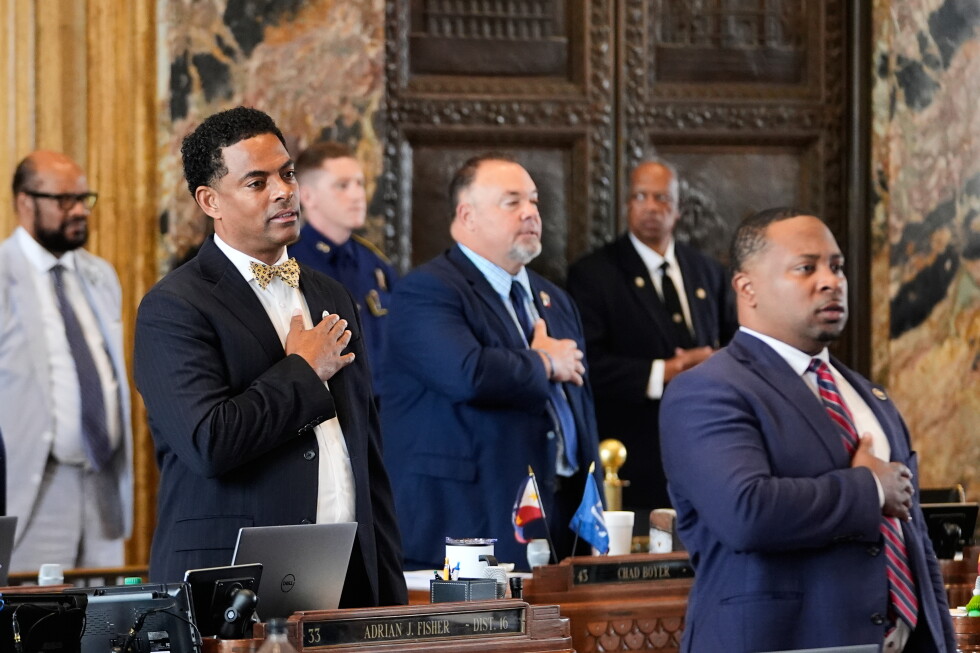
Louisiana Adopts New Congressional Map, Reducing Majority-Black Districts
BATON ROUGE, La. — A new congressional district map aimed at bolstering Republican representation was signed into law by Louisiana Gov. Jeff Landry on Friday. This action eliminates one of the state’s two majority-Black districts, both represented by Democrats, potentially increasing Republican seats.
The Republican-majority Louisiana Legislature approved the plan shortly before Landry’s signature, despite the U.S. Supreme Court’s earlier decision deeming the previous map with two majority-Black districts as an illegal racial gerrymander. This ruling coincided with ongoing national debates about redistricting, intensified by efforts to maintain Republican control in the U.S. House during midterm elections.
Efforts by Louisiana Republicans to secure all six state congressional seats were previously considered but ultimately, the Legislature opted for a 5-1 map. This approach was deemed more secure for preserving current Republican seats, particularly protecting U.S. House Speaker Mike Johnson from a challenging reelection.
Concerns Over Racial Gerrymandering
Democratic leaders argue that the new district map unfairly concentrates Black voters into a single district, reducing their influence elsewhere. State Sen. Royce Duplessis criticized the redistricting decision, noting that Louisiana, unlike some Southern states such as South Carolina, chose to redraw its map during an election year, a move he described as a “vicious race to the bottom.”
In defense, Republican state Sen. Jay Morris emphasized that the boundaries were determined by party affiliation rather than race. “I purposely put more Democrats into District 2 to make the remaining districts better performing for Republicans,” Morris explained. He also stated that race data was deliberately excluded from the demographers’ considerations.
Opponents like Democratic Sen. Sam Jenkins warned that the map could lead to legal troubles, describing it as racially gerrymandered. Morris responded, “Agree to disagree.”
Legal Challenges and Future Litigation
The revised map follows a lower court’s mandate, which initially required a second majority-Black district to comply with the Voting Rights Act. However, this map was invalidated by the Supreme Court due to racial gerrymandering concerns.
Gov. Landry postponed the state’s closed U.S. House primary initially scheduled for May 16, moving the date to November 3 and opening it to all candidates irrespective of party. The redistricting changes notably affect Democratic U.S. Rep. Cleo Fields’ district by integrating predominantly white areas from Baton Rouge and southern Louisiana. It also modifies the district of Democratic U.S. Rep. Troy Carter to include parts of Baton Rouge.
Anticipating future legal battles, the ACLU of Louisiana has hinted at possible litigation, calling the map a “racial gerrymander hiding behind the thin veneer of partisanship.” Meanwhile, victorious plaintiffs from the Supreme Court’s decision criticized the new map for maintaining a majority-Black district.
Broader Redistricting Efforts in Southern States
Following the Supreme Court decision, several Republican-led Southern states have revisited their congressional maps, leveraging a weakened federal Voting Rights Act to potentially increase Republican seats. Although Republicans are currently leading in this redistricting battle, the outcome remains uncertain for the upcoming U.S. House elections.
Meanwhile, in Wisconsin, a liberal-controlled Supreme Court decision may pave the way for Democrats to contest Republican-friendly districts by 2028. A bipartisan group of business executives has filed an appeal to redraw the state’s congressional map, seeking trial proceedings that could influence future elections.