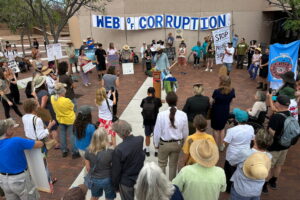
A ruling from the 5th U.S. Circuit Court of Appeals has terminated a Texas law known as the Texas Dream Act, which allowed certain undocumented students to pay in-state tuition rates at public colleges and universities. The court decided that advocacy groups, a community college, and a student had no standing to defend the law because federal legislation prohibits states from offering tuition benefits based on residency to undocumented students unless the same benefit is provided to all U.S. citizens.
The Texas Dream Act, established in 2001, enabled students who graduated from Texas high schools or obtained equivalent diplomas, resided in Texas, and promised to apply for permanent residency when eligible, to benefit from in-state tuition, even without legal immigration status.
Governor Greg Abbott lauded the court’s 2-1 decision on X, stating that Texas and the Trump administration’s Justice Department had achieved a significant legal triumph. However, the ruling was met with disappointment by groups such as La Unión del Pueblo Entero (LUPE) and the Mexican American Legal Defense and Educational Fund (MALDEF).
“Education is a human right, no matter someone’s immigration status or background,” remarked Tania Chavez Camacho, LUPE’s president and executive director.
Thomas A. Saenz, president and general counsel of MALDEF, representing Students for Affordable Tuition, expressed intent to seek further judicial review, criticizing the rapid repeal of the Texas Dream Act as a grave legal misstep.
Austin Community College reaffirmed its dedication to supporting all students in alignment with the law, emphasizing its mission to offer “accessible, high-quality education and opportunities for all.”
Marco Julian Gonzalez, a business student at the University of Texas at Austin, conveyed his dismay at the ruling, highlighting the negative portrayal of undocumented students as “criminal illegal aliens” by some politicians.
Judges Jerry E. Smith and Don Willett formed the majority opinion, with Judge Irma Carrillo Ramirez dissenting. Their appointments were by Presidents Ronald Reagan, Donald Trump, and Joe Biden, respectively.
The Background
In 2001, Texas pioneered legislation to allow certain undocumented students to pay in-state tuition, supported by a bipartisan consensus and signed into law by Republican Governor Rick Perry. The law targeted students who met specific educational and residency criteria and committed to pursuing legal residency.
Despite multiple attempts to amend the law, it came under legal scrutiny when federal immigration policy shifted. The Justice Department challenged the act, leading to an agreement with Texas Attorney General Ken Paxton to block the law, a move sanctioned by U.S. District Judge Reed O’Connor.
Student and Advocacy Group Responses
Students for Affordable Tuition, LUPE, Austin Community College, and student Oscar Silva sought permission to intervene in defense of the Texas Dream Act, arguing that the rapid judicial process denied their right to due process. They contended that the law did not conflict with federal statutes as it was not solely based on residency but included other qualifying criteria.
The advocacy groups highlighted the financial impact on students, many of whom face increased tuition costs, potentially jeopardizing their educational pursuits.
Federal Government’s Position
The Justice Department maintained that the Texas Dream Act breached a 1996 federal immigration law, asserting that it was incompatible with federal statutes. They argued that attempts to defend the law were legally insubstantial and unnecessary for the judicial process.
While addressing due process concerns, a Justice Department attorney stated that external groups had their arguments heard by both the trial court and the appeals court.
Impact and Future Implications
The ruling affects more than 57,000 students who benefited from the Texas Dream Act. The discontinuation of the law is projected to have significant economic repercussions for Texas, including potential losses in wages and consumer spending. Schools like Austin Community College anticipate financial losses and operational challenges.
Since the law was blocked, confusion has persisted regarding the eligibility for in-state tuition, leading to discrepancies such as DACA recipients being charged out-of-state rates.
For more details, see the full report at The Texas Tribune.