LONDON (AP) — During a recent intense heat wave, much of London’s grass turned brown as temperatures soared across the UK and Europe, causing a surge in water usage and prompting water suppliers to advise against excessive outdoor water consumption.
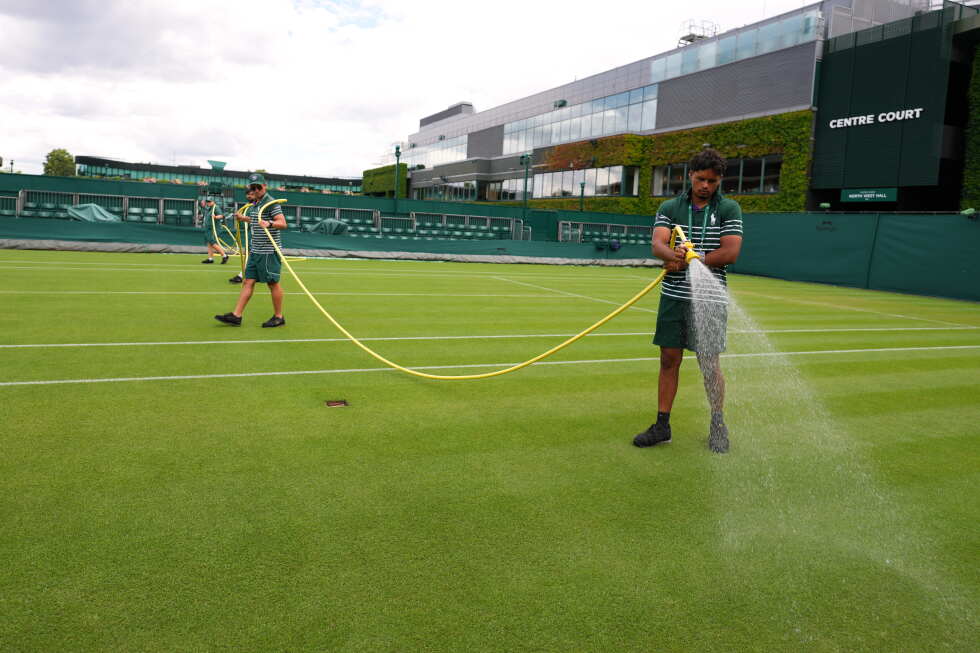
Despite the scorching conditions, the iconic grass courts of Wimbledon remain vibrantly green as the Grand Slam tournament unfolds.
Renowned for their lush appearance, these courts are meticulously maintained by Neil Stubley, head of courts and horticulture at the All England Club, and his team of 31 groundskeepers.
Stubley stated that he closely monitors climate conditions using “probably about 25 weather apps” to ensure the courts remain in prime condition. This effort is supported by extensive research into heat-resistant grass varieties.
Stubley acknowledged the reality of increasingly frequent heat waves in Britain, saying, “It’s inevitable and it is happening.” For nearly four decades, the club has conducted trials on grass species to identify varieties best suited for tennis and capable of enduring drought and wear.
Since 2001, Wimbledon’s 18 tournament courts and 20 practice courts have been planted with perennial ryegrass. Centre Court and four other courts are equipped with a system that allows for soil moisture measurement, crucial for maintaining optimal playing conditions.
During the record-breaking heat in June, these soil moisture probes were essential as Britain experienced its hottest June ever, according to the Met Office, the country’s national weather service.
Although temperatures have moderated this week, Stubley explained that the drop in overnight temperatures has been beneficial. “At the moment, in London, in the UK, you may have a 33-degree (Celsius) day (91 Fahrenheit) but you’re then getting a 17-degree (62 F) overnight,” he said. “That allows the temperature to come down, it allows the dew point to come in.”
This week’s Wimbledon matches have seen temperatures not exceed 26 C (79 F), but hotter weather is anticipated in the coming days.
Water Management
Each Wimbledon court features a distinct irrigation plan, although the club lacks its own water supply system. Conservation remains a priority for the organizers.
Stubley commented on these efforts: “Every time we do a project, part of the remit is how can we conserve things, whether that be energy, whether that be water.” He noted the challenges posed by changing legislation regarding water use, such as borehole permissions.
Surface Challenges
All four Grand Slam tournaments have faced issues with heat in recent years, but Wimbledon is unique in being played on live grass, unlike the hard and clay courts of the other events.
The Sports Turf Research Institute (STRI) in Yorkshire independently verifies the conditions of the Wimbledon courts, conducting moisture and hardness tests and even counting grass blades to assess wear.
Stubley explained that daily data collection allows for precise adjustments: “Each court will have its own microclimate. … When we’re getting those hardness readings and it’s saying that Court 14 is firmer than Centre Court, we can then add a little bit more water to 14 and a little less to Centre Court.”
Wear and Tear from Play
Wimbledon’s courts face wear not only from the weather but also from player movement. Defending champion Jannik Sinner and seven-time winner Novak Djokovic, for instance, inadvertently act as lawn mowers when sliding on the courts.
Stubley remarked on the impact: “If you look at the pimple of a grass-court tennis shoe, it’s almost like a cheese grater.” This sliding action spreads out the damage, differentiating it from the concentrated wear seen in serving areas.
___
AP tennis: https://apnews.com/hub/tennis