Utah voters will head to the polls on Tuesday to select congressional candidates using a newly implemented map that introduces a Democratic-leaning district in Salt Lake City, altering the reelection landscape for the state’s all-Republican congressional delegation.
The revised district boundaries may pave the way for an additional Democratic seat, challenging the Republican effort to maintain their narrow majority in the U.S. House during a typical midterm election cycle where the president’s party often loses congressional seats.
Following a court ruling, Utah adopted the new map against the wishes of the Republican-led Legislature, which had initially approved a 2021 plan that split Salt Lake City among four Republican-dominated districts. This plan was deemed unconstitutional as it violated a voter-approved 2018 initiative aimed at curbing partisan gerrymandering.
In February, the Utah Supreme Court affirmed the lower court’s decision. Additionally, a Republican initiative, supported by former President Donald Trump, to overturn the 2018 anti-gerrymandering law, failed to reach the November ballot. Meanwhile, Republicans are expected to benefit from redistricting efforts in other states, encouraged by Trump.
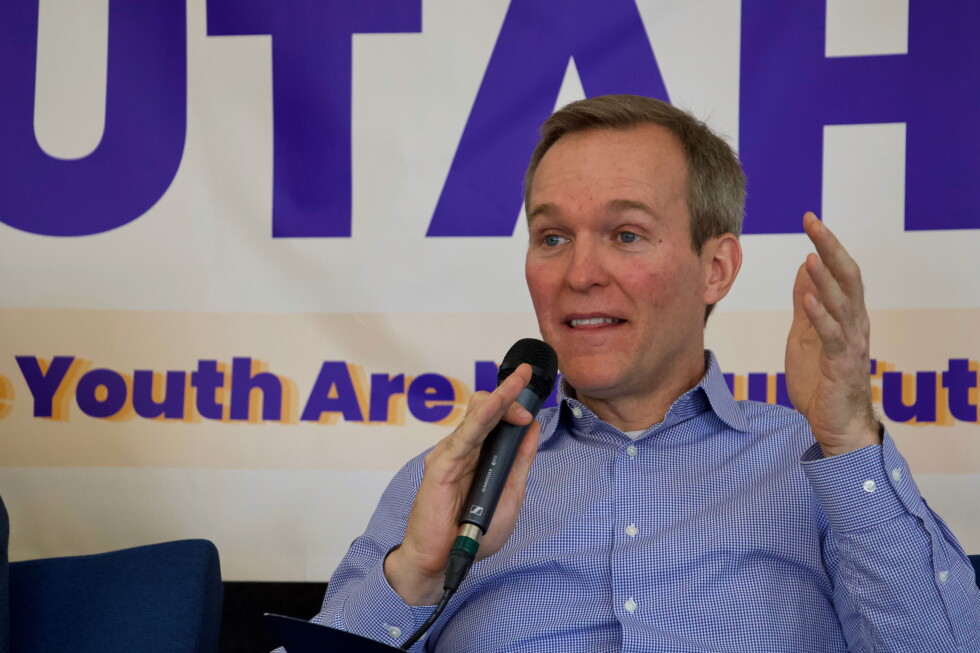
In the redefined 1st Congressional District, centered around Salt Lake City, former Democratic U.S. Rep. Ben McAdams seeks to return to Congress. His competitors include state Sen. Nate Blouin, tax attorney Michael Farrell, and former lobbyist Liban Mohamed. McAdams leads in fundraising, with nearly three times the amount raised by Blouin.
Republican Riley Owen runs unopposed in this district. According to projections, had this district existed during the 2024 presidential election, it would have been won by former Vice President Kamala Harris with 60% of the vote.
The newly drawn 2nd Congressional District in northwest Utah remains largely unchanged. It closely mirrors the current 1st District. Republican U.S. Rep. Blake Moore faces a primary challenge from state Rep. Karianne Lisonbee. Lisonbee criticized Moore for his involvement with the “Better Boundaries” committee that supported the 2018 redistricting law.
In the expansive 3rd Congressional District, Rep. Celeste Maloy is up against former state Rep. Phil Lyman. Maloy narrowly won the convention nomination but not by enough to prevent Lyman from advancing to the primary ballot.
For the new 4th Congressional District, Rep. Mike Kennedy is running unopposed. This district overlaps with Maloy’s current 2nd District, with Rep. Burgess Owens choosing not to seek reelection. Former President Trump has endorsed the incumbents seeking reelection.
Half of Utah’s state Senate seats and all state House seats will be contested in 2026, with Republicans holding supermajorities in both chambers.
Election Details
Polls close at 8 p.m. MT (10 p.m. ET). The Associated Press will report results for contested primaries at various governmental levels. Registered voters can participate in the Democratic primary regardless of party affiliation, while only registered Republicans may vote in the Republican primary. In-person registration is available during early voting and on Election Day.
Voter Statistics
As of June 16, Utah has approximately 2.1 million registered voters, including about 1 million Republicans, 297,000 Democrats, and 622,000 unaffiliated voters. In 2024, 427,000 votes were cast in the Republican primary, while Democratic primaries saw between 68,000 and 221,000 votes, depending on the election year.
Voting Methods
Utah primarily conducts elections via mail. By the recent Thursday, around 163,000 ballots had been cast, with the majority from Republicans. Initial vote updates typically include early in-person and mail ballots, with some counties releasing these along with Election Day results.
Vote Counting
During the 2024 state primary, initial results were reported shortly after polls closed and reached about 90% of the total count within two days. The AP declares winners only when assured of no possible changes from trailing candidates.
Recount Procedures
Recounts occur automatically in the event of a tie. Candidates may request a recount if the margin is 0.25% or less. For races with under 400 votes, a recount can be requested if the margin is one vote. The AP may declare a winner if the lead is insurmountable by recounts or legal contests.
As of Tuesday, the countdown stands at 133 days until the 2026 midterm elections.
Follow ongoing election coverage at https://apnews.com/projects/elections-2026/.
“`