Federal Appeals Court Calls for Further Review of Alabama’s Nitrogen Execution Method
The controversial use of nitrogen gas in Alabama’s capital punishment process has been put under scrutiny by a federal appeals court, which has called for additional evaluation of its compliance with the constitutional prohibition against cruel and unusual punishment. The decision was made on Monday night and it may affect the upcoming execution scheduled for Thursday.
Alabama first adopted nitrogen gas as a method of execution in 2024. This method involves replacing breathable air with pure nitrogen via a respirator, ultimately leading to death due to a lack of oxygen. The recent ruling reverses a previous decision made in May, which found the method constitutional, and sends the case back for further consideration.
The case centers around Jeffery Lee, a death row inmate who is scheduled for execution using nitrogen gas later this week. While the appeals court did not issue a stay on Lee’s execution, it requested a review of his proposed alternative execution method, the firing squad, to determine its feasibility.
The U.S. Supreme Court mandates a two-prong test for evaluating the constitutionality of execution methods. Challengers must demonstrate that the method presents a substantial risk of causing excessive pain and that a viable alternative is available. The appeals court acknowledged that Lee satisfied the first requirement but deferred the second to the trial court.
Concerns were raised by the appeals panel regarding the nitrogen execution method, particularly about the duration it might take for the individual to lose consciousness. In their statement, the panel noted, “In our view, the overall suffering described by the district court, which lasts for one to three minutes, presents a substantial risk of serious harm over and above death itself.”
The Alabama Attorney General’s Office has yet to respond to the ruling, although the state maintains that the nitrogen gas method is constitutional. Critics of the method applauded the decision. Rev. Jeff Hood, who has served as a spiritual adviser during nitrogen executions, remarked, “For the first time a court has acknowledged what I and so many others have seen with our own eyes. Nitrogen executions are a unique form of horror.”
Nationally, nitrogen gas has been used in eight executions, with seven occurring in Alabama and one in Louisiana. Lee’s legal team argues that the method results in undue suffering, citing that a recent nitrogen execution in Alabama took over 30 minutes.
Jeffery Lee was convicted for the murders of Jimmy Ellis and Elaine Thompson during a pawnshop robbery in 1998. Despite a jury recommending life imprisonment by a narrow margin, a judge overrode this decision and sentenced Lee to death. Alabama abolished the practice of judicial overrides in death penalty cases in 2017.
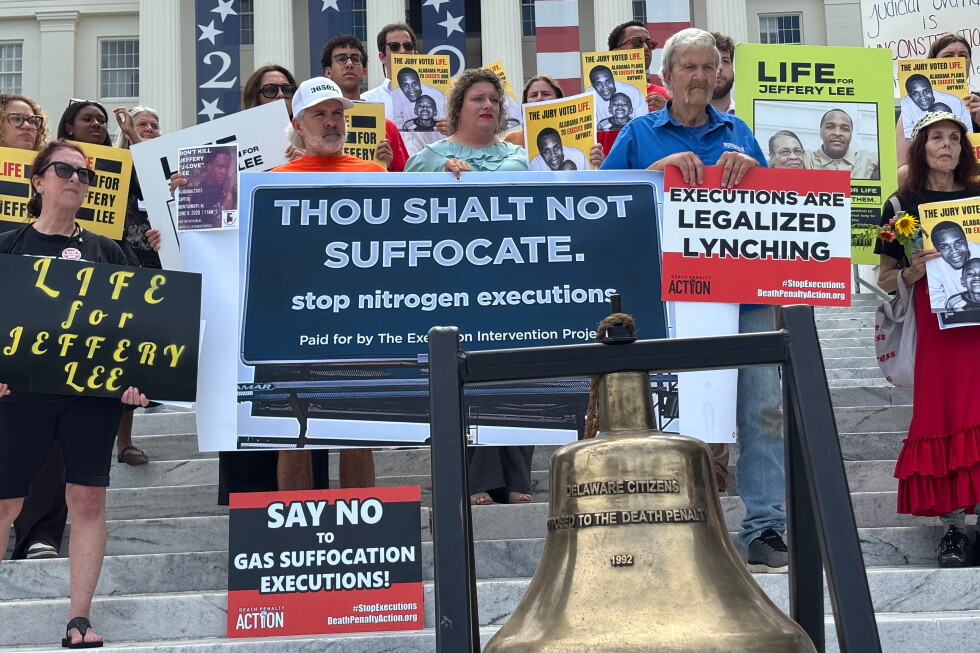
A vigil was held at the Alabama Capitol advocating for Lee’s sentence to be commuted to life imprisonment. However, Alabama Attorney General Steve Marshall opposed the clemency plea, stating, “The people of Alabama have not forgotten Jimmy and Elaine. I have not forgotten them. Anything short of carrying out the sentence imposed by the court falls short of justice for the victims, and that is not what victims of this state deserve.”