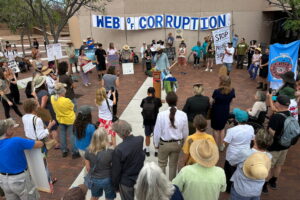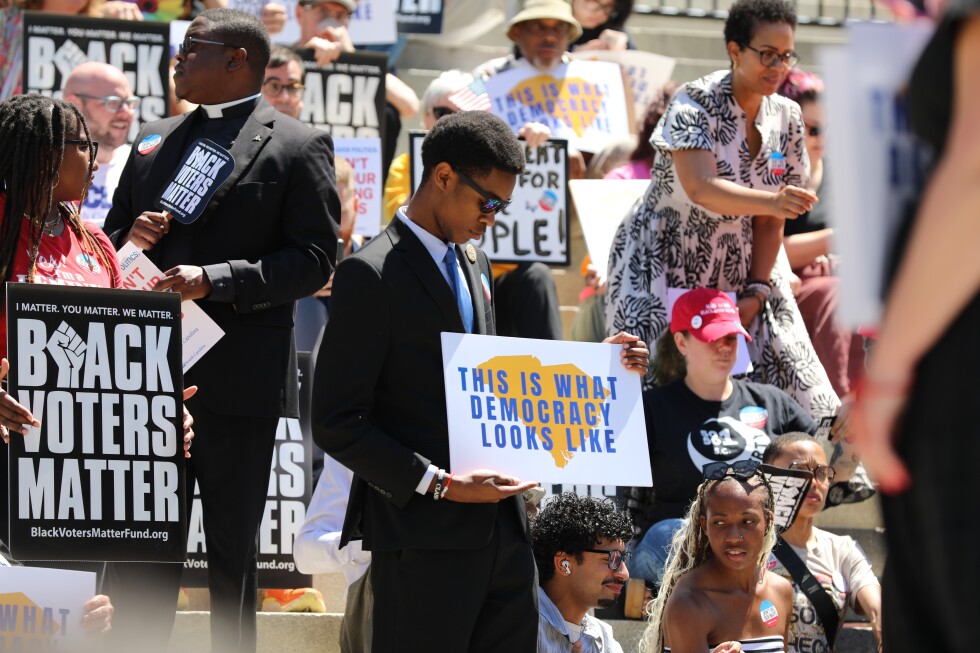
ATLANTA — A new wave of civil rights activism emerges as a coalition of multiracial leaders and activists mobilizes against efforts by a predominantly white conservative alliance to dismantle the Voting Rights Act (VRA) and alter political districts, affecting the ability of Black and nonwhite voters to elect leaders.
The NAACP President Derrick Johnson emphasizes the urgency of action. “We have to respond as quickly as possible,” Johnson stated in an interview, expressing concerns about reverting to a “1950s reality.”
The NAACP, with its long history of advocating for Black political rights, joins various groups for a rally in Alabama. The events will honor the Civil Rights Movement’s role in the 1965 Voting Rights Act, with gatherings in Selma and Montgomery.
Recent Supreme Court decisions have weakened the VRA, no longer considering race in drawing congressional and other districts. Civil rights activists see the Alabama events as a starting point for renewed efforts.
Jared Evans of the Louisiana-based Power Coalition for Equity and Justice highlights the significance of the VRA, referring to it as the “foundational nucleus of the Civil Rights Movement.” He points out recent legal decisions that have eroded its effectiveness.
Georgia Sen. Raphael Warnock, speaking from Atlanta’s Ebenezer Baptist Church, described the current situation as “Jim Crow in new clothes,” emphasizing the need for political, economic, and personal power.
Seeking Legislative Action
Organizers aim to secure more electoral victories and influence policy debates to ensure diverse political representation. U.S. Rep. Terri Sewell advocates for the reintroduction of the John R. Lewis Voting Rights Act, seeking to eliminate partisan gerrymandering and restore federal oversight of election procedures.
The Supreme Court’s ruling in Callais, which denies the necessity of majority nonwhite districts, has sparked concerns about erasing Black political representation.
Redistricting Battles in Southern States
Following the Callais decision, Republican lawmakers in Alabama and Louisiana quickly redrew congressional districts, reducing majority-Black districts. Tennessee also altered its districts, provoking criticism for racial gerrymandering.
Despite opposition from some conservatives, such as South Carolina state Senate Majority Leader Shane Massey, who resisted disenfranchising Black voters, the push for redistricting continues. Activists anticipate further challenges at state and local levels.
Beyond Partisan Politics
While heavily minority districts often align with Democrats, the fight transcends party lines. NAACP leader Johnson warns that the broader agenda includes curtailing various rights and implementing economic policies detrimental to workers.
“It’s not a Black problem,” Johnson asserts. “That’s an American problem.”
Building a Modern Movement
Despite challenges in uniting diverse organizations and voters, the urgency of the situation has sparked increased engagement. The NAACP and allies are contesting new district maps and aiming to boost voter turnout in upcoming elections.
Reflecting on historical precedents, Johnson emphasizes the long-term nature of the struggle, recalling the decade-long fight for school desegregation following the Brown v. Board of Education decision. Despite the absence of a singular leader, he remains hopeful for progress.