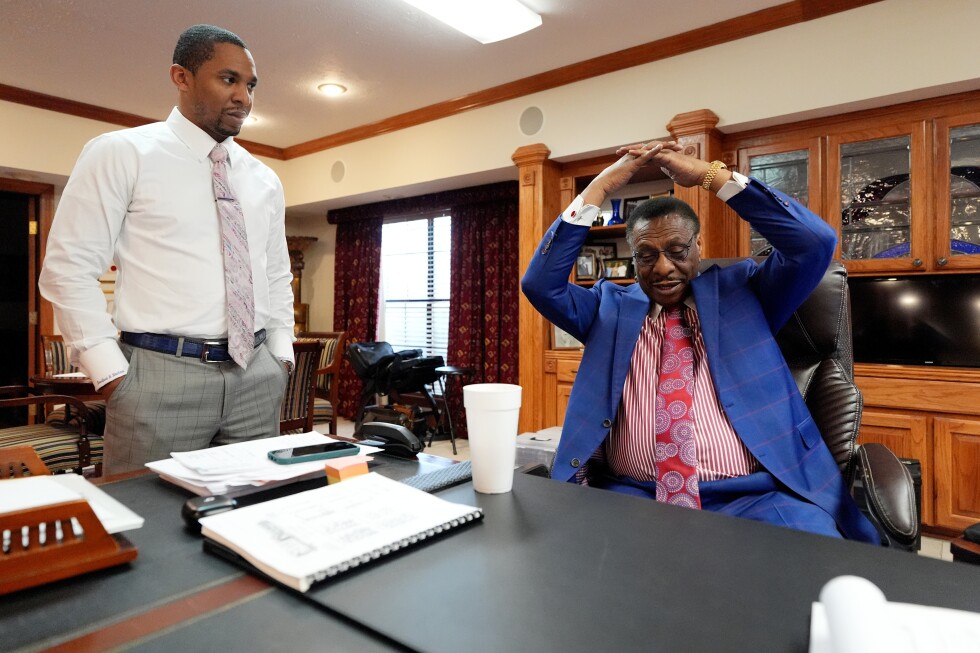
In Mississippi, Edward Blackmon Jr.’s journey towards becoming a civil rights lawyer began at the age of 16 when he was arrested during a protest advocating for voting rights. Along with his classmates, he was transported in a truck previously used for poultry, enduring the sweltering heat before spending three nights in a cramped jail cell without a bed.
This pivotal experience propelled Blackmon to become one of the pioneering Black lawmakers in Mississippi since Reconstruction. He is part of a generation of Black Americans who challenged voting barriers and sought political representation in the South, an area still grappling with the legacy of slavery.
The Voting Rights Act, a significant achievement of this struggle, faced a setback this week when the U.S. Supreme Court ruled against considering racial demographics in congressional district mapping. This decision by the conservative majority of the court could alter political power distribution and hinder minority representation.
While the majority opinion views racism as a bygone issue, critics see the decision as a revival of Jim Crow laws, with one Louisiana politician describing it as “a defibrillator to the heart of Jim Crow.”
Bradford Blackmon, Edward’s son and a state senator in Mississippi, remarked on the importance of political boundaries, stating, “how the political lines are drawn shapes who has a real chance before anyone ever votes.”
Edward Blackmon, now 78, reflects on his life’s work, acknowledging that the struggle for civil rights continues. “It’s just another cycle — an ongoing struggle without a foreseeable ending,” he said.
A legacy at risk
The Supreme Court’s decision on a Louisiana congressional map challenge has left many Black Americans concerned about the Voting Rights Act’s effectiveness. Before its 1965 enactment, Black voters in the Deep South had limited ballot access. The act’s passage enabled over 250,000 Black Americans to vote within a year, and by 2024, nearly 22 million were registered nationwide.
Veterans of the voting rights movement, who marched alongside figures like John Lewis and Martin Luther King Jr., express concern as their hard-won gains appear to be eroding.
Jonathan Jackson, an Illinois congressman and son of the late Rev. Jesse Jackson, shared his concerns about a future with fewer protections, calling it “surreal and devastating.”
Charles Mauldin, who was assaulted during the 1965 Bloody Sunday, described the ruling as a continuation of an ongoing battle, stating, “I’m disappointed but not surprised. They’ve been chipping away at the 1965 Voting Rights Act for the last 60 years.”
Who holds power now
In Louisiana, young Black politicians worry that the court’s ruling may not only determine electoral outcomes but also impact candidates’ viability, especially in local races that could lead to higher offices.
Davante Lewis, a Democrat on the state’s utility regulatory board, anticipates district redraws that could jeopardize his and similar candidates’ chances. “They can target my communities … to ensure that I can’t get to an elected office,” Lewis said. Jamie Davis, a Democratic Senate candidate, fears the decision may further discourage already skeptical voters.
In Tennessee, State Rep. Justin Pearson notes the discouragement among those who fought for the Voting Rights Act and foresees a potential resurgence of the civil rights movement.
Advocates of the ruling argue for a race-neutral redistricting approach. However, Mississippi state Rep. Bryant Clark contends that it overlooks the overlap between race and party in the state, calling it “a roundabout way to basically legalize racially discriminatory redistricting.”
Edward Blackmon Jr. emphasized that current district maps allow Black voters to elect candidates in certain areas while maintaining Republican dominance statewide. He noted that incumbents have little motivation to change this balance, as it could lead to more competitive districts.
Fight continues
Edward Blackmon Jr. recalls growing up in Canton during the height of Jim Crow. Black children attended separate schools, and during harvest seasons, they were ushered into trucks for fieldwork.
His father, a World War II veteran, struggled to find stable employment in Mississippi, eventually relocating to New York. Blackmon grew up hearing civil rights discussions among community leaders and was inspired by their commitment.
Federal intervention following the Voting Rights Act’s passage provided Black residents opportunities to register to vote without fear of intimidation. Blackmon and other lawyers utilized the act to challenge discriminatory election systems, resulting in new district maps that better reflected Black communities’ voting power.
Blackmon affirmed the act’s significance, stating, “Without the Voting Rights Act, Mississippi would look so much different than it looks now.”