Mandates for Ten Commandments Displays in U.S. Schools Gain Momentum
Recent court decisions are reinforcing initiatives to require the display of the Ten Commandments in public schools across the United States. This movement is part of a broader effort to increase the presence of religious elements in educational environments, including proposals to make Bible stories part of mandatory reading curricula.
The campaign to install the Ten Commandments in every classroom has seen significant progress in Texas. A U.S. appeals court recently dismissed a challenge to a Texas law mandating the display, marking a notable victory for proponents who argue that such measures do not infringe upon the rights of students or their families, regardless of their faith.
Reactions to the law have been mixed, sparking contentious debates at school board meetings. Some educators have opted to resign rather than comply with the new requirements. Guidance has been issued to teachers on how to address student inquiries regarding the displays.
Southern States Lead the Charge
Republican legislators in Southern states are at the forefront of this initiative. Louisiana was the first to pass such a requirement in 2024, followed by Arkansas and Texas. In Alabama, a new law signed by Republican Governor Kay Ivey mandates the display of the Ten Commandments in classrooms and common areas like cafeterias and libraries for students in grades 5 through 12.
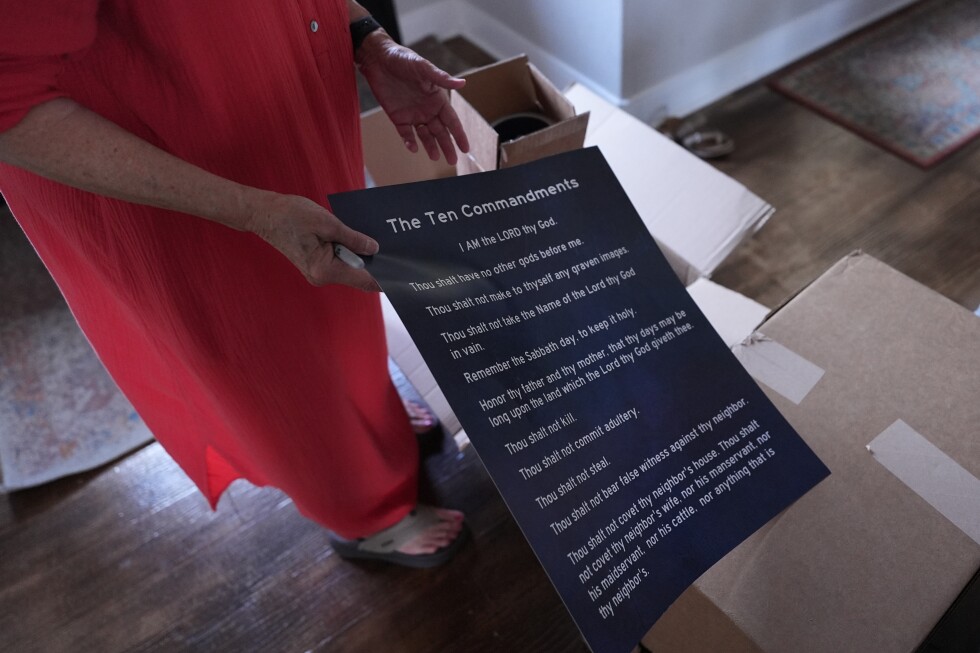
In Texas, the law, enacted by Governor Greg Abbott, requires all public school classrooms to exhibit the Ten Commandments. The law stipulates that districts only need to display them if donated, leading to conservative groups and individuals providing posters to schools as the academic year commenced.
An analysis by the Associated Press, utilizing the bill-tracking software Plural, identified at least 30 legislative measures introduced for current sessions aiming to mandate or allow the display of the Ten Commandments in schools. All these initiatives have been championed by Republican lawmakers, predominantly in states with GOP majorities.
Judicial Rulings Favor Supporters
The 5th U.S. Circuit Court of Appeals in New Orleans overturned a previous ruling that had temporarily prevented several Texas districts from displaying the commandments. The court’s 9-8 decision affirmed that the mandate does not infringe upon the rights of students or parents.
According to the ruling, “No child is made to recite the Commandments, believe them, or affirm their divine origin.” The American Civil Liberties Union (ACLU) and other opposition groups expressed their disappointment, stating, “The First Amendment safeguards the separation of church and state, and the freedom of families to choose how, when, and if to provide their children with religious instruction. This decision tramples those rights.”
In a related case, the same appeals court previously allowed Louisiana to enforce its similar law, with the state’s Attorney General Liz Murrill praising the Texas decision as aligning with their legal arguments.
Broader Religious Education Debates
The Texas mandate represents only one facet of the ongoing debate over religious content in public education. In 2024, Texas approved an optional Bible-focused curriculum for elementary grades, with a proposal to make Bible stories part of the required reading awaiting a vote.
Oklahoma has also seen legal challenges after its former education official mandated the incorporation of Bible content into lesson plans for grades 5 through 12, resulting in a lawsuit. Many schools have opted to ignore this directive.
Last year, the Oklahoma Supreme Court blocked a move to establish the country’s first publicly funded religious charter school, a case currently pending before the U.S. Supreme Court.
Future Developments
The ACLU and other groups that oppose the Texas law have indicated plans to appeal the 5th Circuit’s decision to the U.S. Supreme Court.