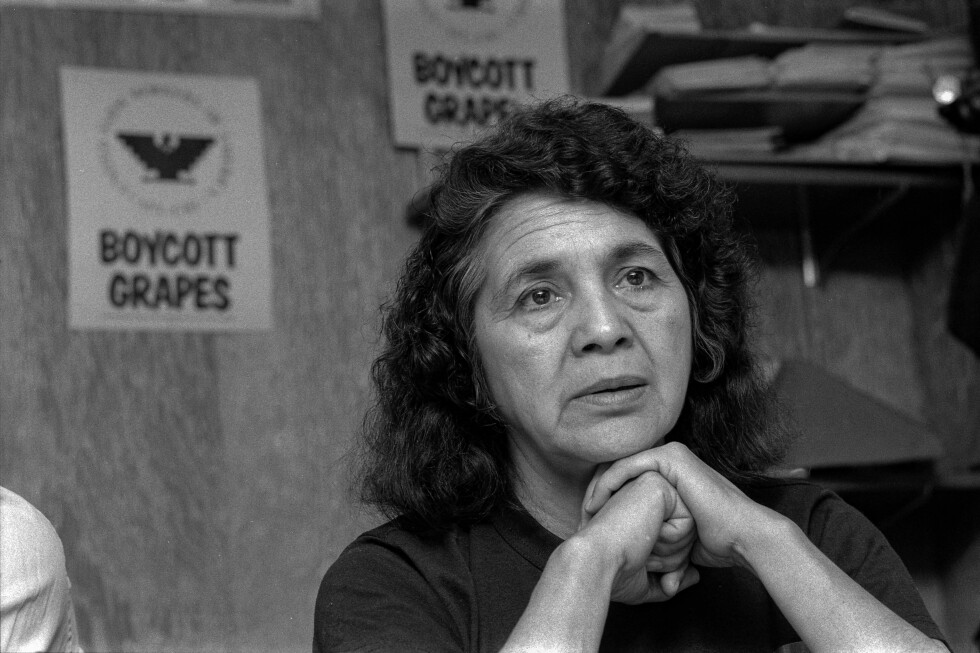
Dolores Huerta, a prominent labor rights advocate, recently disclosed that she and other women were victims of sexual misconduct by César Chavez, the esteemed leader of the United Farm Workers union. Chavez, who passed away over 30 years ago, is celebrated for his role in improving the working conditions and wages of farmworkers in the 1960s. The allegations have sparked immediate demands for changes to memorials dedicated to him, a figure revered by many Democratic leaders in the United States.
Huerta, in her statement on Wednesday, shared that she chose to remain silent for six decades to protect the farmworker movement. She recounted two separate incidents of sexual abuse by Chavez, one involving coercion and the other involving force.
“I carried this secret for as long as I did because building the movement and securing farmworker rights was life’s work. The formation of a union was the only vehicle to accomplish and secure those rights, and I wasn’t going to let César or anyone else get in the way,” she stated.
Huerta, who independently gained recognition for her contributions to labor rights, co-founded the National Farm Workers Association with Chavez in 1962, which evolved into the United Farm Workers of America. Their partnership was likened to that of Martin Luther King Jr. and Rosa Parks due to their collective efforts in promoting civil rights and racial equality.
The New York Times reported on Wednesday that Chavez engaged in grooming and sexual abuse of young girls involved in the movement. Huerta, who was in her 30s at the time, also revealed to the newspaper that she was one of the victims. She further disclosed that both incidents led to pregnancies, which she kept hidden, arranging for the children to be raised by other families. “No one knew the full truth about how they were conceived until just a few weeks ago,” she mentioned in her statement.
Huerta emphasized that she was unaware of other victims of Chavez’s actions, and while she condemned his behavior, she urged that the farmworker movement’s achievements should not be overshadowed by one individual’s misconduct. “César’s actions do not diminish the permanent improvements achieved for farmworkers with the help of thousands of people,” she affirmed. “We must continue to engage and support our community, which needs advocacy and activism now more than ever.”
Chavez’s family expressed devastation over the revelations, offering their sympathies to the survivors and commending their bravery. “We carry our own memories of the person we knew. Someone whose life included work and contributions that matter deeply to many people,” they stated.
Leaders reconsider celebrations honoring Chavez
Chavez’s name is commemorated across streets, schools, and parks in the Southwest. California was the first state to observe his birthday, and in 2014, then-President Barack Obama designated March 31 as national César Chavez Day. When President Joe Biden assumed office, he included a bronze bust of Chavez in the Oval Office. Neither Biden nor Obama has commented on the recent allegations.
Responses were swift from both political parties. Prior to the public announcement, several César Chavez celebrations in San Francisco, Texas, and Arizona were canceled at the request of the César Chavez Foundation. Event organizers did not respond to requests for comment from The Associated Press.
Texas Governor Greg Abbott, a Republican, declared that the state would not observe the César Chavez Day holiday and plans to encourage the Legislature to eliminate it. California Governor Gavin Newsom, processing the news, refrained from committing to changes regarding the state holiday, emphasizing that the movement transcended Chavez. “It’s about labor. It’s about social justice, economic justice, racial justice,” he said.
Arizona Governor Katie Hobbs has decided against recognizing March 31 as César Chavez Day, a reversal from the previous two years. In Arizona, the day is not a state holiday. Meanwhile, Phoenix’s City Council is preparing to vote on renaming the holiday and other locations bearing Chavez’s name. Albuquerque Mayor Tim Keller has initiated a citywide review of Chavez’s recognitions. U.S. Senator Ben Ray Luján of New Mexico stated that Chavez’s name should be removed from public honors.
Chavez, born in Yuma, Arizona, grew up in a Mexican American family that traveled California to work in agricultural fields. He passed away in California in 1993 at the age of 66. Chavez gained national recognition for his early organizing efforts, a hunger strike, a grape boycott, and ultimately securing negotiations with growers for improved farmworker wages and conditions.
The César Chavez Foundation, expressing support for the victims, announced intentions to reevaluate its identity with the Chavez family’s backing. “We are committed to restorative justice and healing for those who have been harmed, and to ensure our organization reflects the dignity and safety every person deserves,” the foundation declared.
Latino civil rights leaders weigh allegations
Latino leaders and community organizations are grappling with the implications of Chavez’s actions on the labor rights movement while underscoring that it was a collective effort of many individuals fighting for justice. The League of United Latin American Citizens condemned all forms of sexual violence, asserting that “no individual, regardless of stature or legacy, is above accountability.” Similarly, Voto Latino leaders emphasized that while Chavez’s actions are indefensible, they do not negate the contributions of others. “The women who organized, marched, and sacrificed alongside farmworkers carried this movement on their backs,” Voto Latino stated.
U.S. Congresswoman Teresa Leger Fernández, chair of the Democratic Women’s Caucus, conveyed her heartbreak and concern for the women who came forward with their stories of abuse. The United Farm Workers union distanced itself from annual celebrations of its founder, describing the allegations as troubling. In a statement, the union encouraged participation in immigration justice events or acts of service, rather than the customary events in March honoring Chavez’s legacy.