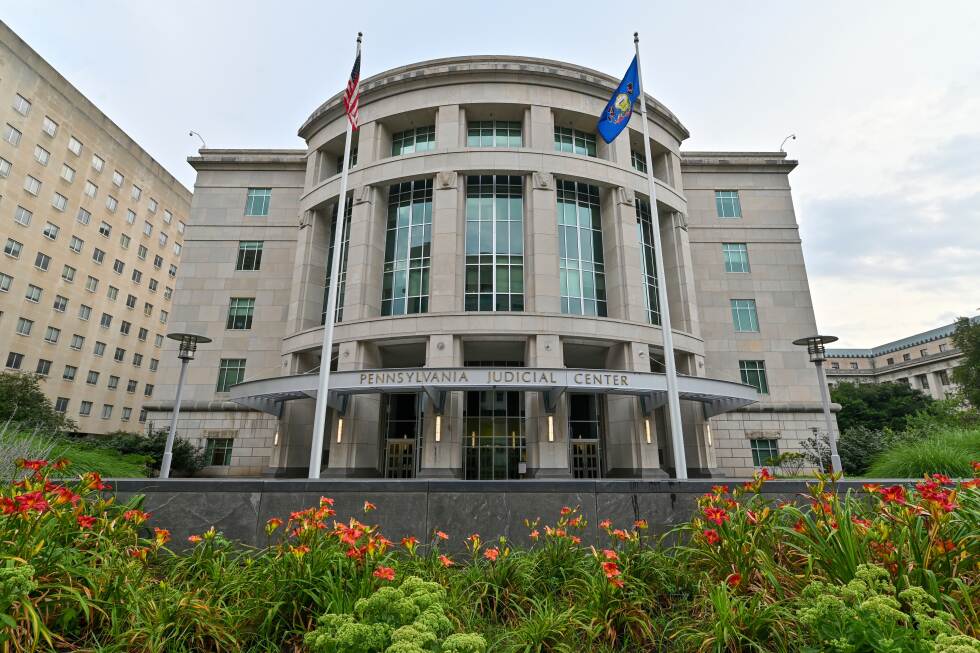
Pennsylvania Supreme Court Reverses Automatic Life Sentences for Second-Degree Murder
The Pennsylvania Supreme Court has ruled against the automatic imposition of life sentences without parole for individuals convicted of second-degree murder. This decision marks a significant shift in the state’s sentencing laws, deeming the previous practice unconstitutional under the state’s prohibition of cruel punishment.
The case in question involved Derek Lee, who was convicted for a 2014 murder in Pittsburgh. The ruling not only impacts Lee, whose sentence will be revisited, but also affects approximately 1,000 other inmates serving similar sentences for second-degree murder.
The court has allowed a four-month period for the Pennsylvania Legislature to explore remedial actions. This stay provides time to address legislative measures, though the court specified that their decision does not extend to “questions of retroactivity.”
Prison reform advocates view this decision as a pivotal development, whereas the Allegheny County District Attorney’s office has expressed its intention to adhere to the court’s directive.
Under current Pennsylvania law, individuals can be held responsible for second-degree murder if they were involved in a felony that resulted in death, with life without parole being the only sentencing option. Chief Justice Debra Todd criticized the lack of distinction in sentencing between those who commit the act of murder and accomplices who may have played lesser roles.
“The mandatory penalty scheme of life without parole for all offenders convicted of second-degree murder fails to assess individual culpability regarding the intent to kill, and mandates the same punishment regardless of that culpability,” Chief Justice Todd wrote.
This ruling follows long-standing efforts to challenge mandatory life-without-parole sentences across the nation. The Sentencing Project’s Nazgol Ghandnoosh noted that while Pennsylvania is one of 11 states with such laws, others like California, Colorado, and Minnesota have revised their approaches.
Justice Kevin Dougherty pointed out the discrepancy between those convicted of first-degree murder — who must have shown intent to kill — and those serving life sentences for second-degree murder, who may not have anticipated a loss of life.
Lee’s legal team, represented by the Abolitionist Law Center, argued for a universal ruling against life sentences without parole for all second-degree murder convictions. However, the court decided that individual circumstances must guide sentencing decisions, allowing for the possibility of life without parole based on factors specific to each case.
State prosecutors maintained that legislative bodies should address policy issues around second-degree murder sentences. They also highlighted the potential impact on victims’ families, emphasizing the high burden of proof required for convicting accomplices.
The Pennsylvania District Attorneys Association noted the four-month delay offers a chance for prosecutors to engage with victims’ families to discuss case-specific implications and address concerns arising from the court’s decision.
The ruling is expected to generate new litigation, with the state’s public defenders’ association preparing to investigate individual cases further and pursue strategic litigation to apply the decision retroactively.
In Lee’s case, a jury convicted him of second-degree murder, while he was acquitted of first-degree murder in the death of Leonard Butler. The incident involved a struggle over a firearm with Lee’s codefendant, Paul Durham.
Justice Sallie Mundy described Lee’s involvement in the crime as deliberate, mentioning his participation in an armed home invasion and his use of force during the incident.
State Representative Tim Briggs expressed intentions to collaborate with Senate Republicans on legislative action, advocating for the decision’s retroactive application to reconsider cases of those serving life sentences for roles like a getaway driver.
Briggs remarked, “I think inaction leaves a lot of this up to the courts to decide.”
Chief Justice Todd’s opinion, referencing an advocacy report, highlighted that 73% of those convicted of felony murder in Pennsylvania were 25 or younger at the time of the crime, with nearly 70% being Black individuals.