US Economic Growth Slows Amid Government Shutdown and Consumer Spending Decline
The economic expansion in the United States experienced a deceleration in the final quarter of the last year, primarily influenced by the federal government’s six-week shutdown and a reduction in consumer expenditure. According to the Commerce Department’s report, the nation’s gross domestic product (GDP), which measures the total output of goods and services, grew at a 1.4% annual rate during this period. This marks a decline from the 4.4% growth seen in the previous quarter and 3.8% in the quarter before that.
Economists suggest that this trend might indicate a more tempered growth trajectory in the near future, as consumers face increased debt and decreased savings in their efforts to sustain spending. Business investment, aside from data centers and AI-related equipment, showed only moderate growth.
Nevertheless, a key indicator of underlying growth, which includes consumer and business spending, remained relatively robust at 2.4%. The government shutdown significantly impacted economic growth, reducing it by a full percentage point.
Consumer and corporate spending maintained a “reasonably solid” pace, as noted by Martha Gimbel, executive director of the Budget Lab at Yale and a former economist in the Biden White House, who commented, “This is not a disastrous report.”
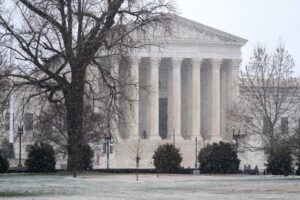
In a related event, the Supreme Court invalidated many tariffs imposed by President Donald Trump, which had slightly increased inflation and potentially discouraged hiring due to higher business costs. President Trump quickly pledged to reintroduce these tariffs under different legislation.
The fourth quarter saw a 2.4% increase in consumer spending, a solid rise but below the third quarter’s 3.5% gain. Federal government spending plummeted nearly 17% due to the shutdown, a decline expected to largely reverse in subsequent quarters.
The heightened growth observed during the summer and fall, where the economy expanded at about a 4% annual rate, was partly due to decreased imports. Companies had previously increased imports to preempt Trump’s tariffs, which initially boosted growth in the second and third quarters before having minimal impact at year’s end.
Diane Swonk, chief economist at KPMG, described the economy as “one-legged,” primarily driven by artificial intelligence, which is supporting business investment and elevating wealth for stockholders benefiting from rising share prices. However, many households have incurred more debt to sustain spending, resulting in a saving rate dropping to 3.6%, the lowest since August 2008 during the Great Recession. “The economy looks golden on paper, but beneath the surface is lead,” Swonk observed.
Prior to the data release, President Trump criticized congressional Democrats for last fall’s government shutdown and reiterated critiques of Federal Reserve Chair Jerome Powell for not reducing interest rates swiftly enough. Trump stated on social media, “The Democrat Shutdown cost the U.S.A. at least two points in GDP… No Shutdowns! Also, LOWER INTEREST RATES. ‘Two Late’ Powell is the WORST!!!”
Separate findings on Friday indicated that inflation, according to the Fed’s preferred measure, accelerated in December, with rising costs of items like furniture, clothes, and groceries, making it less probable for the Fed to reduce interest rates soon.
Earlier predictions by Trump had anticipated a GDP growth exceeding 5% despite the shutdown effects, asserting the economy’s strongest point in history, although new data reveals a slowdown since 2024 following his White House return. This information precedes Trump’s upcoming State of the Union address where he is expected to claim economic prosperity.
The report highlights an unusual economic situation: steady growth without significant job creation. Although the GDP grew by 2.2% in 2025, less than 200,000 jobs were added last year, the lowest since the 2020 pandemic onset.
Several factors contribute to this disparity, including the Trump administration’s immigration policies slowing population growth and reducing available workers, keeping the unemployment rate relatively stable at 4.3% despite minimal hiring. Businesses may also hesitate to hire due to uncertainties over artificial intelligence’s impact on production efficiency and tariff-related profit reductions.
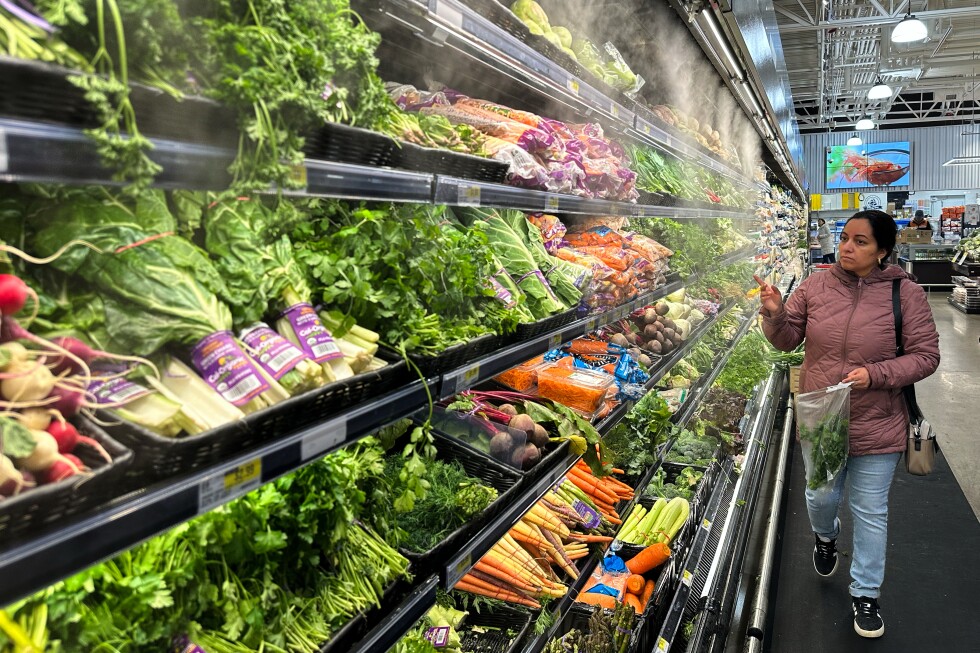
The current economic climate is characterized by solid growth, moderate inflation, and low unemployment, yet consumer sentiment remains pessimistic. In January, consumer confidence fell to its lowest level since 2014, although spending continues to drive growth. This spending pattern, possibly led by affluent consumers, reflects a “K-shaped” economy, with data indicating that even lower-income consumers are increasing their expenditures, albeit at a slower rate.