The longstanding trade tensions between the United States and Canada continue to simmer, despite their deep ties as allies and trading partners. The two countries have shared a complex relationship, often marked by disputes over issues like Canadian softwood lumber imports and U.S. access to Canada’s protected dairy market. Nonetheless, the 5,525-mile border between them remains one of the most open in the world, with nearly 330,000 people and $2 billion in goods crossing daily. Approximately 800,000 Canadians reside in the U.S.
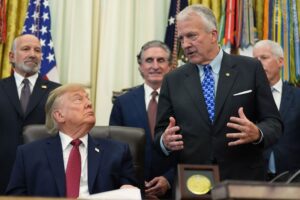
Recently, President Donald Trump has taken a more confrontational stance towards Canada, imposing tariffs on Canadian goods and suggesting that Canada could become the 51st U.S. state. This aggressive approach has strained the traditionally cooperative relationship, leading to public backlash in Canada. A petition demanding the expulsion of U.S. Ambassador Pete Hoekstra, a Trump ally, has gathered nearly 218,000 signatures, accusing him of normalizing Trump’s annexation rhetoric.
Tensions may escalate further if Trump proceeds with a plan to impose 50% tariffs on $20 billion worth of Canadian exports, including products such as hockey sticks and tongue depressors, set to take effect at 12:01 a.m. Wednesday. As the deadline looms, both countries are actively seeking a resolution to avoid these tariffs.
Canadian Prime Minister Mark Carney emphasized the importance of ongoing negotiations, stating, “The negotiations are very intense and delicate. This is not the time to talk about negotiations in public.”
Seeking Resolution
With nearly 72% of Canadian exports destined for the U.S., the stakes are high for Canada. The Trump administration, mindful of the potential economic impact, may hesitate to implement steep tariffs that could raise prices for American consumers ahead of the November midterm elections. Ryan Majerus, a partner at King & Spalding and former U.S. trade official, noted, “I don’t think either side really wants these tariffs to come into effect. There’s a pretty strong push on both sides to find an off ramp here.”
The U.S. seeks to leverage the situation to encourage Canada to purchase more American military equipment, participate in missile defense initiatives, and increase access to critical minerals, reducing reliance on imports from China. Conversely, Canada aims to secure relief from U.S. tariffs on steel and aluminum, alongside softwood lumber.
Trump’s Tariff Strategy
President Trump has made tariffs a central element of his economic policy, imposing import taxes on numerous countries. In a recent move, he applied tariffs of 10% to 12.5% on imports from 59 countries and the European Union, citing insufficient enforcement against imports made from forced labor. To target Canada, Trump invoked Section 338 of the Tariff Act of 1930, imposing 50% tariffs on certain Canadian products.
Section 338, a rarely used provision, allows the president to impose tariffs without investigation or time limits on imports from countries perceived to discriminate against U.S. businesses. Trump cited Canada’s alleged discrimination against American exports like autos, alcohol, and cheese as justification. His actions have sparked retaliatory tariffs from Canada, further straining bilateral relations.
Renegotiating Trade Agreements
The U.S. is currently renegotiating the US-Mexico-Canada Agreement (USMCA), with the threat of Section 338 tariffs serving as leverage for the U.S. to demand concessions from Canada. Christopher Gundermann from the Center for Strategic and International Studies observed, “From Carney’s perspective, you need (USMCA) to be renegotiated. You can’t renegotiate it with a massive trade war going on.”
The Canadian government, mindful of public sentiment, faces pressure to resist U.S. demands without appearing weak or vulnerable. Daniel Béland, a political science professor at McGill University, warned that yielding to U.S. pressure without reciprocal benefits could provoke a strong backlash in Canada.
Canada’s Minister for U.S. Trade, Dominic LeBlanc, met with U.S. Trade Representative Jamieson Greer recently but remained cautious about revealing details. “The work is continuing,” LeBlanc stated. “We continue to do our job.”