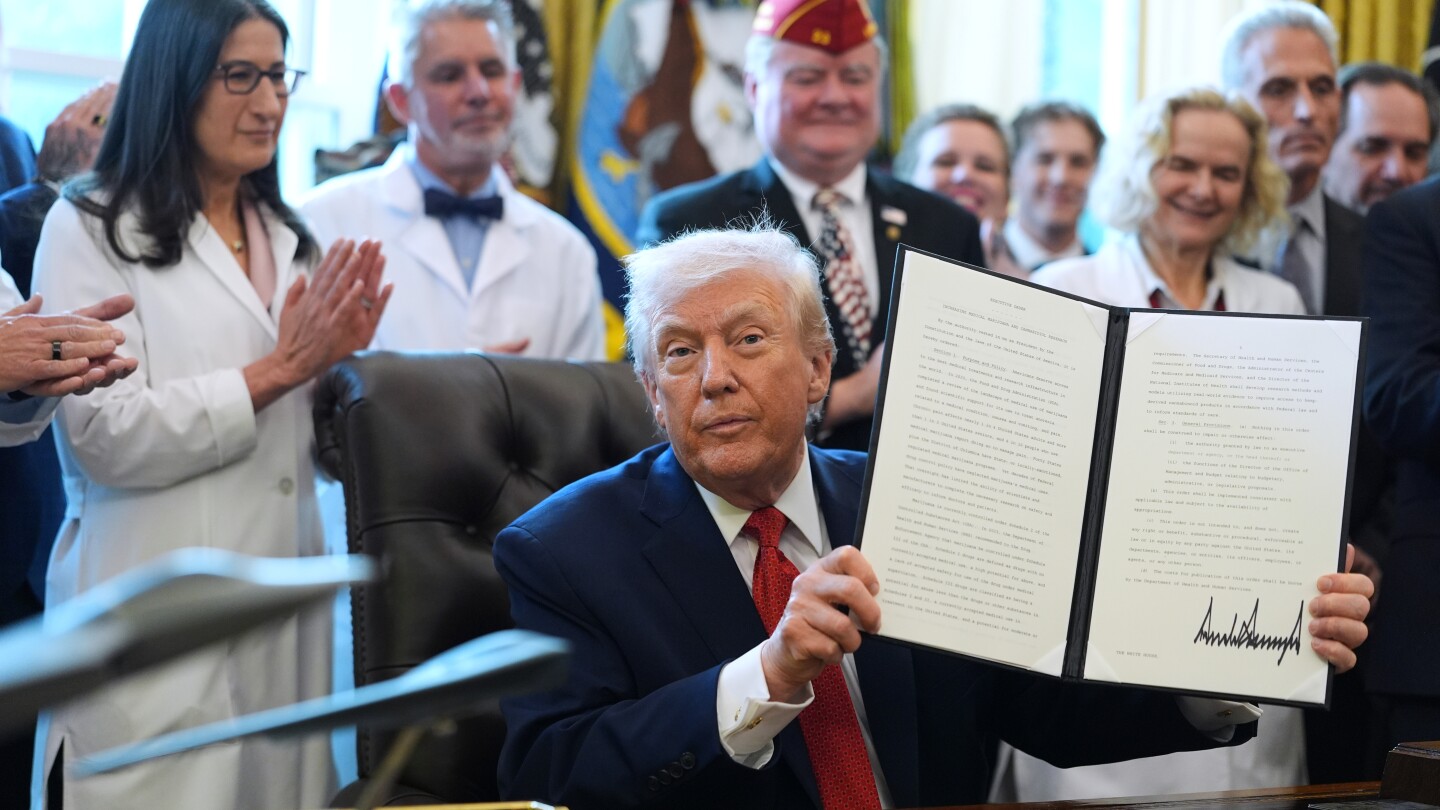
Trump Signs Executive Order to Reclassify Marijuana, Paving Way for Medical Research
WASHINGTON (AP) — In a significant shift in federal drug policy, President Donald Trump has signed an executive order to potentially reclassify marijuana as a less dangerous drug, thereby opening new avenues for medical research. The move aligns more closely with state-level policies that have already taken similar steps.
The proposal would transition marijuana from its current status as a Schedule I drug—grouped with substances such as heroin and LSD—to a Schedule III classification, where it would join drugs like ketamine and certain anabolic steroids.
While this reclassification by the Drug Enforcement Administration (DEA) would not make recreational use legal nationwide, it could alter how marijuana is regulated and potentially alleviate tax burdens on the cannabis industry.
President Trump stated that he had received numerous calls in support of the move, highlighting its potential benefits for patients. “We have people begging for me to do this. People that are in great pain,” he noted.
At present, medical marijuana is permitted in 40 states and Washington, D.C., with several states also allowing recreational use. However, federal laws have remained stricter, leaving individuals vulnerable to prosecution.
Under Trump’s predecessor, Joe Biden, the Justice Department had also proposed reclassifying marijuana to a Schedule III substance. Unlike Biden, Trump faces divided support within his party, with some Republicans opposing any changes and urging the maintenance of current standards.
The reclassification process is typically complex, involving a public comment period that has already drawn significant feedback nationwide. When Trump took office in January, he pushed for the process to proceed as swiftly as legally possible, although a definitive timeline remains unclear.
According to Gallup polling, a majority of Americans favor a less restrictive approach to marijuana. Support for legalization has risen from 36% in 2005 to 64% this year, though Republican support has waned recently.
Trump’s order also emphasizes expanded research and access to CBD, a legal hemp-derived product, whose efficacy in treating pain, anxiety, and sleep issues is debated. A new Medicare pilot program would allow seniors to access CBD at no cost if prescribed by a doctor, according to Dr. Mehmet Oz of the Centers for Medicare and Medicaid Services.
Despite support, over 20 Republican senators, led by North Carolina Sen. Ted Budd, have voiced opposition, arguing that marijuana remains dangerous. Their letter to the president cautioned that rescheduling could “undermine your strong efforts to Make America Great Again.”
The resistance is rooted in concerns over marijuana’s impact on health, road, and workplace safety. The letter also claimed foreign actors, like Communist China, could benefit from the rescheduling.
In the early days of Trump’s administration, the Justice Department showed minimal interest in marijuana rescheduling, a topic that faced strong resistance under Biden’s DEA. Trump has prioritized combating other drugs, notably fentanyl, even authorizing military action against suspected drug transports.
Jack Riley, a former DEA deputy administrator, acknowledged the focus on drug wars as a national security priority but criticized marijuana rescheduling for sending a conflicting message. “He’s blowing up boats in Latin America that he says are full of fentanyl and cocaine but on the other hand loosening the restrictions that will allow wider exposure to a first-level drug,” Riley commented.
Opponents, including the group Smart Approaches to Marijuana, have threatened legal action if rescheduling proceeds. Conversely, some advocates want the government to treat cannabis more like alcohol. Trump has not committed to decriminalizing marijuana but urged his children to avoid drug use.
As reported by the U.S. Department of Health and Human Services, over 30,000 licensed practitioners recommend medical marijuana to more than 6 million patients for at least 15 conditions. The FDA supports its use for treating anorexia-related conditions, nausea, vomiting, and pain, with chronic pain being a common ailment among older adults.