WASHINGTON (AP) — President Donald Trump has enacted a new executive order aimed at altering childhood vaccine protocols based on his belief that vaccines should be spaced over separate medical visits, a theory that has been widely discredited.
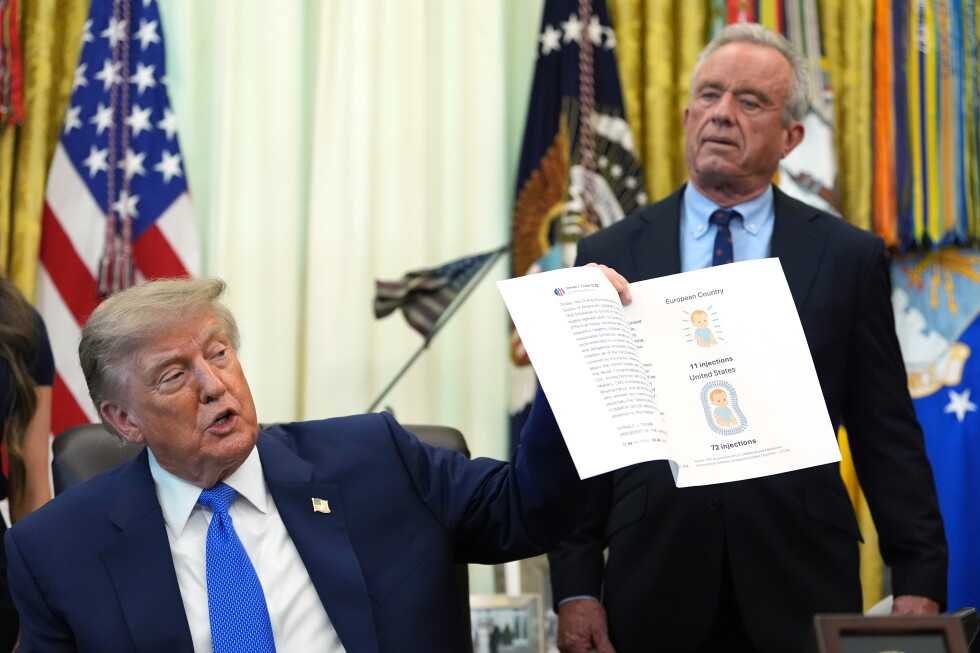
The directive proposes that the measles, mumps, and rubella (MMR) vaccine be divided into individual shots for each disease, with all childhood vaccinations scheduled at separate appointments when feasible. It also instructs the Department of Health and Human Services to enhance vaccine research, despite vaccines already undergoing extensive studies, and to devise a plan to provide separate measles, mumps, and rubella vaccines for children, a choice currently unavailable in the U.S.
This focus on vaccines signifies a shift from the Trump administration’s recent push towards less contentious health policies, such as promoting healthy eating and addressing drug pricing and medical fraud, in the lead-up to the midterm elections in November.
Health specialists express concern that prolonged intervals between vaccinations, as recommended by Trump, may heighten the risk of children contracting preventable diseases before completing their immunization schedule. Vaccines undergo comprehensive studies to ensure safe combinations and are monitored for safety over time.
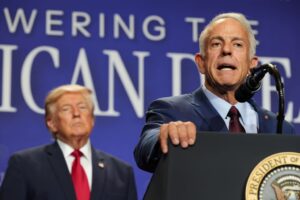
Trump hailed the order as a significant win for “parents rights, religious and constitutional rights, and for the gold standard science.”
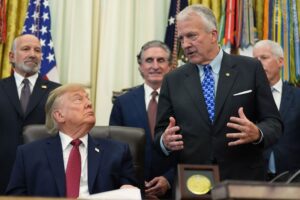
During a discussion in the Oval Office, Trump insinuated that vaccine schedules might influence autism rates, a claim that contradicts scientific consensus and years of research affirming no connection between vaccines and autism. Despite federal judicial blocks on prior attempts to modify the vaccine schedule, a White House official stated that Trump is entitled to issue recommendations via executive order.
Dr. Andrew Racine, head of the American Academy of Pediatrics, criticized the announcement for sowing unnecessary doubt and fear. “Science about vaccines and their efficacy has not changed,” Racine asserted. “The distribution of viruses and other pathogens in our environment has not changed. Children in this country have not changed in the last 48 hours.”
Senator Bill Cassidy, who chairs the Senate health committee, opposed the executive order via social media, affirming the safety of vaccines and their lack of connection to autism. “I’m a doctor. This executive order is wrong,” the Louisiana senator tweeted. “The President does not have the expertise to make these changes.”
Authority over Vaccine Policy
Although the order suggests revised vaccine guidelines, the power to mandate vaccinations for schoolchildren resides with states, not the federal government. The order encourages states with vaccine laws to update their statutes to align with the administration’s proposed schedule.
In December, Trump directed a review of international vaccine protocols by the Department of Health and Human Services, which responded by suggesting a reduction in the number of recommended vaccines for children. This proposal is currently stalled by a court ruling.
Typically, any changes to federal vaccine guidelines require the Centers for Disease Control and Prevention director’s approval. The newly appointed CDC director, Dr. Erica Schwartz, previously led vaccination policy for the U.S. Coast Guard.
Lawrence Gostin, a public health law expert at Georgetown University, noted that the Supreme Court’s interpretation might empower Trump to bypass Schwartz if she disagrees with the new recommendations.
In discussions with reporters, a White House representative did not cite specific studies supporting the decision to separate the MMR vaccine but mentioned that some countries offer single measles vaccines under certain conditions.
Trump spokesperson Kush Desai stated that the president is one of many parents concerned about the combined MMR vaccine and argued that offering single-disease vaccines would provide parents with more choices, potentially boosting vaccine compliance.
Research has indicated that using combination shots for childhood vaccines, as opposed to single vaccines, increases the probability of children receiving all recommended vaccinations by age two.
Previous Vaccine Policy Actions
Health Secretary Robert F. Kennedy Jr., an anti-vaccine activist before taking office, initiated a review of immunization policies early in Trump’s presidency. He replaced a 17-member vaccine advisory committee with members who issued more restrictive recommendations, halted by a federal judge. Kennedy also attempted to change the CDC’s stance on the autism-vaccine link without new supporting evidence.
Trump has continuously linked vaccines to autism, despite overwhelming evidence against such a connection. He has pressed Kennedy to identify autism’s cause, a commitment Kennedy made with new research last year. At a recent Cabinet meeting, Trump asked Kennedy for updates on autism research.
“How are you doing on the autism research?” Trump inquired.
“We will have an answer for you,” Kennedy replied.
Scientific studies involving over 5 million children across various countries consistently find no link between childhood vaccines and autism. “I’m not sure that there is anything that has been as thoroughly looked at as this question,” Dr. Racine emphasized, adding that the answer remains a definitive no.
The order comes as schools reopen nationwide amid a measles outbreak that threatens the U.S.’s measles elimination status. Medical professionals are concerned that misinformation about vaccines could fuel vaccine hesitancy, with federal data indicating a decline in kindergarten vaccination rates and a rise in exemptions to record levels in the 2024-25 school year.