Trump Seeks Supreme Court’s Protection Against Prosecution
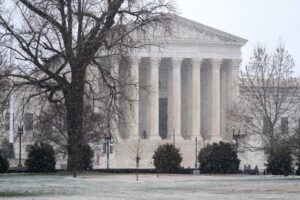
Former President Donald Trump is relying on the conservative-leaning Supreme Court, a body that includes three justices he appointed, to rule in his favor for immunity from criminal prosecution. The court is scheduled to deliberate on Thursday regarding Trump’s appeal to avoid federal charges brought by special counsel Jack Smith. These charges relate to Trump’s actions following his loss in the 2020 presidential election.
While Trump continues to face legal challenges related to both his 2016 and 2020 presidential campaigns, he utilizes this ongoing courtroom attention to bolster his narrative of being a political martyr. On Truth Social, Trump has accused President Joe Biden of “weaponizing the DOJ against his Political Opponent, ME.”
Debates Surrounding the Role of the Supreme Court
The Supreme Court remains a focal point of national discussion, particularly due to its controversial decisions that have affected constitutional abortion rights and bolstered 2nd Amendment protections. Recently, justices have faced scrutiny over their conduct off the bench and transparency concerning conflicts of interest. Justice Clarence Thomas, in particular, has been under pressure to recuse himself from cases linked to Trump due to his wife’s connections with Trump affiliates.
Trump’s impact on the federal judiciary extends through his appointments, namely Justices Neil Gorsuch, Brett Kavanaugh, and Amy Coney Barrett. These appointments were pivotal in the court’s June 2022 decision in Dobbs v. Jackson Women’s Health Organization, which overturned the constitutional right to abortion.
The Argument Over Executive Immunity
A central issue is whether a former president can claim immunity from criminal prosecution for actions taken while in office. Lower courts have dismissed Trump’s assertion of immunity, stating that such protection ended when he exited the presidency.
Although Trump is not physically present in the Supreme Court, his influence is unmistakable. His social media remarks about the justices during his presidency fostered division and tension within the court. In 2020, Chief Justice John Roberts urged justices to present a unified front in disputes concerning Trump’s efforts to conceal his financial records from Manhattan prosecutors and congressional committees.
Trump’s legal representatives argue that removing absolute immunity could subject a president to “de facto blackmail and extortion while in office, and condemn (a president) to years of post-office trauma at the hands of political opponents.” However, Smith counters by noting that previous presidents have accepted the possibility of criminal accountability for actions taken while in office.
Supreme Court’s Pivotal Rulings
The Supreme Court’s 2023-24 session is expected to be significant, addressing issues related to abortion pills, gun control, and federal regulatory authority. Trump’s insistence on a novel interpretation of absolute presidential immunity from criminal trial adds complexity to these proceedings.
Smith maintains that legal precedent concerning the separation of powers permits the criminal prosecution of former presidents for their official actions. He argues that a president’s constitutional obligation to “take care that the laws be faithfully executed” does not imply a right to violate those laws.
Trump’s legal team insists that the judiciary cannot evaluate a president’s official acts, either prior to or after leaving office. “From Marbury through Fitzgerald, and beyond, this Court has consistently held that (federal) courts cannot sit in judgment directly over the President’s official acts, whether before or after he leaves office,” they wrote.