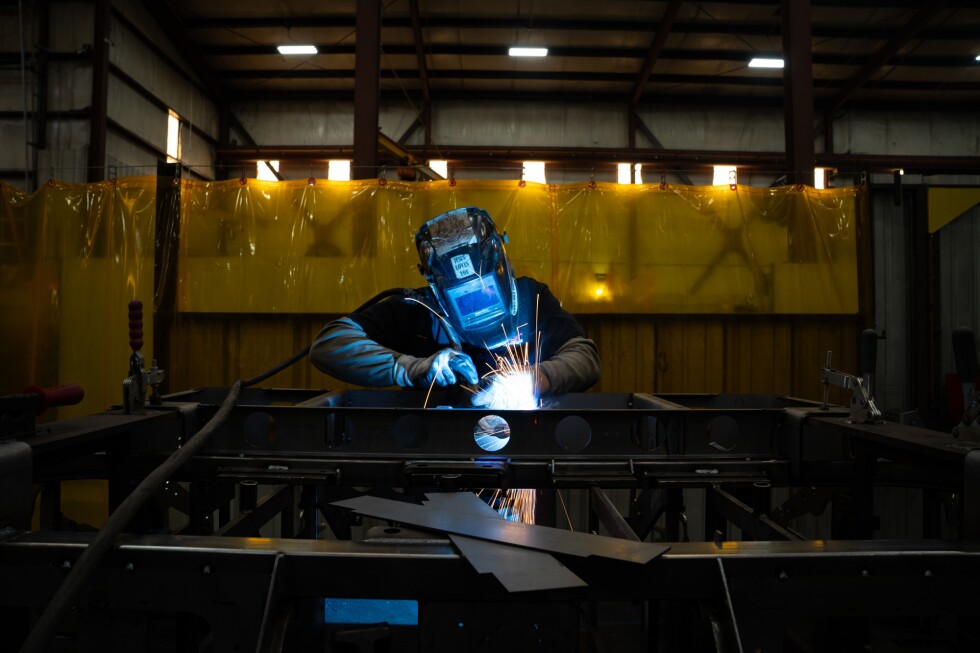
WASHINGTON (AP) — Jay Allen, who supports President Donald Trump, initially backed him for his tax-cutting and deregulation promises, hoping these policies would benefit his manufacturing firm in northeast Arkansas.
Allen Engineering Corp., which produces industrial machinery for concrete work, has been adversely affected by the tariffs central to Trump’s economic strategy. These import duties have significantly increased the cost of crucial components like engines and steel, pushing up the prices of Allen’s power trowels, which can reach up to $100,000.
Contrary to Trump’s assertions that tariffs would boost U.S. manufacturing, Allen’s company is experiencing the opposite effect. The situation may worsen as the administration attempts to design new tariffs following the Supreme Court’s decision deeming the current emergency tariffs illegal.
Allen reported that his company operated at a loss in 2025 due to these tariffs, reducing his workforce from 205 to 140 employees. Price hikes of 8% to 10% have been necessary to cope, though they could negatively impact sales.
“What’s really sad is the unintended consequences of his tariffs are hurting manufacturing in our country,” Allen stated. “Unfortunately, the working-class people are getting squeezed.”
Manufacturing jobs decrease in Trump’s first year back
Trump’s justification for tariffs is that they would lead to more factories in the U.S. and help reduce the federal budget deficit. However, this has not yet been realized.
Manufacturing jobs have seen a decline, with 98,000 jobs lost in Trump’s first year back in office. Companies are pursuing over $130 billion in tariff refunds from the administration, while the federal deficit is expected to increase over the coming decade.
Despite this, the White House claims that construction spending is high, more factory workers are being hired, and investments are being made, which could eventually lead to a resurgence in manufacturing.
“It takes time to get production online, and therefore it will be some more time before we fully materialize the benefits of the president’s policies,” Pierre Yared, acting chairman of the White House Council of Economic Advisers, explained in an email.
Biden’s bill influences construction growth
The construction growth cited by the White House is largely attributed to initiatives from Joe Biden’s administration.
Anticipation of support from Biden’s CHIPS and Science Act in 2022 spurred factory construction, driven by subsidies for chip manufacturing plants. This led to a significant rise in manufacturing construction spending, according to Skanda Amarnath of Employ America.
Though factory construction has slowed under Trump, it remains elevated due to ongoing Biden-era projects in states like Arizona, Texas, and Idaho.
Interviews conducted by regional Federal Reserve banks reveal that while some businesses may expand using Trump’s tax incentives, there is no significant manufacturing boom resulting from his tariffs.
“You don’t get the sense that there is this new manufacturing renaissance under way,” Amarnath commented.
Investment challenges due to tariff uncertainty
Trump has enacted over 50 tariff-related actions, not counting his frequent tariff threats. This has created uncertainty, complicating long-term planning for smaller manufacturers.
Allen Engineering, for instance, imports engines from Germany, and shifting production to the U.S. would require a substantial $20 million investment, a risky move amidst tariff unpredictability.
“Are engine-makers going to spend that kind of money to move production from Germany to the U.S. when they don’t know what the landscape is going to be in three years?” Allen questioned. “I don’t know who is going to be in the White House, and what the stance is going to be on these tariffs.”
Joseph Steinberg, an economist, noted that even in the best-case scenario, it could take a decade for manufacturing jobs to recover to pre-tariff levels. Current conditions, however, are far from ideal due to unsettled U.S. trade policies.
Equipment manufacturers face rising steel costs
According to the Census Bureau, 98% of U.S. manufacturing firms employ fewer than 200 workers, lacking the influence to counteract tariff impacts like larger corporations.
The Association of Equipment Manufacturers reported that the U.S. lags behind China in global manufacturing and has called for tax credits and tariff relief on essential materials unavailable domestically.
Steel tariffs have been a significant issue, with rates increased to 50% in June, unaffected by the Supreme Court’s decision.
While Trump claims these tariffs have benefited U.S. steel mills, companies using steel, like South Carolina’s Calder Brothers, have suffered.
Glen Calder, president of the company, noted, “The steel tariffs were the first thing that got my attention. My steel pricing jumped 25% two weeks before the tariffs went into effect for domestic steel. The market price just jumped. It has stayed elevated.”
China’s trade surplus widens
Trump’s tariff strategy aimed to bolster U.S. competitiveness against China, where he plans to visit for discussions with Xi Jinping.
Instead, the U.S. trade deficit in manufacturing expanded last year, while China’s global trade surplus hit a record $1.2 trillion.
Lori Wallach of the American Economic Liberties Project highlighted a key flaw in Trump’s tariff approach, noting his bypassing of Congress and failure to address World Trade Organization gaps in trade agreements with other nations.
Trump’s reluctance for international cooperation has prevented the formation of a coalition to impose penalties on foreign manufacturers for unfair practices, putting American manufacturers at a disadvantage, Wallach argued.
“The general revulsion of this administration to international cooperation means they’re trying to do it alone,” Wallach explained.