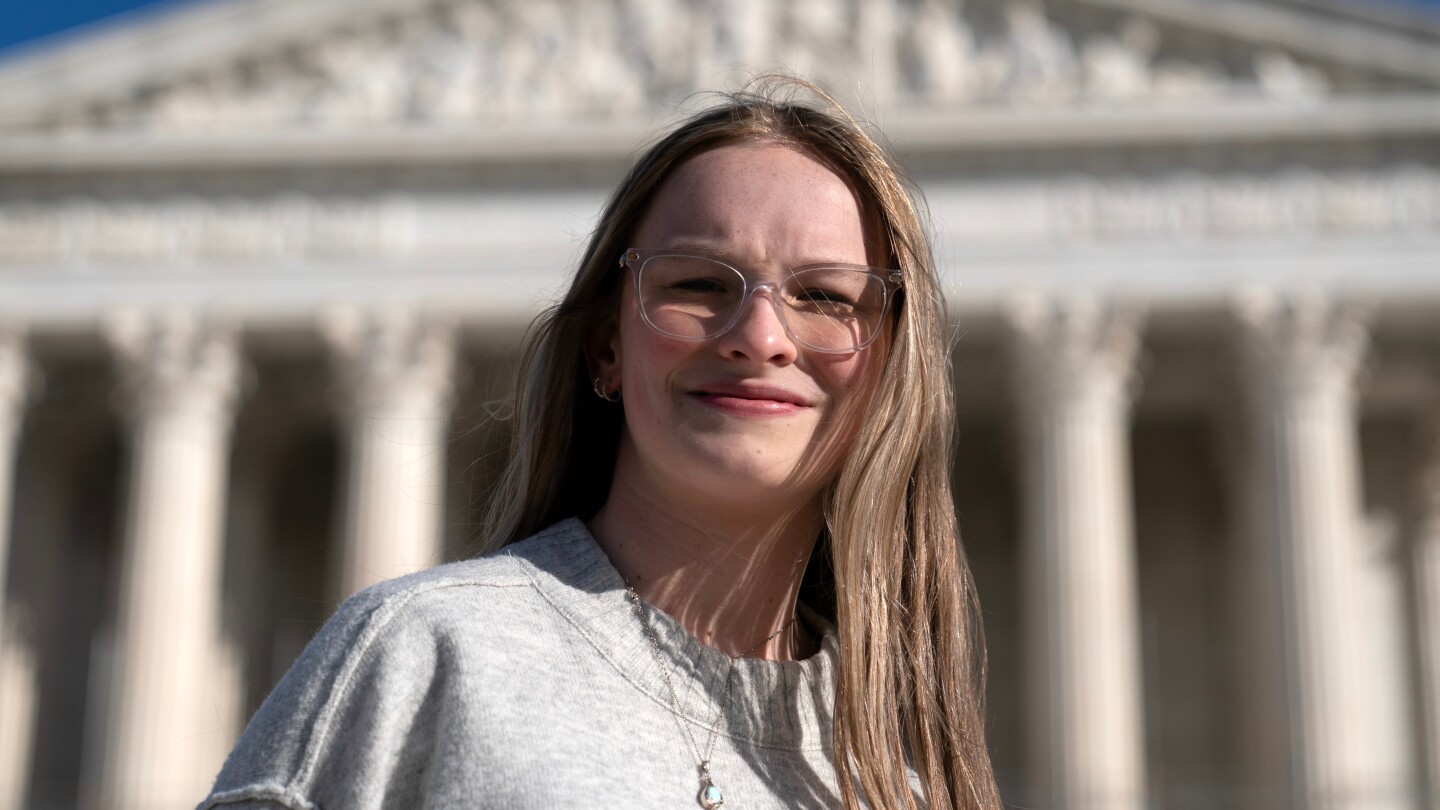
Transgender Athlete Faces Uncertain Future Amid Legal Battles
In West Virginia, 15-year-old sophomore Becky Pepper-Jackson, who made a notable impact by securing third place in the discus throw during her freshman year, faces an uncertain future in her high school athletic career. The state’s law banning transgender girls from participation in girls’ sports has been temporarily halted by lower courts. However, the outcome might shift with the conservative-leaning Supreme Court set to hear arguments soon. Similar legislation exists in over two dozen states.
The Supreme Court will deliberate on whether these bans infringe upon the Constitution or Title IX, the federal law that prohibits sex discrimination in education. A parallel case from Idaho, involving college student Lindsay Hecox, will also be reviewed. Decisions in these cases are anticipated by early summer.
During President Donald Trump’s administration, numerous policies targeting transgender individuals were introduced, including military service restrictions and defining gender as fixed at birth.
Becky Pepper-Jackson’s Role in a Broader Debate
Pepper-Jackson has become a central figure in the national debate over transgender athletes. “I think it’s something that needs to be done,” she shared with the Associated Press. “It’s something I’m here to do because … this is important to me. I know it’s important to other people. So, like, I’m here for it.”
From her home in Bridgeport, West Virginia, she and her mother, Heather Jackson, reflected on the journey that began when Pepper-Jackson was still in middle school. As a dedicated athlete, she has improved her performance significantly, now competing in both the discus and shot put events.
Challenges and Perspectives
Pepper-Jackson’s athletic improvement has been cited as a reason to exclude her from competing against girls. West Virginia’s Attorney General, JB McCuskey, stated, “There are immutable physical and biological characteristic differences between men and women… those differences will erode the ability and the places for women in these sports which we have fought so hard for over the last 50 years.”
Despite only a few transgender athletes in West Virginia, the issue has garnered significant attention. Major organizations like the NCAA and U.S. Olympic and Paralympic Committees have also enacted bans on transgender women in sports following an executive order from Trump.
Public opinion leans towards supporting these bans, with a 2025 poll revealing that approximately 60% of U.S. adults favor such restrictions, while 20% oppose and about 25% remain undecided.
Legal and Social Implications
The Supreme Court’s upcoming decisions could have broader implications for legal battles in states that continue to permit transgender athletes. The court’s recent rulings, including the 2020 decision recognizing workplace discrimination against transgender individuals as sex discrimination, will be pivotal in these cases.
If prohibited from competing, Pepper-Jackson plans to continue her passions in weightlifting and playing the trumpet in school bands. She acknowledges the potential emotional impact, stating, “It will hurt a lot, and I know it will, but that’s what I’ll have to do.”