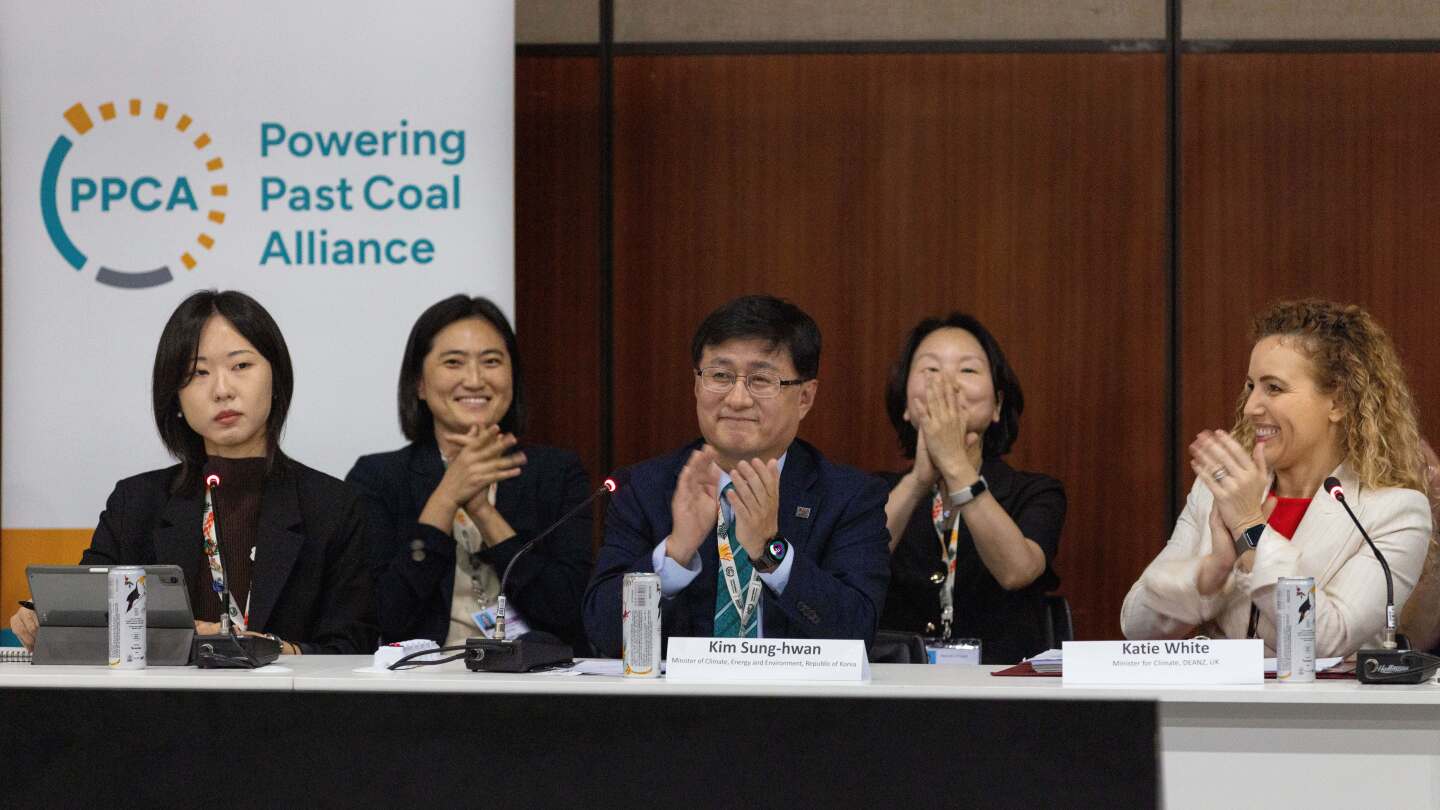
SEOUL, South Korea (AP) — In a bid to combat climate change, South Korea is making strides to reduce its coal dependency. This ambition, however, contrasts with the Trump administration’s push to bolster U.S. natural gas exports.
During recent United Nations climate discussions, South Korea’s newly established Ministry of Climate, Energy and Environment announced an ambitious plan. The country aims to phase out most of its coal-fired power plants by 2040 while slashing carbon emissions by half by 2035.
Specialists note that South Korea, which is a leading coal importer and has one of the largest coal plant fleets globally, is eager to accelerate its shift to renewable energy. This transition, however, is lagging behind its neighbors and global benchmarks.
In a move to cement trade agreements with former President Donald Trump, South Korea is boosting its imports of U.S. liquefied natural gas (LNG). Environmental advocates argue that such plans might challenge South Korea’s climate commitments, potentially anchoring the nation in a fossil fuel-driven future.
Negotiations are in progress for South Korea to invest $350 billion in U.S. infrastructure and purchase up to $100 billion in U.S. energy, including LNG. While LNG emits less than coal, it still contributes to greenhouse gas emissions, notably methane.
South Korea’s total LNG imports might not grow if they balance increased U.S. imports with reductions from other suppliers like Australia and the Middle East.
Yet, as Michelle Kim from the U.S.-based Institute for Energy Economics and Financial Analysis notes, South Korea faces the challenge of harmonizing these seemingly contradictory energy strategies.
Power Transition and Climate Aspirations
South Korea’s liberal President Lee Jae Myung, who was elected in a snap election in June, has been a proponent of stronger climate policies. His stance marks a shift from his conservative predecessor Yoon Suk Yeol, who was removed following a martial law incident.
“As the global temperature rises, we all need to responsibly take climate action and Korea will have a stronger sense of responsibility in tackling the climate crisis,” Kim Sung-hwan, the first Minister of Climate, Energy, and Environment, told The Associated Press.
South Korea’s target to reduce carbon emissions by 53% to 61% of its 2018 levels has been critiqued for not meeting activists’ expectations. Business groups representing large manufacturers had suggested a 48% reduction target.
“This range presents an effort by the government to accommodate two very different ways of thinking about the economic and climate future of the nation,” stated Joojin Kim from the Seoul-based advocacy organization, Solutions for Our Climate.
South Korea’s Climate Challenges with U.S. Trade Deals
Even after Trump’s imposed tariffs, South Korea has pledged to expand its use of clean energy. To avoid increased tariffs, South Korea proposed importing more U.S. LNG, though a final trade agreement is pending.
Speculations based on industry analysis and U.S. federal documents suggest the potential deal could span three to ten years. This could result in South Korea importing between 3 million to 9 million tons of American LNG annually.
According to the International Energy Agency (IEA), LNG comprised nearly one-fifth of South Korea’s total energy supply last year. The government aims to reduce this to 10.6% by 2038.
Insung Lee from Greenpeace in Seoul warns that if the trade deal increases LNG imports, it could jeopardize South Korea’s climate objectives by creating an oversupply and necessitating excess gas burning.
“If we just replace coal plants with LNG, that means the coal exit actually doesn’t lead to a green transition and merely shifts Korea’s addiction from coal to gas, which undermines the whole spirit of climate action,” Lee stated.
South Korea’s Energy Composition
In 2022, renewable energy accounted for 7% of South Korea’s power generation, based on IEA data. Government statistics indicate an increase to 10.5% last year, yet this remains among the lowest for major economies.
Japan, which has a much larger economy, derives 21% of its energy from renewables. Spain, with an economy similar in size to South Korea, generates 42% from renewables.
Globally, clean energy contributed approximately 30% of electricity in 2023.
Nuclear energy remains a significant part of South Korea’s energy mix, with government figures showing it accounted for 31% of total electricity output last year.
“We will transition into a new energy system that focuses on renewables and nuclear, while phasing out coal,” said Kim, the energy minister. He added that LNG will serve as a “complementary or emergency energy source” to address inconsistencies in renewable energy provision.
Earlier this December, South Korea set forth another target to enhance its offshore wind power capacity to 4 gigawatts, a tenfold increase from current levels.
Michelle Kim from IEEFA pointed out that South Korean businesses failing to reduce carbon emissions might face competitive setbacks.
Industries such as shipping and aviation are under pressure to cut emissions, offering incentives for low emitters and creating barriers for high emitters, she commented.
“This is a lot of risk,” she emphasized. “South Korea needs to speed up renewable energy deployment and come out from high dependency on the fossil fuel industry.”
Coal Trade Anticipates South Korea’s Shift
At last month’s climate discussions, South Korea became a member of the Powering Past Coal Alliance, a consortium advocating for the transition to green energy.
Bruce Douglas from the Global Renewables Alliance remarked that this move is largely emblematic but indicates a definitive governmental intent to transition from fossil fuels to clean energy.
South Korea predominantly imports its coal from Australia, Indonesia, and Russia, and its move toward renewables will likely affect regional markets.
The commitment to close 40 of its 61 coal facilities by 2040 could represent a “forced transition” for coal suppliers in the Asia-Pacific, according to James Bowen from Climate Analytics. “It’s a reality that they’re going to have to face this downturn in the market,” he noted.
“The writing’s on the wall,” Bowen added. “One of the biggest importers in the world, one of the biggest customers, is starting to move away from coal.”