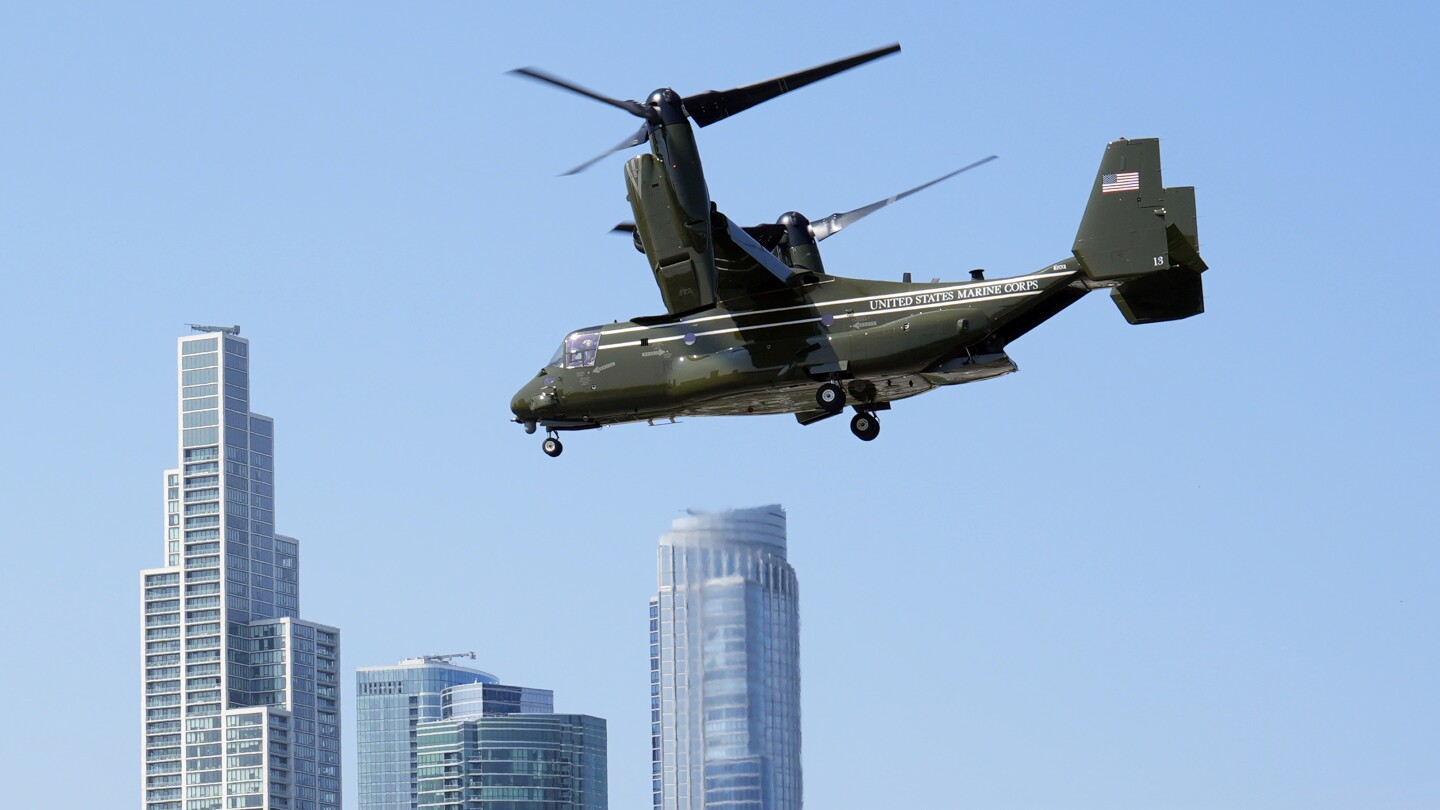
Pentagon Halts V-22 Osprey Flights Amid Safety Concerns
The United States Department of Defense has temporarily suspended flights of its V-22 Osprey fleet. This decision follows concerns over weakened metal components potentially contributing to a recent near-crash incident, marking another challenge for the aircraft already facing safety issues.
Vice Adm. Carl Chebi of Naval Air Systems Command, who oversees the Osprey program, recommended the pause “out of an abundance of caution,” according to spokeswoman Marcia Hart. Consequently, the Marine Corps, Navy, and Air Force have all adhered to this pause, with the Marines stating their suspension began on Friday and will last until at least Monday. The other branches are expected to extend their pauses as investigations continue.
A detailed investigation by The Associated Press has revealed increasing safety concerns over the past five years, including faster-than-expected wear of parts and design issues that contribute to accidents. The Osprey, which operates both as a helicopter and an airplane, has experienced these problems increasingly.
Following these revelations, legislators have urged Defense Secretary Lloyd Austin to ground the Osprey fleet until safety and design issues highlighted by the AP are addressed. The latest incident, which occurred at Cannon Air Force Base in New Mexico on November 20, bore similarities to a previous crash near Japan last year that resulted in the deaths of eight Air Force Special Operations Command members.
In the Japan crash, metal inclusions in critical gears of the Osprey’s transmission caused the gearing to fail mid-flight, leading to a catastrophic aircraft failure. The crew was unaware of the severity of the situation and did not land immediately. The lessons from that fatal incident may have contributed to the survival of the crew in the recent Cannon incident, as they managed to land the aircraft swiftly after receiving similar warnings and losing an engine.
Preliminary examinations suggest that metal weaknesses, though located in a different part than in the Japan incident, may have had a role in the Cannon event. Following recommendations from NAVAIR, Lt. Gen. Michael Conley, AFSOC commander, has ordered a suspension of all Osprey training flights to allow a thorough investigation, as confirmed by command spokeswoman Lt. Col. Becky Heyse.
The metal involved, known as X-53 VIMVAR, was identified in the Japan crash investigation as containing microscopic weak spots due to foreign substances during manufacturing. These weak spots can lead to fatigue cracking, with seven previous cracking incidents likely resulting from the same metal weakness.
Efforts to enhance the metal’s strength have been ongoing between the military and Bell Flight, the company responsible for building the transmission system and assembling the Osprey in Amarillo, Texas. Since the aircraft’s introduction thirty years ago, there have been 64 fatalities and 93 injuries in crashes involving the V-22 Osprey. Japan’s military also briefly grounded its fleet in October after an Osprey incident during takeoff.