Mexico’s Supreme Court Ventures Beyond the Capital to Engage Remote Communities
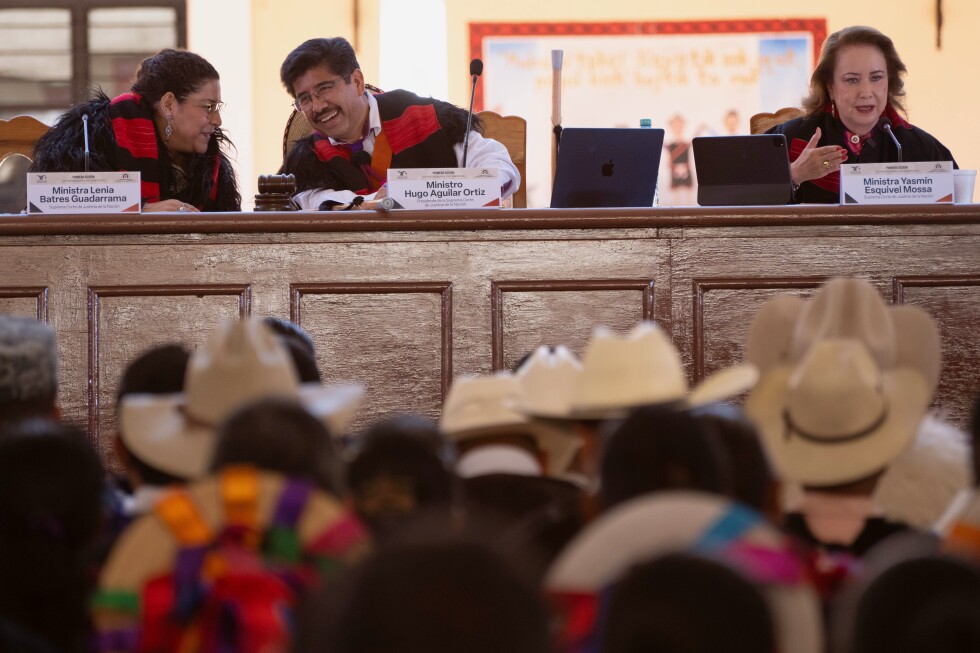
TENEJAPA, Mexico — In a groundbreaking move, Mexico’s Supreme Court convened outside its traditional venue in Mexico City for the first time, opting instead for the picturesque mountain town of Tenejapa in Chiapas. This initiative aims to connect the country’s elite judiciary with remote communities.
Under a large tent in Tenejapa’s central square, around 2,000 attendees gathered to witness the court’s proceedings. This session marks the beginning of a broader plan to extend the court’s reach beyond urban centers.
The court’s current justices were chosen through a popular election last year, a historic first. Leading the court is Hugo Aguilar, an Indigenous lawyer from Oaxaca. Aguilar emphasized the importance of transparency, stating, “Often in our communities we only feel the effects of a decision” made elsewhere. He added that the court’s goal is for the public to observe and understand its decision-making process.
Attendees included Indigenous leaders, authorities, and community members, some holding signs advocating for the “right to self-determination.” Among them was María de la Cruz Velasco, who expressed optimism about Aguilar’s approach: “It makes me happy that this new minister (Aguilar) comes out to the towns, to cities to carry out justice because we really need to listen to the people.” Velasco, who leads a foundation supporting femicide victims, recounted how the Supreme Court intervened in her daughter’s case, ensuring justice was served.
The session also included members from La Candelaria, a community within San Cristobal de las Casas, which has long sought self-governance. Their case has reached the Supreme Court and was part of the discussions.
While court sessions can be challenging for laypeople to follow, the Supreme Court has historically championed human rights from a progressive stance, even if some rulings have yet to be implemented. Velasco shared her experience, noting that local courts initially hesitated to classify her daughter’s murder as femicide, but the Supreme Court recognized the gender-based nature of the crime, resulting in a 55-year prison sentence for the perpetrator.
This Supreme Court, the first to be elected by public vote, was designed to enhance accountability and responsiveness. However, the electoral process faced criticism for potentially politicizing the judiciary, with low voter turnout and a dominance of candidates affiliated with the ruling party. Despite these controversies, the court’s appearance in Tenejapa was met with appreciation from the local populace.