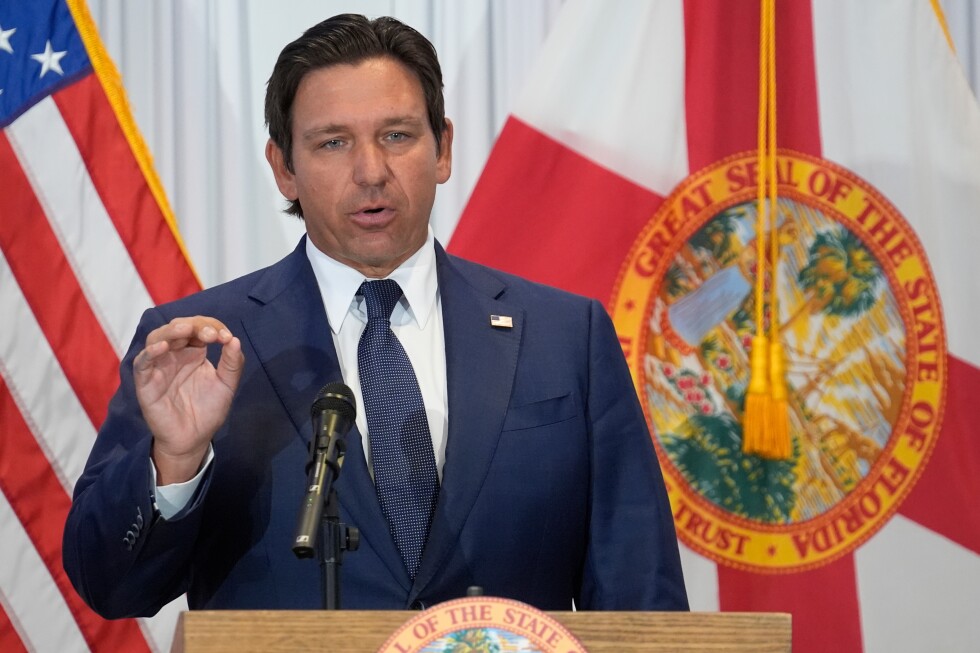
Florida Governor’s Redistricting Move Challenged in Court
In Orlando, a legal challenge has emerged against Florida Governor Ron DeSantis’ recent actions regarding the state’s congressional map. The lawsuit, filed on Thursday, argues that DeSantis lacks the authority to initiate a special legislative session for redistricting mid-decade, as this power resides with the state lawmakers.
Last month, Governor DeSantis issued a proclamation calling for a special session scheduled for April to address the redrawing of Florida’s congressional districts. This move has been described in the lawsuit as a violation of the Florida constitution’s separation of powers doctrine. The lawsuit, backed by the National Redistricting Foundation, was submitted to the Florida Supreme Court.
The governor’s decision to push for new district lines has added Florida to the list of states engaging in what some are calling a “redistricting arms race.” Currently, Republicans hold 20 of Florida’s 28 congressional seats. Reconfiguring these districts in favor of the Republican Party could have significant implications for former President Donald Trump’s broader strategy to influence congressional districting in GOP-dominated states. Such changes could potentially assist Republicans in gaining additional seats in the upcoming midterm elections, thereby helping them maintain control over the narrowly divided U.S. House.
Across the United States, this unconventional mid-decade redistricting effort has so far indicated a potential gain of nine seats for Republicans in states like Texas, Missouri, North Carolina, and Ohio. Conversely, Democrats anticipate winning six additional seats in California and Utah, creating a net benefit of three seats for Republicans. However, the new maps are facing legal challenges in some states, and their influence on the 2026 elections remains uncertain.
In 2010, a significant majority of Florida voters approved an amendment to the state constitution that prohibits gerrymandering, the practice of drawing district lines to unduly favor one political party. Despite this, last July, the Florida Supreme Court upheld a map endorsed by DeSantis that was criticized for potentially violating the “Fair Districts” amendment.
The lawsuit is directed against both Governor DeSantis and Florida Secretary of State Cord Byrd. It challenges a directive from Byrd instructing county elections supervisors to apply rules that are typically used only during years when Florida’s districts are redrawn. The lawsuit demands that DeSantis demonstrate his legal authority to convene a special session for redistricting. Should he fail to do so, the lawsuit seeks to have his proclamation declared unenforceable.
According to the lawsuit, “The decision over whether and when to reapportion Florida’s congressional districts belongs to the Legislature. While the Governor is entitled to call for a special session, he has no power to bind the Legislature into carrying out his preferred policy objectives by undergoing a legally unnecessary reapportionment.”
Governor DeSantis’ office has not yet responded to requests for comment on the matter.
For more updates, follow Mike Schneider on Bluesky: @mikeysid.bsky.social.