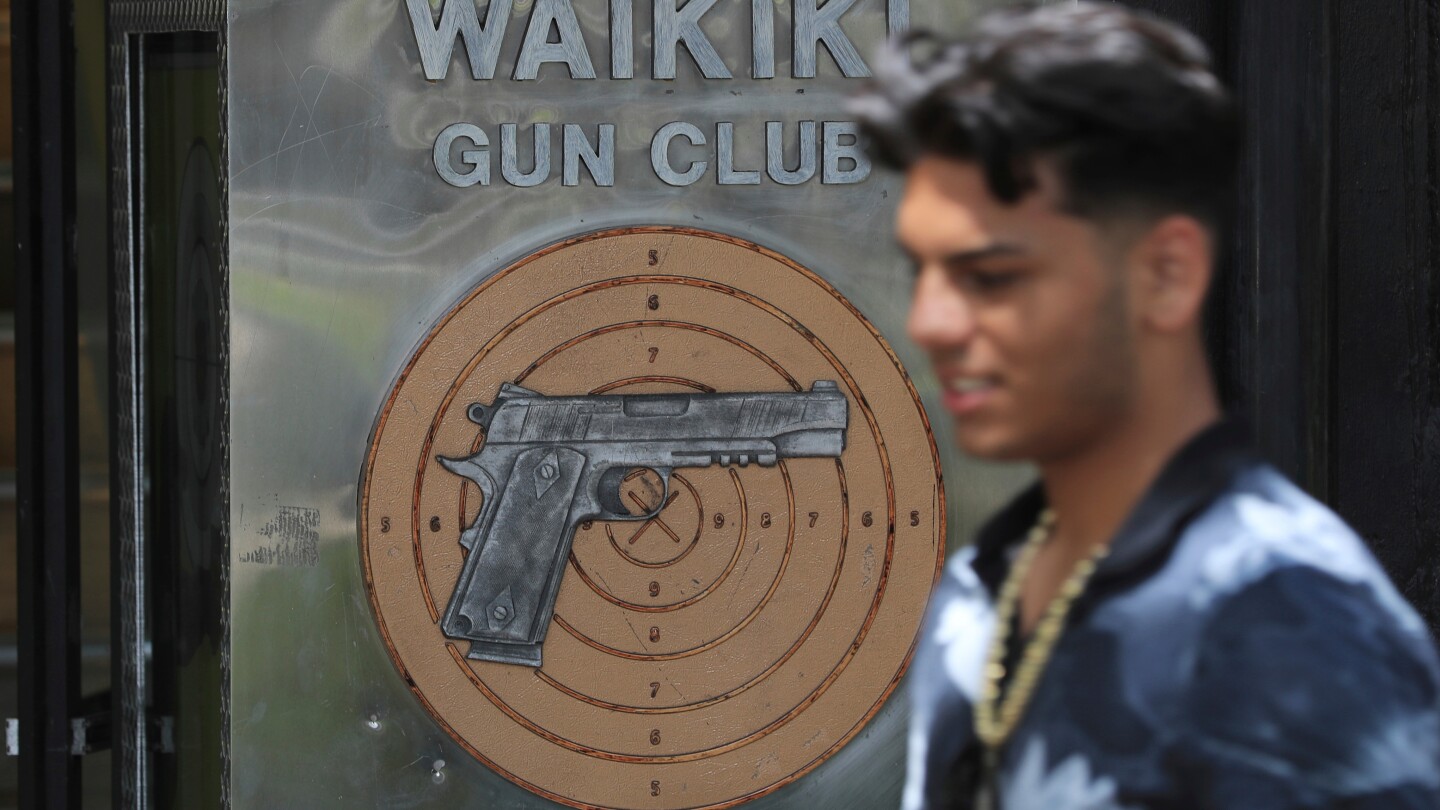
HONOLULU — A pivotal legal debate surrounding Hawaii’s gun control measures, known for their stringency, will be addressed by the U.S. Supreme Court this Tuesday. At the center of the discussion is the state’s restriction on carrying firearms on private properties accessible to the public, such as shops and hotels, without explicit permission from the property owner.
Restrictions in Public and Private Spaces
In 2023, three residents of Maui initiated a lawsuit challenging new regulations that prohibit firearms in locations like beaches, banks, and establishments serving alcohol. The plaintiffs contend that Hawaii’s regulations violate Second Amendment rights, expressing concerns about personal safety at secluded beaches and the reluctance of property owners to display “guns allowed” signage due to potential customer deterrence.
Historically, carrying guns in public was uncommon in Hawaii, primarily due to stringent permit issuance by county police chiefs. However, a 2022 Supreme Court decision expanded gun rights across the nation, prompting Hawaii to revise its laws. Consequently, Democratic Gov. Josh Green enacted legislation permitting more concealed carry permits while restricting specific locations where firearms can be carried.
Supreme Court to Focus on a Single Issue
After a federal judge in Honolulu blocked these restrictions, the state filed an appeal. In 2024, a three-judge appeals court panel overturned much of the judge’s decision, allowing the state to maintain firearm prohibitions at beaches, parks, bars, and on private property without explicit owner consent.
The Supreme Court has agreed to evaluate only the provision that assumes firearms are banned on private property unless explicitly permitted by the owner. Alan Beck, representing the plaintiffs, is preparing for his first Supreme Court argument, highlighting Hawaii’s unique position in the broader national debate. “A lot of times Hawaii doesn’t get to be part of the national conversation … because it’s an insular place off in the Pacific,” Beck remarked.
Balancing Self-Defense and Property Rights
Beck asserts that enforcing this default rule could undermine the Second Amendment’s provision for self-defense. He cited declarations from Maui business owners open to gun carriers but hesitant to post signs due to cultural differences with tourists from Asia and Europe.
Conversely, Chris Marvin, affiliated with Everytown for Gun Safety in Hawaii, supports the restriction, reflecting on common courtesy: “You don’t walk into someone else’s home or a local mom-and-pop shop with a weapon unless you know for a fact that you’re welcome to do so.”
Historical Context and Cultural Traditions
Despite Hawaii’s stringent gun laws, the state reports low rates of gun violence. Beck argues against the misconception that Hawaiians are opposed to firearms, citing a vibrant hunting culture, particularly on the outer islands. The 2022 Supreme Court ruling emphasized the need for firearm regulations to align with historical traditions.
In its briefs, Hawaii references historical restrictions dating back to King Kamehameha III’s era, suggesting a longstanding tradition of strict gun control even before statehood. Billy Clark from Giffords Law Center, supporting Hawaii, stated, “A proper inquiry into historical tradition would consider all of the cultures that have come together to make America.” Beck, however, disagrees, asserting, “The laws of a monarchy that predates the United States is not part of our American tradition of constitutional rights.”