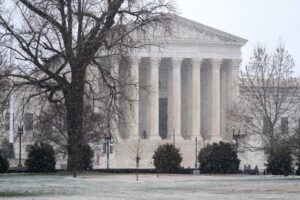
Governments and businesses worldwide are assessing the consequences following the U.S. Supreme Court’s decision to overturn certain sweeping tariffs implemented by the Trump administration, which had significantly impacted global trade.
This development marks the latest in a series of tariff-related changes initiated since President Donald Trump resumed office 13 months ago, disrupting numerous trade relationships with major economies. The decision has prompted reactions from countries such as South Korea and regions in South America.
South Korea’s Trade Ministry convened an urgent meeting to evaluate the ruling’s implications. While exports like automobiles and steel to the U.S. remain unaffected, other goods might be subjected to a new 10% tariff following an executive order signed by Trump. Furthermore, Trump announced plans to increase this tariff to 15%.
In France, President Emmanuel Macron commended the United States’ adherence to the “rule of law,” emphasizing the importance of democratic checks and balances during a visit to a Paris agricultural fair, but advised caution against celebrating prematurely.
Officials are meticulously reviewing recent bilateral and multilateral agreements with the U.S. in anticipation of further changes, as additional 10% global tariffs have been proposed under different regulations.
Impact on Businesses in Mexico and Beyond
Sergio Bermúdez, who leads an industrial parks company in Ciudad Juárez, Mexico, expressed concern over the potential 10% tariff’s impact. Businesses in Juarez, heavily reliant on exporting goods to the U.S., are evaluating how these changes might affect them.
The economic fluctuations in the U.S. over the past year have led to increased caution among global business leaders, affecting investment prospects. Mexico’s Economy Secretary, Marcelo Ebrard, stated that Mexico is monitoring the situation cautiously, with 85% of its exports remaining tariff-free due to the United States-Mexico-Canada Agreement. Ebrard is planning a visit to the U.S. to discuss economic matters next week.
Alan Russell, CEO of Tecma, noted the increased complexity in assisting American businesses to operate in Mexico, as his company’s workload has surged due to evolving import regulations. The ongoing uncertainty remains a significant challenge, he said.
Seeking Tariff Refunds
Some U.S. importers who have potentially overpaid tariffs are exploring avenues for refunds. This process is anticipated to be complicated, and foreign companies might also seek to claim their share.
Bernd Lange, chair of the European Parliament’s trade committee, advocated on Deutschland radio for the reimbursement of excess tariffs, estimating that German companies or their U.S. importers alone have overpaid by over 100 billion euros ($118 billion).
The Swiss technology industry association, Swissmem, praised the Supreme Court’s decision, reporting an 18% drop in exports to the U.S. during the fourth quarter when Switzerland faced higher tariffs than many European neighbors. Swissmem President Martin Hirzel remarked on X that while the ruling is a positive step, it does not resolve all issues.