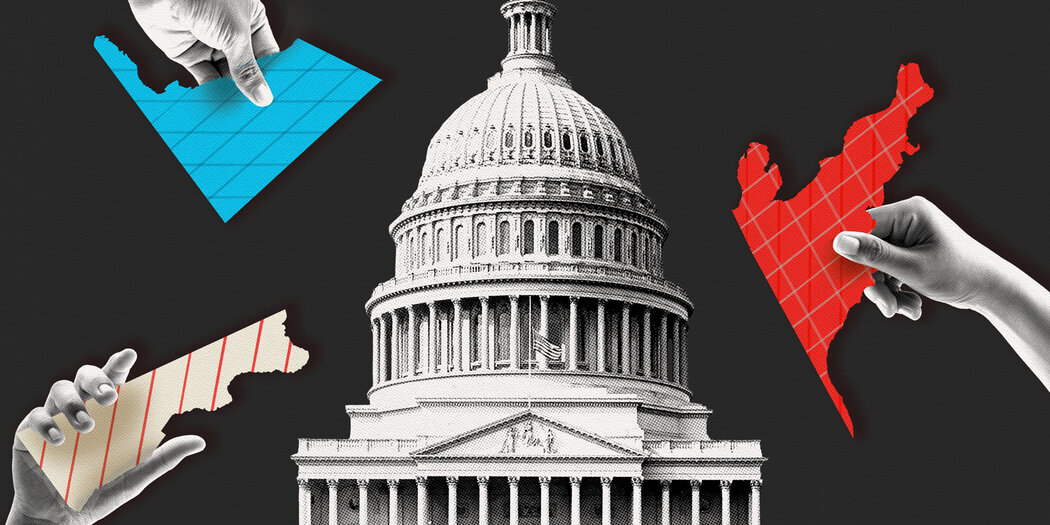
The Battle for House Control: Narrow Playing Fields and the Impact of Gerrymandering
In an election year where control of the House is fiercely contested, only a small fraction of districts are deemed competitive. According to election analysts at the Cook Political Report, just 27 out of 435 districts are considered toss-ups, with 12 currently held by Democrats and 15 by Republicans. Additionally, 16 districts are categorized as leaning Democratic or Republican, highlighting the limited scope of competitive races.
The diminishing number of competitive districts is partially attributed to intentional designs. Historically, around 40% of congressional districts closely followed national presidential vote trends, acting as bellwether districts. Today, though presidential elections remain closely contested, the alignment between district-level and national presidential results has markedly decreased, with over 80% of districts now strongly favoring one party.
In these districts, presidential and congressional candidates often win by significant margins. In the 2020 election, Joe Biden won 167 districts by 15 percentage points or more, while Donald Trump achieved similar results in 149 districts. These figures demonstrate the entrenched partisan divides within the House of Representatives.
The Role of Redistricting and Gerrymandering
The decline in competitive districts is linked to the growing influence of single-party control over the redistricting process. In the upcoming 2024 elections, the majority of the 27 toss-up districts were drawn by commissions, courts, or under divided government control. Notably, 17 of these districts were crafted by non-partisan entities, emphasizing the role of fair map drawing in fostering competition.
Independent commissions, active in states like Arizona, California, Colorado, and Michigan, have been instrumental in maintaining or creating competitive districts. Despite being responsible for only 19% of districts, these commissions have drawn 41% of the toss-up districts for 2024. Meanwhile, states with single-party control over redistricting, especially those dominated by Republicans, have produced fewer competitive districts, potentially due to gerrymandering practices.
In contrast, Democrat-controlled redistricting efforts have resulted in slightly more competitive districts, but a similar trend of reduced competition persists. The South, despite being a politically dynamic region, features only two toss-up districts, reflecting the impact of partisan map drawing.
Implications for Future Elections
Despite the geographical diversity and changing demographics in regions like the South, competitive House races remain scarce due to strategic redistricting. The suburbs of major cities such as Atlanta, Charlotte, Dallas, and Houston, which could serve as battlegrounds, have been predetermined through gerrymandering.
Even if redistricting processes were entirely unbiased, not all districts would be competitive. Factors like geographic sorting and entrenched political identities contribute to the lack of competition in certain areas. However, without significant reforms like the Freedom to Vote Act and the John R. Lewis Voting Rights Advancement Act, the trend of limited competitive districts may persist.
As the political landscape continues to evolve, the path to a House majority increasingly depends on the districts shaped by fairer redistricting practices, independent commissions, and legal frameworks that enforce equitable map drawing.