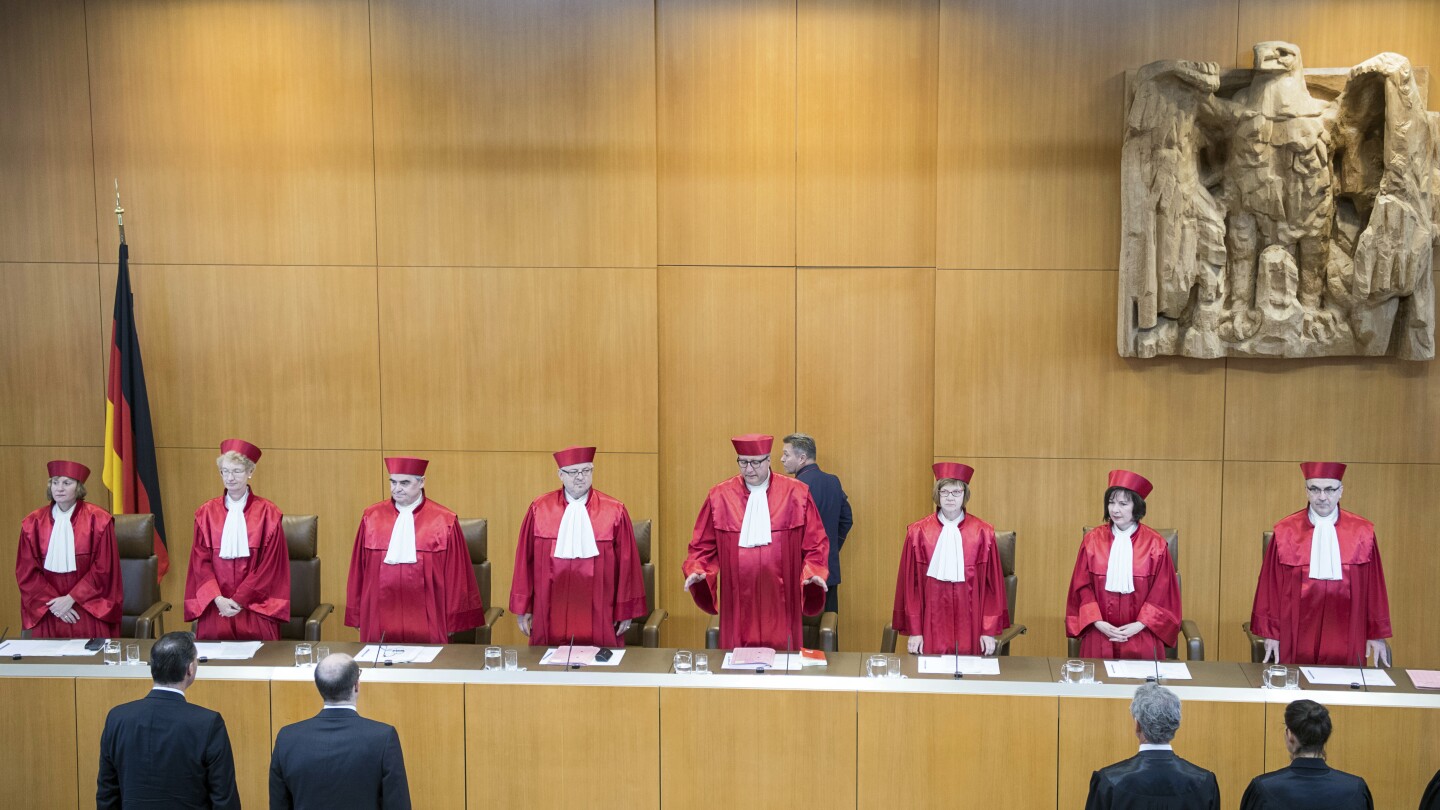
German Lawmakers Pass New Protections for Federal Constitutional Court
BERLIN (AP) — In a decisive move to safeguard Germany’s Federal Constitutional Court from potential political interference, the country’s parliament has ratified legislation aimed at preventing manipulation by authoritarian or extremist entities.
Drawing lessons from political developments in Poland and Hungary, the legislation was crafted collaboratively by Germany’s current governing coalition, which recently disbanded, and the main conservative opposition. The Bundestag, Germany’s lower house of parliament, gave its approval with a substantial majority of 600 votes to 69, as the chamber prepares for an early election in February.
The newly approved measures will enshrine the court’s operational principles within the constitution, necessitating a two-thirds parliamentary majority for any future amendments, as opposed to a simple majority.
Interior Minister Nancy Faeser emphasized the importance of this protection, stating, “We see when we look abroad that, when autocrats come to power, they almost always first turn against the effectiveness and independence of justice.” Although specific countries were not mentioned, proponents have frequently cited Poland’s previous nationalist conservative regime’s efforts to control the Constitutional Tribunal as a significant concern.
Located in Karlsruhe, the Federal Constitutional Court frequently plays a crucial role in adjudicating key policy disputes. It is composed of two panels with eight judges each, who serve a single 12-year term. The reform will constitutionally fix these terms, as well as the age limit of 68 for justices.
The far-right Alternative for Germany party, polling around 20% in recent surveys, has criticized the reform, claiming it allows mainstream parties to secure their influence over the court.
Currently, half of the court’s justices are elected by the Bundestag, while the other half are chosen by the upper house, representing Germany’s 16 states. Political parties propose candidates, who must receive a two-thirds majority vote to be elected, a requirement intended to maintain balance and prevent the appointment of highly divisive figures.
The reform also introduces a mechanism to circumvent “obstructive minorities” that might impede the election of justices. This provision permits either the Bundestag or the upper house to elect judges if the other fails to do so, thereby ensuring the continuity of the court’s functions.