Georgia Supreme Court Questions Validity of West and De la Cruz Votes
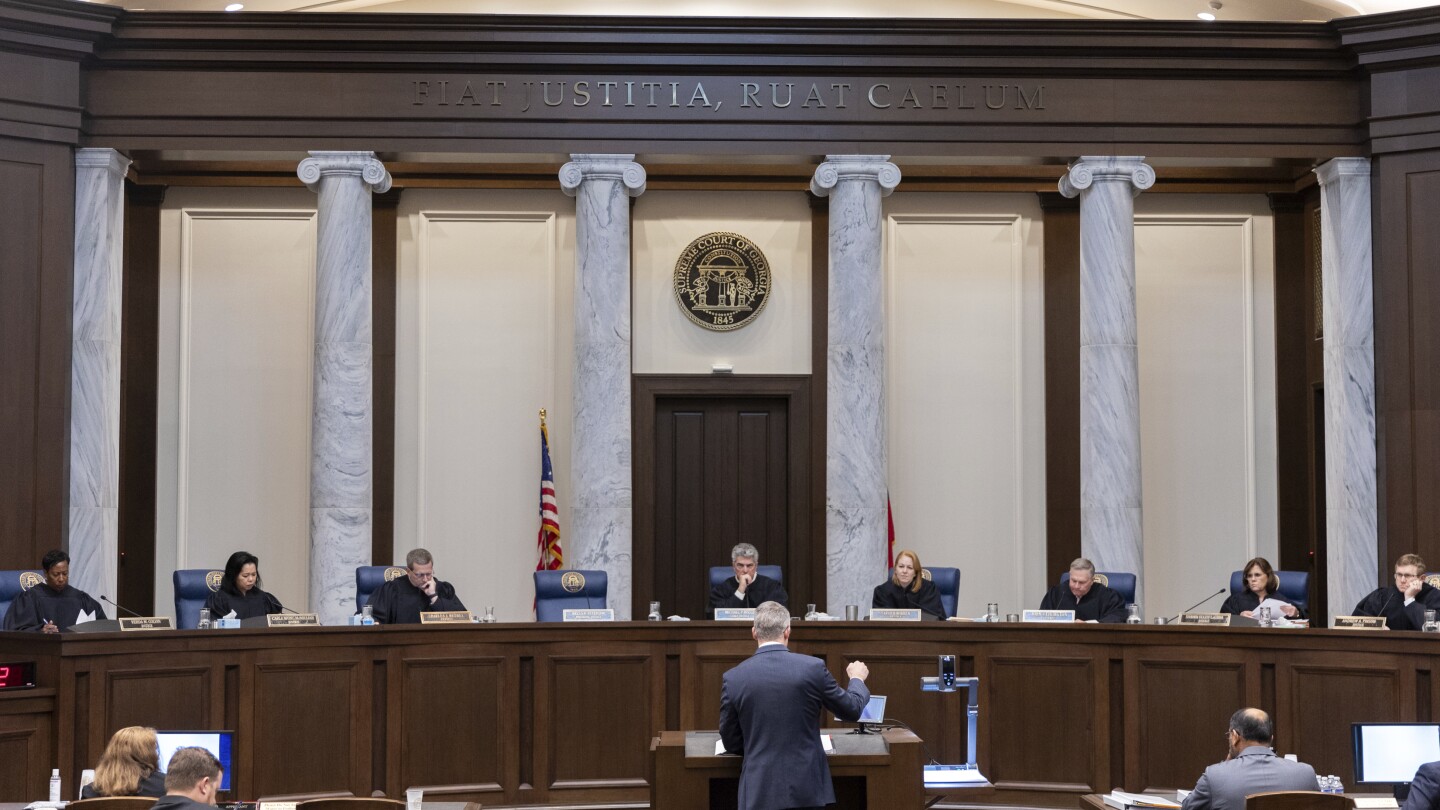
ATLANTA (AP) – During a hearing on Tuesday, Georgia Supreme Court justices expressed doubts about whether votes for presidential candidates Cornel West and Claudia De la Cruz should be counted. This skepticism could lead to their disqualification from the battleground state’s ballots.
Democrats argue that West and De la Cruz did not properly qualify for the ballot because their presidential electors did not submit separate petitions containing 7,500 signatures each. Only one petition per candidate was submitted. De la Cruz is the nominee of the Party for Socialism and Liberation, but both candidates qualified as independents in Georgia.
If the justices rule to disqualify West and De la Cruz, their names would still appear on the ballots, but votes for them would not be counted. Elizabeth Young, a lawyer for Secretary of State Brad Raffensperger, mentioned that it is too late to reprint ballots due to insufficient watermarked security paper and potential issues with reprogramming voting machines.
Young noted that if disqualification is ordered, Raffensperger could issue notices at polling places and with mailed-out ballots indicating that votes for West and De la Cruz would not count, a common practice for late ballot changes in Georgia.
Chief Justice Michael Boggs assured a decision would be made “as soon as possible.”
A disqualification would leave Georgia voters with four presidential options: Kamala Harris for the Democrats, Donald Trump for the Republicans, Chase Oliver for the Libertarians, and Jill Stein for the Green Party. Democrats, Republicans, and Libertarians automatically qualify for elections in Georgia. The presence of four candidates would be the highest since 2000, while six would be the most since 1948.
The legal debate centered on interpreting the relationship between a 2017 federal court ruling that lowered the signature threshold for statewide ballot access to 7,500 and subsequent changes to state election law.
“In this case, the secretary had a decision to make, and it was a difficult one,” Young said regarding Raffensperger’s decision to include West and De la Cruz on the ballot. “The decision he made was sound and is not subject to legal error and wasn’t clearly erroneous.”
However, two lower court judges in Atlanta disagreed in separate decisions, ordering the disqualification of West and De la Cruz. The justices suggested that these judges might have been correct, repeatedly referencing state law provisions that seem to require each elector for an independent candidate to file a separate petition.
Bryan Tyson, a lawyer for West, argued that requiring separate petitions for each elector would undermine the principles that led to the 2017 federal court decision aimed at lowering ballot access barriers. “Ultimately it would require an interpretation of the statute that would say you have to do electors and you have to have way more than 7,500 signatures. And that just can’t be the constitutional answer,” Tyson said after the hearing.
Sachin Varghese, a lawyer for the Democratic Party, contended that the plain wording of the law is “fatal” to Tyson’s argument, stating that the elector is the candidate who must file a petition, not the presidential nominee. “There is simply no way to read the statute and conclude the elector is not a candidate,” Varghese told the justices.
Georgia is one of several states where Democrats have challenged third-party and independent candidates to prevent them from drawing votes away from Harris. This comes after President Joe Biden won Georgia by fewer than 12,000 votes in 2020.
“At the very point when the Democratic Party is trying to say that they’re the only one standing up for democracy against Donald Trump, you see them funding with millions of dollars, backed by their super PACs, attempting to throw third parties off the ballot all across the country,” Estevan Hernandez, the Georgia co-chair of De la Cruz’s campaign, remarked after the hearing.
Republicans in Georgia have aimed to keep all candidates on the ballot and have supported liberal third-party candidates in battleground states.
This situation has led to significant legal activity in Georgia. An administrative law judge initially disqualified West, De la Cruz, Robert F. Kennedy Jr., and the Georgia Green Party from the ballot. Raffensperger overruled the judge, allowing West and De la Cruz to remain on the ballot. He also ruled that Jill Stein should appear on Georgia ballots under a new Georgia law because the national Green Party qualified her in at least 20 other states.
Kennedy withdrew his candidacy in Georgia after suspending his campaign and endorsing Trump, keeping his name off the ballots.