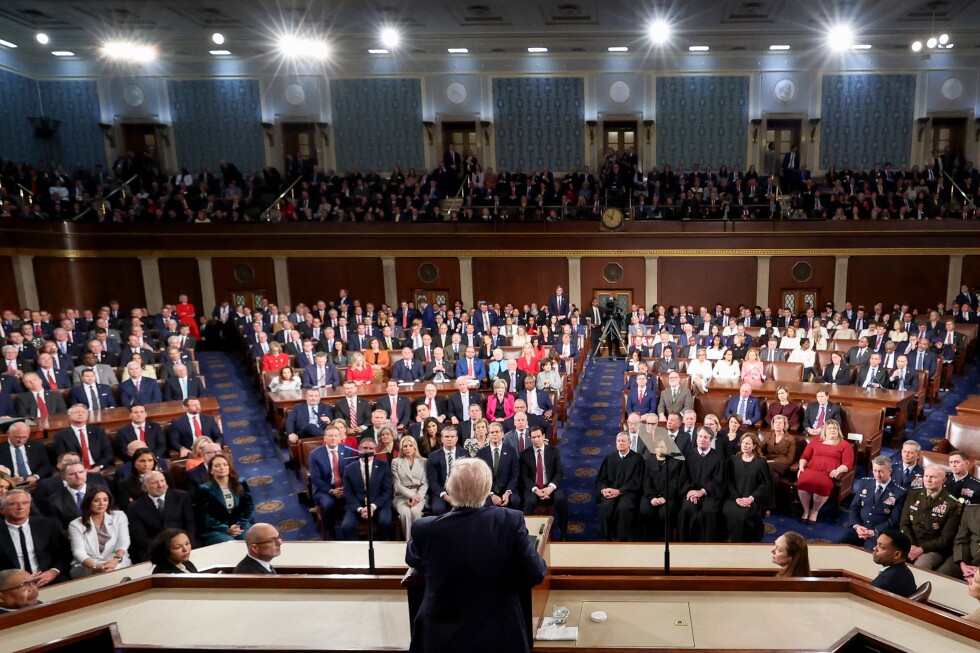
Analysis of President Trump’s State of the Nation Address
President Donald Trump’s recent State of the Nation address drew attention with its bold claims and optimistic portrayal of the country’s status. However, a closer examination reveals significant discrepancies between his statements and the underlying facts.
The Economic Landscape
Trump asserted that he inherited a stagnant economy, yet data indicates otherwise. The U.S. economy expanded by 2.8% in 2024, surpassing the growth rate of 2.2% at the onset of Trump’s second term. Despite Trump’s claims of rapidly rising incomes, inflation-adjusted after-tax incomes grew by a mere 0.9% in 2025, reflecting the slowest increase since 2022 when inflation led to a reduction in real income.
Foreign Investment
The president boasted about securing over $18 trillion in investments from global sources. This figure lacks substantiation, as the White House reports a significantly lower number of $9.6 trillion, which includes commitments from the previous administration. A recent study casts doubt on the feasibility of more than $5 trillion in projected investments from key trading partners.
Employment Figures
Trump’s statement that more Americans are working than ever before is technically accurate. However, it overlooks the critical metric of employment-to-population ratio, which has declined over the past 25 years. The unemployment rate stands at 4.3%, up from 4% when Biden left office, with the lowest rate during Biden’s tenure being 3.4%.
International Conflicts
The president claimed to have ended eight wars in his first ten months. This assertion is an exaggeration. While Trump has played a role in mediating international relations, his impact is often overstated. In several instances, such as the tensions between Serbia and Kosovo or Egypt and Ethiopia, no active warfare existed to resolve.
Tariff Impact
Despite Trump’s imposition of substantial tariffs, these measures have not significantly affected the federal budget deficit. The projected revenue from these tariffs is insufficient to offset the administration’s $4.7 trillion in tax cuts, which largely benefit corporations and high-income individuals. Furthermore, tariffs account for less than 4% of federal revenue, with income and payroll taxes comprising the majority.
Prescription Drug Prices
Trump’s claim of drastically reducing prescription drug prices by over 100% defies logic. While efforts have been made to lower costs, such a reduction would imply negative prices, which is not feasible. Health policy experts, such as Geoffrey Joyce, have dismissed this statement as fictitious.
Crime Statistics
The president highlighted a significant drop in the U.S. murder rate, the lowest in 125 years. Although there was a 21% decrease in homicides from 2024 to 2025, crime rates had already been declining in previous years. The FBI’s upcoming report may confirm a historic low in homicide rates for 2025.
Immigration Policies
While Trump emphasized legal immigration, his administration has implemented measures restricting entry from numerous countries, often citing national security concerns. These policies include a suspension of the refugee program and limitations on immigration from almost 40 countries, primarily in Africa.
Tax Reforms
Trump claimed that his tax reform bill eliminates taxes on tips, overtime, and Social Security. However, not all Social Security beneficiaries benefit from these deductions, and eligibility is contingent on income levels and age, with deductions phasing out for higher-income individuals.
Election Integrity
The president called for the approval of the Save America Act, citing widespread election fraud by noncitizens. However, evidence of such fraud is scarce, with experts affirming its rarity. A review in Michigan found only 15 noncitizens potentially voting in the 2024 election out of over 5.7 million ballots.
Historical Context
Trump’s reference to the ongoing revolution since 1776 overlooks the fact that the American Revolution began in 1775 and concluded in 1783. The declaration of independence in 1776 marked a pivotal moment, but the conflict officially ended years later.
For detailed fact checks, visit AP Fact Checks.