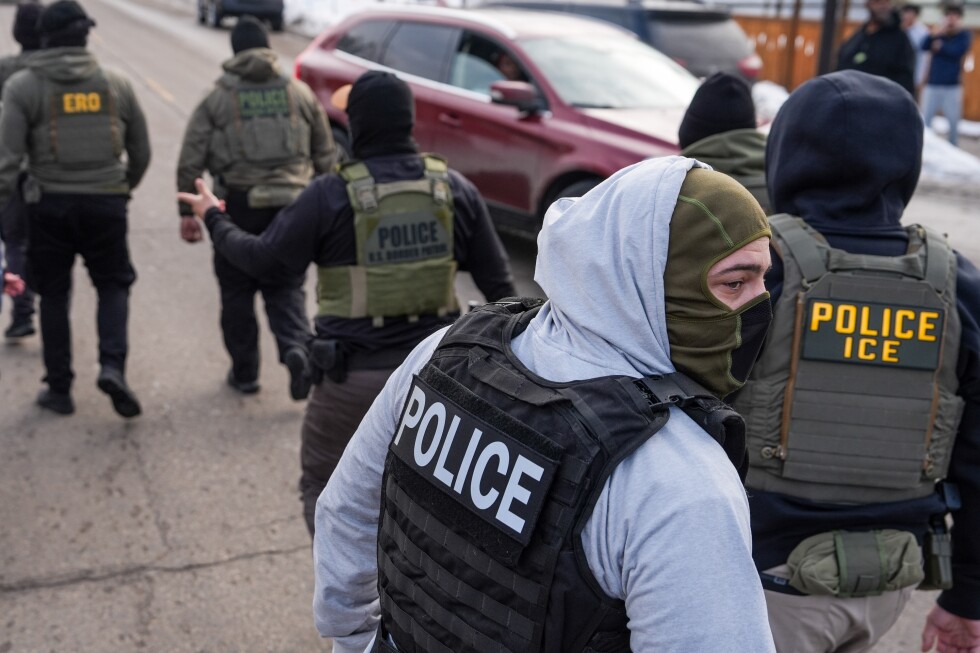
WASHINGTON (AP) — The sight of smashed car windows, individuals being tackled on city streets, and even the detention of a child in a bunny ear snowcap has become emblematic of the Trump administration’s immigration enforcement. The masked federal officers involved in these operations have sparked significant debate.
In recent U.S. history, no other American policing operation has so widely masked its officers. The Department of Homeland Security supports the practice as a means to protect employees from online harassment. However, experts caution that the use of masks incites fear in communities and could erode public trust and accountability in law enforcement.
The issue of whether to prohibit the use of masks by these officers, or to allow it to continue, has become a focal point in congressional discussions about Homeland Security funding, especially with an impending partial shutdown on Friday.
“Humans read each others’ faces — that’s how we communicate,” stated Justin Smith, a former Colorado sheriff and current executive director and CEO of the National Sheriffs’ Association. “When you have a number of federal agents involved in these operations, and they can’t be identified, you can’t see their face, it just tends to make people uncomfortable,” he explained. “That’s bringing up some questions.”
Democrats Call for Transparency
The use of masks by federal agents has been a consistent practice during President Donald Trump’s mass deportation initiatives. What began as an unsettling image in the spring, with officers masking themselves while detaining a Tufts University student, has become a common scene in cities like Los Angeles and Chicago. The shooting deaths of two U.S. citizens during protests against ICE raids in Minneapolis have intensified public outrage and prompted legislative responses.
The Democratic slogan “Cameras on, masks off” reflects their demand for transparency, urging that officers also utilize body cameras for enhanced accountability. House Democratic Leader Hakeem Jeffries emphasized that unmasking federal agents is a “hard red line” in ongoing negotiations.
According to Immigration and Customs Enforcement (ICE), officers wear masks to prevent doxing, which has previously endangered them and their families. ICE insists that officers carry badges and credentials and will identify themselves when necessary for public safety.
ICE, bolstered by funds from Trump’s tax cuts, which allocated approximately $170 billion to Homeland Security, has expanded its workforce significantly. Last year, ICE announced it had doubled its staff to 22,000, incentivized by rapid hiring and $50,000 signing bonuses.
Many Republicans argue that the current political environment exposes immigration officers to risks if their identities are revealed. Sen. Thom Tillis, R-N.C., expressed his disagreement with the Democratic demand for unmasking, citing concerns about personal safety.
ICE’s Unique Approach
Unlike any other law enforcement agency in the U.S., ICE regularly employs masking for its officers. While masks are typically used during special operations, large protests, or for health reasons, widespread use is unprecedented. The American Civil Liberties Union’s Naureen Shah stated, “It is without precedent in modern American history.” She noted that the practice can cause fear and confusion, possibly by design.
In response to the use of masks during 2020 protests, Congress required agents to clearly identify themselves in a defense authorization bill signed by Trump. California has since banned most law enforcement officers from wearing masks, leading to a lawsuit from the Trump administration’s Justice Department.
Seeking Compromise and Further Reforms
Smith from the sheriffs’ association suggests a potential compromise, allowing masks but requiring prominent display of badges or identification numbers. Advocates, however, argue that unmasking is just one step toward necessary reforms.
Advocates are urging Congress to limit ICE’s use of administrative warrants and require judicial approval for home entries. They also aim to end “roving patrols,” where officers use race, language, or job location to question individuals’ legal status, an issue highlighted in a Supreme Court decision last summer.
Greg Chen of the American Immigration Lawyers Association emphasized that due to significant funding from the tax cuts bill, policy reforms are crucial to regulate the agency’s actions. Rep. Ayanna Pressley, D-Mass., noted the pervasive impact of the masked enforcement presence, affecting everyone regardless of immigration status. “It’s a very a heavy presence of surveillance and intimidation,” she remarked. “No one is exempt.”