Canadian Prime Minister Mark Carney Faces Diplomatic Challenges Ahead of G7 Summit
PARIS (AP) — Canadian Prime Minister Mark Carney, recognized for his assertive stance at the World Economic Forum in Davos, is anticipated to adopt a more reserved approach towards U.S. President Donald Trump during the forthcoming summit in Europe.
Earlier this year, Carney gained international acclaim for his speech in Davos, Switzerland, where he criticized the coercive practices of major powers over smaller countries and declared the end of the global rules-based order. This speech positioned him as a prominent figure in middle power resistance and garnered significant attention, overshadowing Trump at the event.
The upcoming Group of Seven (G7) summit in France, beginning Monday, coincides with the critical review of the U.S.-Mexico-Canada Agreement (USMCA) set for July 1. This trade agreement has been pivotal in integrating the economies of the United States, Mexico, and Canada since the 1990s. Given that over 70% of Canada’s exports are directed to the U.S., the preservation of this accord is of utmost importance for Canada. Recently, Trump has expressed uncertainty about renewing the deal.
Robert Bothwell, a Canadian historian, remarked, “Trump is more of a problem for Carney than anybody else because we are more exposed to the United States than anybody else.”
As tensions escalate between Trump and Canada, the once strong alliance, rooted in shared geography and interests, shows signs of strain. In a recent incident, Ontario Premier Doug Ford’s meeting with the U.S. Chamber of Commerce was abruptly canceled. Ford’s minister, Vic Fedeli, suggested that if Trump influenced the cancellation, Ford should consider it a badge of honor.
Trump recently claimed that the U.S. has no need for Canadian products. In response, Carney aims to double Canada’s non-U.S. exports over the next decade, attributing the current investment climate to Trump’s trade policies.
The opening of a significant bridge across the Detroit River, which Trump previously threatened to obstruct, was delayed due to unresolved issues.
The trade war initiated by Trump, coupled with his suggestion that Canada should become the 51st U.S. state, has stirred discontent among Canadians. This political climate contributed to Carney’s election as prime minister, as he vowed to challenge Trump.
U.S. Trade Representative Jamieson Greer highlighted that China and Canada were the only nations to retaliate against the U.S. during the trade war, noting that Canada’s retaliatory measures remain a key concern in discussions.
Daniel Béland, a political science professor at McGill University, observed that Carney appears to have softened his rhetoric towards the Trump administration to prevent further deterioration of relations. “There is a clear tension between what Prime Minister Carney said in his Davos speech about middle powers standing up to hegemons and his attempt to nudge the U.S. administration ‘in the right direction’ with regard to the USMCA review and trade policy more generally,” Béland stated.
Carney has downplayed Trump’s recent remarks about Canada becoming the 51st state. Both Canada and Mexico are advocating for the USMCA’s renewal for another 16 years, though Trump has suggested the possibility of withdrawal. The agreement is likely to undergo annual reviews for the next decade.
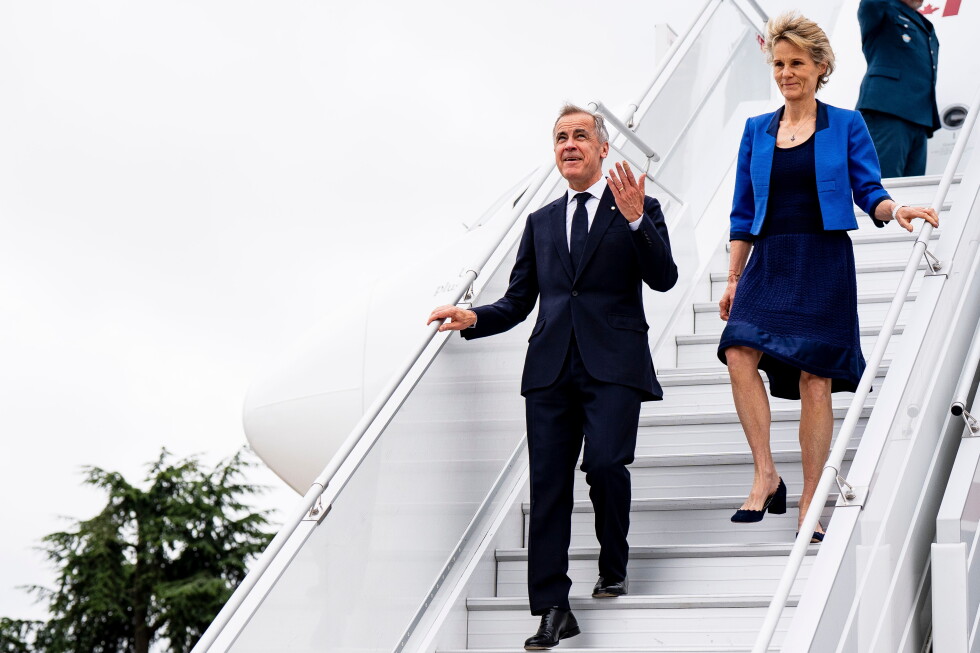
In Paris, Carney is set to meet with French President Emmanuel Macron before the summit in Évian-les-Bains, France. He will also visit Ireland this weekend to discuss diversifying trade away from the U.S. with the Irish prime minister.
This visit marks Carney’s ninth trip to Europe since assuming office in March 2025. Despite efforts to reduce dependency on the U.S., Canada is expected to maintain its status as America’s largest trading partner for the foreseeable future, according to Béland.