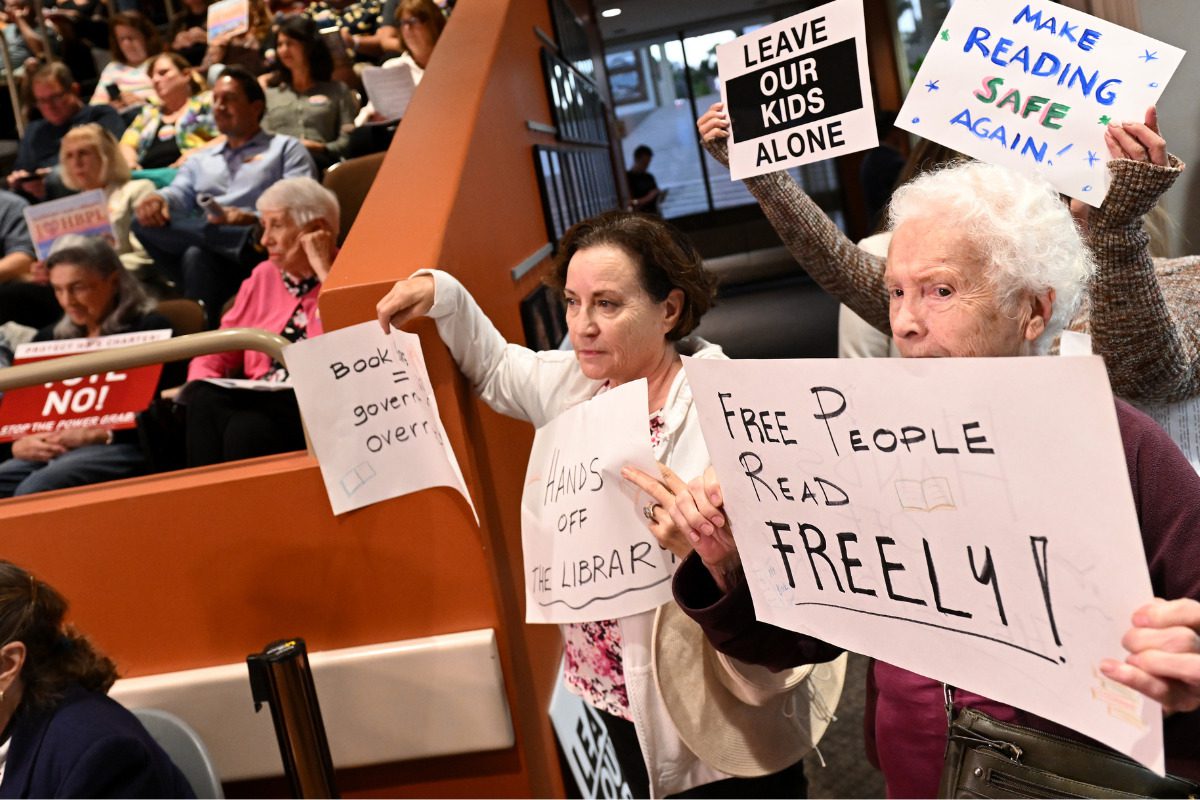
Book bans in Arizona, though it may seem like a relic of the past, are currently active and are causing concern among educators and book lovers.
The week of September 22 marks Banned Books Week, an event focused on celebrating the freedom to read while also highlighting the dangers of censorship.
Sen. Christine Marsh, D-Phoenix, a former public school teacher, has consistently opposed all legislation aimed at banning books in Arizona.
According to Marsh, recent legislative sessions have seen numerous bills targeting public schools.
Marsh is particularly concerned about the broader implications of banning books, especially for children from diverse racial backgrounds or those belonging to the LGBT community, as well as those dealing with difficult life situations. These themes are often present in books that face bans.
“Taking away the opportunity for those kids to see themselves, at least a tiny bit, in the literature that they are reading, I find to be a disturbing problem,” Marsh told The Copper Courier. “Reading is one of the best ways to learn empathy.”
Marsh also highlighted the extra burden placed on teachers who already manage some of the largest class sizes in the country. Removing books involves not only time and energy but also financial resources, which could indirectly defund public schools.
Impact of the Culture War on Public Education
The “culture war” on public education escalated in Fall 2020 when schools resumed during the COVID-19 pandemic. National organizations and anti-public school legislators intensified scrutiny, suggesting that teachers needed to be monitored to prevent indoctrination.
“What was fed to them [parents] is that ‘these folks who are on the computers with your kids [teachers] are bad, you should be watching what they’re doing,’ and that fed into the fear of what was happening in larger society,” said Arizona Education Association President Marisol Garcia.
In 2022, Tom Horne was elected Superintendent of Public Instruction, promising to “expose horrible teachers.” This, according to Garcia, has restricted teachers’ ability to perform their duties and has placed them under increased scrutiny.
Many teachers are taking “preventative measures” by sending out permission slips for books, even when not required, to avoid potential legal issues from parents, Garcia said.
Unfounded Accusations and Mistrust
In September, a Higley Unified School District teacher was investigated by police after a parent accused her of disseminating child pornography and being a groomer over a book used for a school assignment, 12News reported. The baseless accusation led to harassment and threats of lawsuits from other parents.
“They’re afraid of the climate that has been created by politicians around these issues that are not real,” Garcia said. “The culture war is actually impacting teacher retention.”
Last year, Garcia received a permission slip from her son’s teacher for reading The Color Purple by Alice Walker in class. The book, which details the life of an African-American woman facing abuse and bigotry, has been labeled by the state legislature as “sexually explicit.”
“[Its] an amazing book that has won every single award and plays a critical role in understanding history,” Garcia said, emphasizing that parents should be as concerned as educators about such books being banned.
Challenges for Educators
The current environment, influenced by Horne and similar state legislators, has created a negative atmosphere for teachers, limiting their teaching scope and increasing their workload, said Tyler Kowch, communications manager for Save Our Schools Arizona.
“A lot of the attacks on book bans are really attacks on representation,” Kowch said. “These books are lifelines to students who, you know, maybe don’t get to be themselves at home, but they can read a book, and they can see themselves in a book.”
Teachers are always mindful of district standards, student maturity levels, and what is appropriate for their students, Kowch added.
“When people talk about sexually explicit material, oftentimes they’re talking about queer representation, those are two very, very different things, and they may try to conflate them,” Kowch said.
Garcia believes that much of the mistrust and fear surrounding what’s taught in schools could be mitigated if teachers were trusted as professionals. Instead, book bans are driving a wedge between parents and educators, contributing to teacher attrition and discouraging new entrants into the profession.
“Educators enter the profession with—most of us—a secondary degree outside of our bachelor’s degree, who are working beyond our means and being exploited by all these expectations put on by legislators,” Garcia said. “To have people who don’t have the background in how and what to teach at a grade level, telling us what we should and not teach.”
In 2023, Arizona had one of the highest rates of educators planning to leave the profession at 13 percent, nearly double the national rate.
“I think that at the end of the day, parents and educators are on the same side, politicians are trying to leverage this for election purposes,” Garcia said.
Legislative Actions and Proposals
LAW: House Bill 2495, introduced in the 2022 legislative session, requires public schools to get parental approval to teach books or other material that make references to sex. It was signed into law by Republican Gov. Doug Ducey.
LAW: House Bill 2439, also introduced in the 2022 legislative session, establishes parental review for books approved for public school libraries. Schools must post a list of newly purchased books on their websites for at least 60 days after approval. This was also signed into law by Gov. Doug Ducey.
Kowch attended a Paradise Valley school board meeting after this bill passed, where it was noted that schools would need to index their entire library and scan every book for the website.
FAILED: Senate Bill 1700, introduced in the 2023 legislative session, would have allowed a parent to request the removal of a book they find lewd or too sexual. Passed by the state Senate, it never became law after stalling in the House.
This law could have given a single parent disproportionate influence over what an entire class could learn, Kowch noted.
VETO:Senate Bill 1007, introduced in the 2024 legislative session, sought to extend HB2495 by adding a felony designation. It was vetoed by Gov. Katie Hobbs.
VETO: Senate Bill 1696, introduced in the 2023 legislative session, aimed to ban any form of undefined “sexually explicit material” or acts on state-owned property. It was also vetoed by Gov. Katie Hobbs.
“A parent has a right if their student has come home with a book to say, ‘oh, you know, I don’t want you checking this book out from the library, this isn’t the value that we teach in our home,’ but they don’t have the right to, you know, impose their own personal values on other people,” Kowch said.
Kowch argues that the legislators behind these laws are not truly interested in protecting children, as their other initiatives often reveal different priorities.
Books Facing Bans
Books that would fall under the “sexually explicit” or “make references to sex” category include: The Color Purple by Alice Walker, The Diary of a Young Girl by Anne Frank, To Kill a Mockingbird by Harper Lee, The Perks of Being a Wallflower by Stephen Chbosky, and The Great Gatsby by F. Scott Fitzgerald.