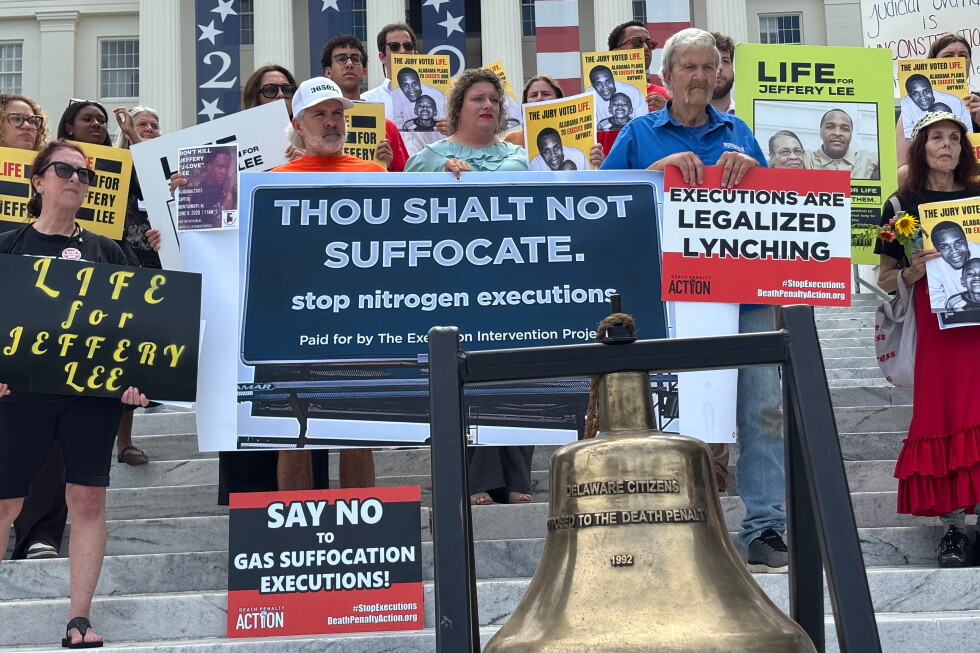
Alabama has requested approval to proceed with the execution of a death row inmate using lethal injection, following judicial decisions that have put the state’s nitrogen gas execution method in question. On Friday, the Alabama Attorney General’s office filed a motion with the Alabama Supreme Court seeking a death warrant for Jeffery Lee, convicted of a 1998 double homicide during a robbery, to be executed by lethal injection. This request arrived shortly after the state’s plan to use nitrogen gas for Lee’s execution was halted by court rulings.
“In sum, ADOC has not been barred from executing Lee, only from executing him by nitrogen hypoxia,” state lawyers stated. Lee’s legal team has yet to issue a statement, with their next action being a response to the Alabama Supreme Court.
On Thursday, the U.S. Supreme Court declined to lift an injunction preventing Lee’s execution with nitrogen gas. The injunction was initially issued by a district judge who deemed the nitrogen protocol a violation of the Eighth Amendment’s prohibition on cruel and unusual punishment. However, the injunction did not restrict Alabama from alternative execution methods like lethal injection or the electric chair.
Alabama Attorney General Steve Marshall’s office refrained from commenting due to ongoing litigation. Marshall had previously expressed determination in seeing Lee’s sentence fulfilled, stating, “The State is prepared to do whatever is necessary to see Mr. Lee’s lawful sentence carried out.”
Legal Uncertainty Surrounds Nitrogen Executions
Recent legal developments have cast uncertainty on the viability of nitrogen gas as an execution method, a practice Alabama adopted in 2024. The method involves using a respirator to replace the air with pure nitrogen, leading to death by oxygen deprivation. Lee contested the constitutionality of this protocol in a 2025 lawsuit. Although U.S. District Judge Emily C. Marks initially upheld the method’s constitutionality, an appellate panel later reversed this, resulting in a new ruling that permanently prohibits its use on Lee.
Despite Alabama’s request for the U.S. Supreme Court to intervene and allow Lee’s execution to proceed, the court maintained the injunction, voting 6-3 without explanation. Justices Clarence Thomas, Samuel Alito, and Neil Gorsuch expressed dissent, favoring Alabama’s request to proceed with the execution.
Robin Maher, executive director of the Death Penalty Information Center, noted the significance of the district court’s ruling, stating, “this method, as Alabama has chosen to use it, is unconstitutional.” Maher anticipates future challenges for other inmates facing nitrogen executions under similar legal grounds.
Lee’s conviction involves two counts of capital murder for the deaths of Jimmy Ellis and Elaine Thompson during a pawnshop robbery on December 12, 1998, where he used a sawed-off shotgun.
The Path Forward for Nitrogen Executions
Nitrogen has been utilized in eight executions in the U.S., with Alabama conducting seven and Louisiana one. Lee was to be the ninth. Alabama may yet appeal to the Supreme Court, which has not previously ruled an execution method unconstitutional.
Fordham Law School Professor Deborah W. Denno remarked on the challenges Alabama faces, stating, “What seems pretty clear to me is that Alabama is going to have a very hard time carrying out a nitrogen hypoxia execution. It’s basically three courts telling you they can’t do that.”
In another case, the Alabama Supreme Court permitted a nitrogen execution for inmate Michael Taylor, but his attorneys have since requested a stay. They argue that the Supreme Court’s recent actions do not reflect a decision on the state’s appeal merits and advise against proceeding at this time.