Historic Rulings on Racial Justice in the U.S.
The journey towards racial equality and social justice in America has been deeply intertwined with pivotal Supreme Court rulings. These decisions have marked both setbacks and advances in the rights of Black Americans over the years.
Dred Scott v. Sandford
The Dred Scott case remains one of the Court’s most controversial decisions, intensifying the national debate on slavery and edging the nation closer to civil war. Dred Scott, an enslaved man, sought freedom for himself and his family, citing residence in free states and territories under the Missouri Compromise. However, Chief Justice Roger B. Taney’s 7–2 ruling concluded that Scott, and others of African descent, were not U.S. citizens and thus could not sue. Taney’s opinion extended to classifying slaves as property, nullifying the Missouri Compromise, and forbidding Congressional action against slavery in U.S. territories. While Scott’s family eventually gained freedom, the decision exacerbated national tensions, contributing to the Civil War. Harriet Scott, Dred’s wife, lived to see the abolition of slavery through the 13th and 14th Amendments.
Plessy v. Ferguson
Following the Civil War, Black Americans, despite constitutional amendments granting citizenship and voting rights, faced systemic discrimination. In 1890, Louisiana mandated separate railway accommodations by race. An activist effort led to Homer Plessy, a man of mixed race, deliberately violating this segregation law. Arrested for sitting in a whites-only train car, Plessy’s case argued that the law violated the 14th Amendment. The Supreme Court, however, upheld the “separate but equal” doctrine. Justice John Marshall Harlan’s dissent warned of its potential to undermine Black citizens’ rights. This precedent laid the foundation for Jim Crow laws, cementing racial segregation for decades.
Brown v. Board of Education
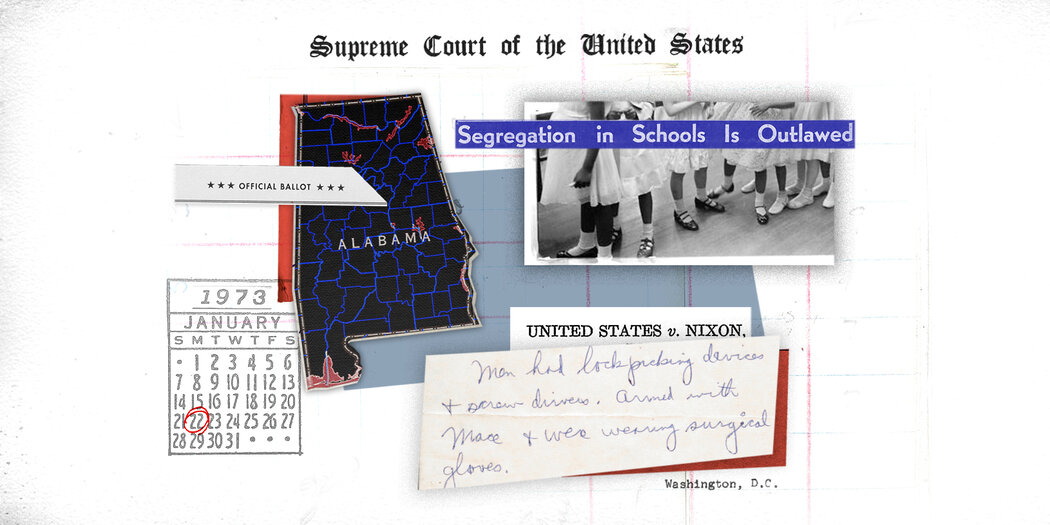
In 1954, the Supreme Court unanimously declared racial segregation in public schools unconstitutional in Brown v. Board of Education. This landmark decision dismantled the “separate but equal” doctrine. Chief Justice Earl Warren, replacing Chief Justice Fred Vinson, played a pivotal role in unifying the Court’s stance. The ruling was a result of strategic efforts by the NAACP, led by Thurgood Marshall, later the first Black justice on the Supreme Court. Despite resistance and slow implementation, Brown marked a significant victory for civil rights.
Loving v. Virginia
In the 1950s, laws prohibiting interracial marriage existed in multiple states. Mildred Jeter and Richard Loving, an interracial couple, were arrested in Virginia for violating such a law. Their case, Loving v. Virginia, reached the Supreme Court in 1967, which invalidated Virginia’s anti-miscegenation law as unconstitutional. Chief Justice Earl Warren stated, “Under our Constitution, the freedom to marry, or not marry, a person of another race resides with the individual, and cannot be infringed by the State.”
Grutter v. Bollinger
The late 20th century saw affirmative action policies in education and employment challenged in courts. The 1978 Bakke case allowed race consideration in admissions if narrowly tailored. In 2003, in Grutter v. Bollinger, the Supreme Court upheld the University of Michigan Law School’s race-conscious admissions policy, arguing diversity as a compelling interest. Justice Sandra Day O’Connor noted, however, that such policies should not be permanent. Justice Clarence Thomas opposed affirmative action, arguing it was unnecessary for Black achievement.
Students for Fair Admissions v. Harvard
Edward Blum, a legal activist, led efforts challenging race-based considerations in law, targeting affirmative action in higher education through Students for Fair Admissions (SFFA). Although lower courts sided with universities like Harvard, the Supreme Court, in 2023, ruled against race-conscious admissions policies, citing violations of the Equal Protection Clause. Chief Justice John Roberts questioned the measurable benefits of diversity in education. Justice Sonia Sotomayor’s dissent highlighted continued systemic inequality, arguing, “Ignoring race will not equalize a society that is racially unequal.” This decision has left educational institutions reevaluating diversity strategies amidst a shift towards race neutrality.