Gerrymandering: A Persistent Influence in American Politics
The term gerrymandering is deeply rooted in American political history, tracing back to the nation’s very first congressional election. During that time, Patrick Henry attempted to manipulate district boundaries to prevent James Madison from being elected to Congress, a tactic that was used even before the term “gerrymandering” was coined. Today, both political parties engage in this practice when given the opportunity.
Currently, gerrymandering holds the potential to determine which party controls the House of Representatives. Historically considered an art form, famously practiced by Democratic House member Phillip Burton from San Francisco in the 1960s to the 1980s, gerrymandering has evolved into a precise science. Advancements in digital technology have enabled partisan mapmakers to create districts that stifle competition for an entire decade.
There was once optimism that the judiciary might intervene. However, a 2019 Supreme Court ruling barred federal judges from regulating partisan gerrymandering. While drawing district lines based on race remains illegal, courts often allow racial gerrymandering when it is justified as political strategy.
This manipulation of district boundaries has resulted in skewed representation, particularly in states like those in the South. Despite significant population growth in the South and Southwest, driven largely by communities of color, these groups remain underrepresented in political power.
Recent analyses by the Brennan Center have shown that gerrymandering will grant Republicans approximately 16 additional House seats in the 2024 elections compared to unbiased maps. This figure exceeds the margin of control in both the current and previous Congress, demonstrating targeted efforts against communities of color. Numerous fair maps could have been created in these gerrymandered states, yet partisan interests prevailed.
Efforts to Combat Gerrymandering
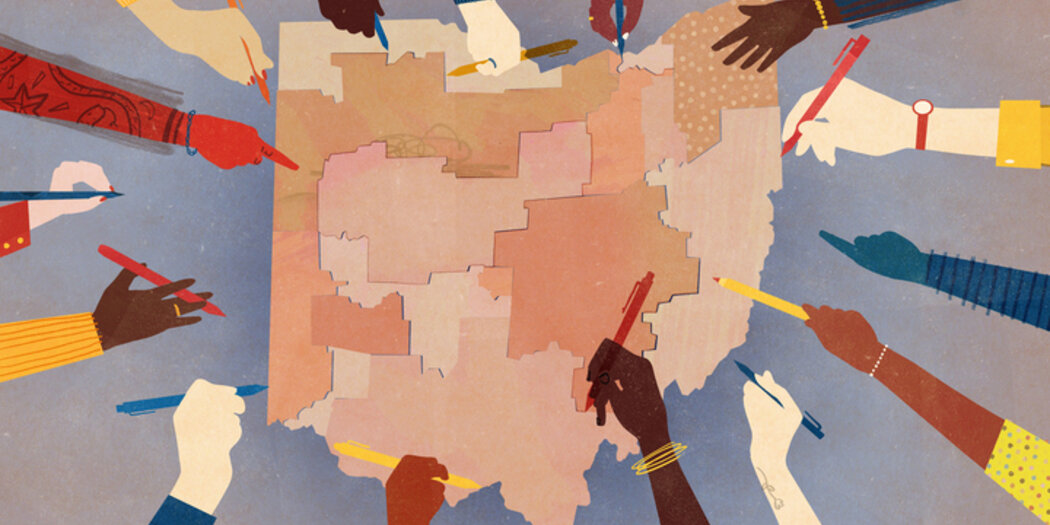
Ohio presents a potential remedy. The state supreme court repeatedly invalidated unfair Republican-drawn maps. Despite this, partisan mapmakers disregarded the rulings. Following the retirement of Chief Justice Maureen O’Connor, a bipartisan effort led by her and the Ohio Organizing Collaborative seeks to establish a citizen-led redistricting commission through a ballot measure. This initiative reflects a growing trend, with states like Arizona, California, Colorado, and Michigan already utilizing independent commissions to oversee redistricting.
The national landscape also offers solutions. The Freedom to Vote Act aims to eliminate partisan gerrymandering in congressional redistricting, while the John R. Lewis Voting Rights Advancement Act seeks to reinforce laws against racially discriminatory practices. These bills nearly passed in the last Congress.
Sen. Charles Schumer recently stated at a Brennan Center event in Chicago that Democrats will prioritize these voting rights bills and propose filibuster rule changes to ensure their passage. Vice President Kamala Harris has expressed her commitment to signing these bills into law, emphasizing their importance during her convention speech.
While gerrymandering is a long-standing issue, so too is the pursuit of fair electoral maps. At the 1787 constitutional convention, James Madison advocated for congressional authority to counteract local political manipulation. His foresight highlighted the enduring challenge of gerrymandering: “Whenever the State Legislatures had a favorite measure to carry, they would take care so to mold their regulations as to favor the candidates they wished to succeed.”
As voters prepare to cast their ballots, the reality remains that their choices are often influenced by maps crafted to benefit certain politicians. The path to reform lies with a Congress shaped by these very biased rules and manipulative maps.