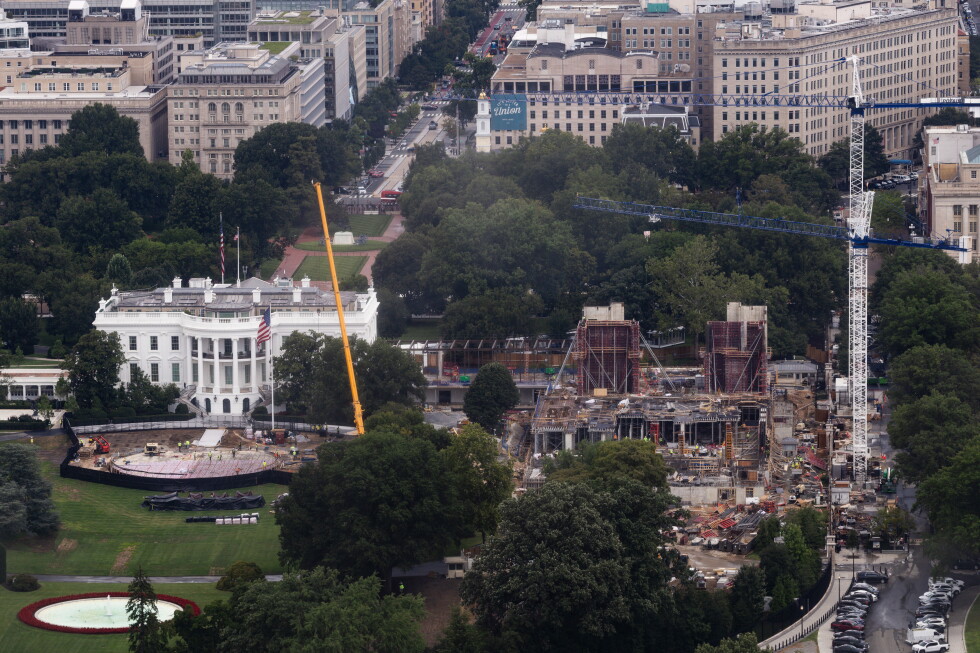
The Trump administration has been ordered by a federal appeals court to suspend the construction of a $400 million ballroom at the White House, citing the lack of congressional approval for the project. The decision, rendered on Friday by the U.S. Court of Appeals for the District of Columbia Circuit, declared that President Donald Trump cannot independently authorize the construction of a 90,000-square-foot ballroom on the site where the East Wing once stood, which was demolished under Trump’s directive last fall.
This week has seen the administration face scrutiny over its construction projects. The National Park Service raised concerns that a proposed 250-foot-tall triumphal arch could affect the historical integrity of nearby sites, including the Lincoln Memorial and Arlington National Cemetery.
In a 2-1 decision, the appeals court supported historic preservationists who had filed a lawsuit to halt the ballroom’s construction. The judges observed that while the matter of building a new ballroom lies with Congress, the administration could still appeal the decision to the U.S. Supreme Court within two weeks.
“Whether or not a massive ballroom should be constructed is for Congress to decide and is not a matter for Executive self-help,” stated the court.
Trump insists Congress’ approval is unnecessary
Neither President Trump nor the White House has issued any immediate comments. Previously, Trump argued that congressional approval was unnecessary as the ballroom’s construction was financially supported through private funds, not public money.
Trump has claimed to have secured substantial funding from corporations and affluent individuals, including himself, to finance the project. “He’s saying I need congressional approval and he’s so wrong,” Trump remarked in March, following a ruling against the ballroom by U.S. District Judge Richard Leon. “This is being financed privately.”
The National Trust for Historic Preservation, which initiated the lawsuit, welcomed the court’s decision, asserting the public’s right to express their views on cherished historical sites like the White House. “From the beginning, our position has been clear and consistent: the law states that only Congress can authorize the construction of a ballroom at the White House,” said Brent Leggs, the organization’s president and CEO.
The appeals court’s decision also upheld a prior order from Judge Leon to halt above-ground construction. However, the judge permitted continued work on underground facilities related to national security.
President Trump criticized Leon’s ruling on social media, accusing the judge of bias and obstructing national security efforts.
Preservationists challenge Trump in court
In December 2025, the National Trust for Historic Preservation filed a lawsuit challenging the ballroom project shortly after the East Wing’s demolition. Government attorneys have defended the construction, citing the necessity of incorporating security enhancements against potential threats.
“These upgrades, alterations, and improvements are essential to protecting the President, his family, and his staff, as well as the White House itself, and the entire project flows from them,” outlined government attorneys in court.
Conversely, lawyers for the preservation group argued that the absence of a ballroom does not present a national security emergency.
Judge Leon, in an initial ruling, had blocked above-ground construction pending congressional approval, a decision which the government appealed. The appeals court advised further consideration of national security concerns.
Trump’s ballroom project received final approval from the National Capital Planning Commission on April 2, a body responsible for overseeing federal construction projects in the Washington area.
“`