HARLINGEN, Texas (AP) — The Trump administration is implementing strategies to address a longstanding backlog in immigration court cases, resulting in a significant rise in missed court appearances and subsequent deportation orders, according to recent data.
In an attempt to expedite proceedings, individual judges are handling dozens to hundreds of cases daily in what are termed as “mega” master hearings. A report from Mobile Pathways highlights that in June, over 1,300 such hearings took place—a nearly threefold increase from the previous year.
Court data reveals that preparation time for many immigrants has been drastically reduced, with some receiving only about a month compared to the previous six months. This decrease in preparation time has led to a surge in missed hearings and abandoned asylum claims.
“The combination of collapsed lead times and packed hearing blocks is a schedule designed for people not to have their case heard,” remarked Bartlomiej Skorupa, COO of Mobile Pathways. He noted that valid claims are often closed without being adjudicated.
Challenges in Immigration Courts
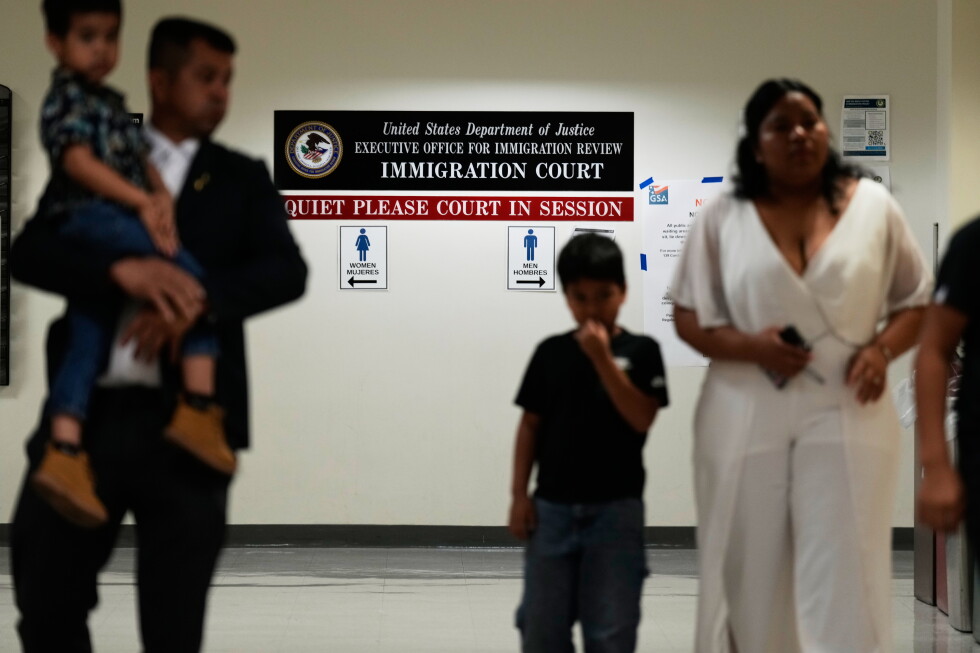
In Harlingen, Texas, people attending mega master hearings often wait outside the courthouse for extended periods due to overcrowding. On a typical day, Judge Delia Gonzalez dealt with around 90 cases, but even with some absentees, she had to reschedule cases after an eight-hour day.
“There’s a real limit to how many cases a judge can hear with any care in one morning,” said former immigration judge Elizabeth Young. “When you cram that many hearings into a single docket, you’re working through a list, not holding court.”
Many immigrants are left requesting more time to gather evidence or due to being misled by fraudulent legal representatives. However, such requests are frequently denied, with most hearings lasting less than five minutes.
No Room for Absences
Similarly, in West Valley City, Utah, Judge Brock Taylor had 159 cases on his docket. By noon, he noted several absentees from various countries, who were ordered deported without appeal. In Chicago, an accident victim was unable to attend a hearing across the country, resulting in a removal order.
Mobile Pathways reports a substantial increase in no-show rates, doubling from 20% to 40% as hearing notice times decreased. This correlates with a rise in deportation orders, from 33,000 in January 2025 to approximately 79,000 in June.
“That’s a recipe for disaster, because more people are going to be ordered removed in absentia who truly have a valid case,” stated Katie Fleming of the Acacia Center for Justice.
Backlog and Caseloads
While some argue that the expedited hearing process helps reduce the backlog, which has decreased from 3.7 million to 3.5 million pending cases, it poses challenges for attorneys and immigrants alike.
“It really is economizing the judge’s time,” commented Andrew Arthur from the Center for Immigration Studies. However, attorneys like Jaime Diez in Brownsville, Texas, express concern over the lack of due process as they struggle to manage increased caseloads.
Diez, standing with a hefty file for a client, remarked, “Due process is being thrown out of the window. It’s very worrisome, I don’t know how long it’s going to last.”